


Atheism Unraveled
The Impossibility of Logic and Morals Without God

Atheists are on a one-way train bound for hell—an eternal fire of justice for the punishment of their sin. They think they can jump out by claiming the evidence for God is insufficient, or that "logic" will give them a lever to switch tracks. This is wishful thinking. The train does not slow down or stop for excuses, and their unbelief and rebellion have strapped them to their seat.
The wicked shall be turned into hell,
and all the nations that forget God.
-Psalm 9:17
- To rip off the atheist's blindfold, showing him that every breath he takes, every thought he thinks, and every moral judgment he makes, can only be justified by the existence of the Christian God of the Bible.
- To give Christians a simple, Biblical battle plan that brings any atheist to his intellectual knees in minutes—no PhD required.
worldview (n): a comprehensive conception or philosophy of the universe and of humanity's relation to it
(See 'worldview', Random House Dictionary, 2025, [dictionary.com]; See also Collins English Dictionary, 10th Edition, William Collins Sons & Co, 2012)
When Christians approach debate with an atheist, they often get nervous, fearing inadequate study of atheistic arguments and inability to thoroughly answer their objections. However, please keep in mind that, in most cases, atheists are no more prepared for debate than Christians.
This does not mean that you should not prepare to debate with an atheist. Some atheists are very intelligent and well prepared. Do not make the arrogant mistake of thinking it will always be easy, or that every conversation will go the same way. The point of my statement was not to make you think it would be a walk in the park, but in my experience, the conceit of atheists—in which they think themselves superior to allegedly ignorant Christians—becomes their greatest weakness.
conceit (n): fancy; imagination; favorable or self-flattering opinion; a lofty or vain conception of ones own person or accomplishments
(See 'conceit', American Dictionary of the English Language, Noah Webster, 1828, retrieved Oct 15, 2025, [webstersdictionary1828.com])
In my experience in debating atheists, they are often quick to condemn the Christian God of the Bible of wrongdoing, while having no foundation for right or wrong. For example, infamous atheist Richard Dawkins wrote a book called The God Delusion, in which he said:
"The God of the Old Testament is arguably the most unpleasant character in all fiction: jealous and proud of it; a petty, unjust, unforgiving control-freak; a vindictive, bloodthirsty ethnic cleanser; a misogynistic, homophobic, racist, infanticidal, genocidal, filicidal, pestilential, megalomaniacal, sadomasochistic, capriciously malevolent bully. "
-Richard Dawkins, The God Delusion, Black Swan, 2007, p. 51, retrieved Sept 2, 2025, [https://archive.org/details/isbn_9780552773317/page/50/mode/2up]
Dawkins presented a lengthy list of accusations, indicting the Christian God of the Bible with various sins and crimes in a shameless display, and although it is a blasphemous offense, I find it comical—not because it holds truth, but because it is childish at best. I prefer not to interrupt an opponent who is destroying himself. Christians may feel compelled to answer each charge point by point, but it is unnecessary. Without the Christian God as his foundation, Dawkins has no philosophical basis for morality, and therefore, he is nothing more than a whining toddler complaining about his feelings—hypocritically doing the very emtionally-driven thing atheists commonly accuse Christians of doing.
I have encountered many Christians who are hesitatant to engage in debate with an atheist, mistakenly believing they must master every detail of the Bible, science, and history to counter all possible accusations. There is good reason why God taught us in His Word that:
The fool hath said in his heart, There is no God. They are corrupt, they have done abominable works, there is none that doeth good.
-Psalm 14:1
This is not to say that Christians are incapable of inappropriate behavior, nor do I claim they never bring shame upon themselves by acting hypocritically from time to time. This especially stems from what I have referred to as "churchgoers," a term I will use in this book to represent those who profess Christ with their words, but whose true allegiance to Him remains questionable at best. (Mat 15:8) However, if atheists want to critique Christians for wrongdoing, they must first point to the moral framework of the Christian God of the Bible because atheism lacks any philosophical foundation to define good, evil, right, or wrong.
To clarify the argument I am making in this book:
justify (v): to show, defend, or uphold as well-grounded
(See 'justify', Random House Dictionary, 2025, [www.dictionary.com]; See also Collins English Dictionary, 10th Edition, William Collins Sons & Co, 2012)
To put it simply, they borrow the Christian worldview to assume logic and morals exist, then use that very foundation to argue against Christianity. This proves them fools, exactly as the Bible describes.
fool (n): one who is destitute of reason, or the common powers of understanding; an idiot; in scripture, is often used for a wicked or depraved person; one who acts contrary to sound wisdom in his moral deportment
(See 'fool', American Dictionary of the English Language, Noah Webster, 1828, retrieved Sept 27, 2025, [webstersdictionary1828.com])
Atheism has existed for thousands of years, but the number of atheists has remained relatively small throughout history, varying by country and era. I am not claiming their small numbers prove their beliefs false (because an ad populum argument is a fallacy), but it does show that, despite media propaganda suggesting otherwise, atheists make up roughly 4% of the U.S. population as of 2023, up from about 2% in 2013, with most of them young—under thirty years of age.
(Public Religion Research Institute, "Religious Change in America," Mar 27, 2024, retrieved Sept 29, 2025, [https://prri.org/research/religious-change-in-america/])
In my view, atheism remains unpopular because of its bleak outlook: if true, it offers no basis for any purpose in life beyond indulging the lusts of the flesh—which is its primary appeal. This explains its greater acceptance among youth and its rejection by the elderly. In most cases, atheists embrace their worldview not for intellectual reasons, but to justify unrestrained sin—unlimited eating, drinking, smoking, and fornicating—though few will admit it openly.
Ultimately, the atheistic philosophy is one that rejects the concept of sin, and to do so, they must throw out the concept of a judge who would assess their moral aptitude.
philosophy (n): literally, the love of wisdom; a general term denoting an explanation of the reasons of things; or an investigation of the causes of all phenomena both of mind and of matter
(See 'philosophy', American Dictionary of the English Language, Noah Webster, 1828, retrieved Sept 29, 2025, [webstersdictionary1828.com])
knowledge (n): information; a clear and certain perception of that which exists, or of truth and fact
understanding (n): comprehension; the faculty of the human mind by which it apprehends the real state of things presented to it, or by which it receives or comprehends the ideas which others express and intend to communicate
wisdom (n): prudence; the right use or exercise of knowledge; the choice of laudable ends, and of the best means to accomplish them
(See 'knowledge', 'understanding' & 'wisdom', American Dictionary of the English Language, Noah Webster, 1828, retrieved Sept 29, 2025, [webstersdictionary1828.com])
And I have filled him with the spirit of God, in wisdom, and in understanding, and in knowledge, and in all manner of workmanship,
-Exodus 31:3
And he changeth the times and the seasons: he removeth kings, and setteth up kings: he giveth wisdom unto the wise, and knowledge to them that know understanding:
-Daniel 2:21
For this cause we also, since the day we heard it, do not cease to pray for you, and to desire that ye might be filled with the knowledge of his will in all wisdom and spiritual understanding;
-Colossians 1:9
A man can memorize endless facts yet lack the understanding to explain them. Knowledge is information, and understanding is comprehension. To comprehend information means you can not only repeat the fact but explain it, giving the reasoning why the fact is true and justified, which is why the best teachers possess strong understanding.
A man can possess information and the understanding to explain it, yet still lack the ability to apply it in real circumstances. This requires wisdom, or what some call prudence, which is the exercise of sound judgment to avoid evil and to make decisions that secure the greatest lasting peace and well-being.
A man's philosophy, or way of thinking, is developed in him instinctually based on his experiences, often without thought, which leads to foolishness. To develop a good philosophy that will maximize his peace and happiness requires first growing a trunk knowledge (i.e. information), expanding the branches of understanding (i.e. comprehension), and then bearing the fruit of wisdom (i.e. prudendce), none of which can be accomplished without roots in the Christian God of the Bible, for He is the foundation of them all.
The fear of the LORD is the beginning of wisdom: and the knowledge of the holy is understanding.
-Proverbs 2:6
In short, your philosophy forms the most essential, fundamental aspects of your character. Once you understand this, you will be astonished to learn that most people never examine their own philosophy. They neither critique their own character nor consider how they affect those around them. Worse still, churchgoers often shun discussion of philosophy, despite the fact that the Gospel of Jesus Christ primarily rebukes and corrects our philosophy:
Beware lest any man spoil you through philosophy and vain deceit, after the tradition of men, after the rudiments of the world, and not after Christ.
-Colossians 2:8
how you behave.
Morals and logic have a philosophical connection between them. If someone is being illogical or irrational, why is that wrong? The fact that men can claim someone is illogical already implies morals, and that means morality is the foundation upon which we build a system of right and wrong in logic, and that extends to all systems, even math and science.
To put it another way, if logic and morals did not exist, then debate would be meaningless. All debate centers around right versus wrong, so if atheists truly lived according to their worldview—which cannot account for moral standards—they would have no reason to debate at all.
Thus, to call atheism a "lack of belief" is deception. Atheists presuppose opposing worldviews wrong, beginning from a foundation of moral law. Like Dawkins, they wield an ethical standard in debate to claim moral superiority.
presupposition (n): something that is assumed in advance or taken for granted
(See 'presupposition', Random House Dictionary, 2025, [dictionary.com]; See also Collins English Dictionary, 10th Edition, William Collins Sons & Co, 2012)
As any police detective will tell you, presuppositions are often necessary to explore possibilities that may lead to facts. Detectives temporarily assume things for the sake of argument, that a line of reasoning may be tested and evidence assessed. If the evidence points elsewhere, the detective must change presuppositions to pursue new leads; however, some presuppositions are so absurd they cannot be entertained because they lie far outside the realm of logical justification.
Suppose you walk along the beach, find something shiny half-buried in the sand, and upon pulling it out, you discover an expensive wristwatch still ticking. What is your first thought? Anyone would be surprised because such an object does not belong there. The logical conclusion is that someone lost it, or left it there by accident, but NOBODY would entertain a presupposition that says, "Wow, look what the sand produced under pressure over millions of years," because that is extreme absurdity.
I would presuppose someone dropped the watch on the beach, but an atheist might argue that the burden falls on me to prove my positive claim—that I offered no evidence someone dropped it, no testimony from the previous owner, no verification from the manufacturer that it was designed and produced. In many cases, the one making the positive claim must provide evidence. However, in this instance, no such evidence is needed because any alternative explanation for the watch's presence is so ludicrous that my position stands uncontested by default.
This type of argument is called "The Impossibility of the Contrary," in which denying the presupposition leads to absurdity, contradiction, or an inability to account for fundamental aspects of reality. Keep this in mind because we will return to it later. In the context of this book, I argue that without the Christian God of the Bible, atheists cannot justify anything in existence.
The problem of induction has been a long-standing controversy in philosophy. Deduction is what I described in the previous chapter: a detective starts from what he knows is universally true and applies it to specific cases, but induction is the opposite—observing many specific examples and inferring a general rule.
For example, the general recipe for baking a cake will be the same in most cases, depending on geographic elevation. If applied according to the instructions, it will always come out the same. However, let's suppose baking a cake tomorrow was not like baking a cake today, then baking a cake would require daily recipe updates to the continuously changing laws of physics.
Thus, induction relies on the future being like the past, and all laws, whether in logic, math, science, or morality, rely on this principle. If the future is not like the past, then no laws can exist, so that begs the question: On what basis do atheists justify the future is like the past?
Some readers might be a bit confused by this question because perhaps you have never thought about it before. Of course, you get up in the morning, your toaster, vehicle, and phone all work the same way they did yesterday, but there are some problems with this that atheists typically do not consider.
For instance, how do you know that you were not brought into existence 30 seconds ago with all your memories intact? If you were to say, "I was here yesterday," that is predicated upon your memories being valid yesterday, and that again begs the question on how you know the future is going to be like the past.
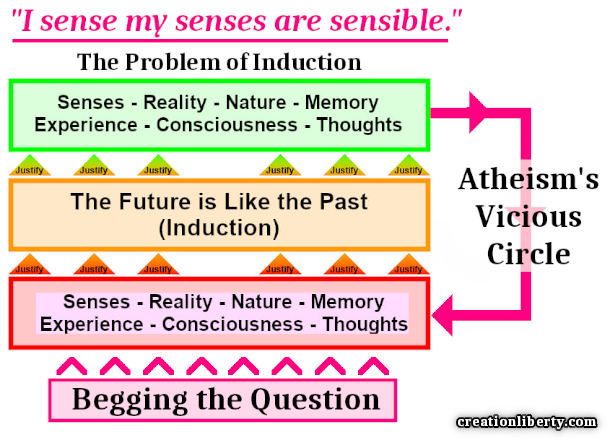
Christians have a very simple answer to this very simple problem, and I will cover more on that later, but this is a stake through the heart of the atheistic worldview. I made a diagram to help others understand the problem:
In the image, the box at the top contains many of the tools atheists rely upon to utilize logic, science, math, and morals, but those tools rely on the future being like the past. To answer this question, we need to fill in the box at the bottom with something.
In every conversation I have had atheists, and every debate I have watched, I have only heard two responses from them when faced with this question:
- The atheist takes the tools from the top box—such as senses, thoughts, memories, experiences—and places them into the bottom box, trapping himself in a hopeless, vicious circle of reasoning. It is like a mother claiming you should follow her parenting advice, then when asked for justification, saying "Because my parenting works"—a vicious cycle that provides no true justification for the premise.
- The atheist says he has no need to justify the problem with induction, which is a deceptive way of saying he has no answer and cannot engage in rational debate on the subject.
"The inductive principle, however, is equally incapable of being proved by an appeal to experience. Experience might conceivably confirm the inductive principle as regards the cases that have been already examined; but as regards unexamined cases, it is the inductive principle alone that can justify any inference from what has been examined to what has not been examined.All arguments which, on the basis of experience, argue as to the future or the unexperienced parts of the past or present, assume the inductive principle; hence we can never use experience to prove the inductive principle without begging the question. "
-Bertrand Russell, The Problems of Philosophy, p. 106, retrieved Sept 30, 2025, [https://archive.org/details/in.ernet.dli.2015.202549/page/n105/mode/2up]
Russell began by noting that assuming the future will resemble the past CANNOT justify our reliance on experience—which includes memory, thought, and senses. He proposed that experience might explain some cases of reality, but even if that were the case, he conceded that it is IMPOSSIBLE to use memories, thoughts, or senses to justify what occurred in the past or will occur in the future.
To simplify, if we were speaking face to face and I said these words to you (i.e. what you are reading right now in this paragraph), everything I spoke—and everything you heard—instantly become the past. The present moment is not a day, an hour, or even a second; it is a microscopically thin line between future and past, and therefore, nearly all existence is categorized in the future or the past.
Russell then concludes that "
Formally, begging the question fallacy looks like this:
Therefore, claim X is true.
Here is an example:
Therefore this is the best restaurant in town.
The alleged justification for the claim is simply to repeat the claim, which provides no reason for the argument. Likewise, atheists beg the question by fallaciously asserting:
- I sense my senses are sensible.
- I think my thoughts are thunk.
- I remember my memory is memorized.
As I pointed out earlier, atheists will sometimes try to avoid the question by claiming there is no need to answer it, but 18th-century Scottish philosopher David Hume disagreed:
"It may, therefore, be a subject worthy of curiosity, to enquire what is the nature of that evidence [i.e. of the future being like the past], which assures us of any real existence and matter of fact, beyond the present testimony of our sense, or the records of our memory. "
-David Hume, An Enquiry Concerning Human Understanding (1748), Oxford University Press, 1999, p. 108, retrieved Oct 7, 2025, [https://archive.org/details/isbn_2700198752481/page/108/mode/2up]
Although Hume never claimed to be an atheist, his worldview embodied atheistic philosophy, but to his credit, he approached this question rationally, recognizing that it demands an answer; otherwise, we cannot justify our own existence. Neither Hume nor Russell ever found that answer, nor will any atheistic philosopher, for our existence does not justify itself, or in other words, it is impossible to justify one's own existence by presupposing one's own existence.
If I argued to an atheist that the Bible is true, and he asked, "What justifies that the Bible is true?" and I replied, "The Bible is true because the Bible says it is true," the atheist would rightly reject that as irrational because it begs the question. Likewise, I reject their question-begging response to the problem of induction.
Because they cannot answer this simple question, many atheistic philosophers turn to 17th century French philosopher René Descartes [i.e. day-cart], famous for his statement (roughly translated) "I think, therefore I am." Atheists are so desperate for an answer to this question, they do not realize that in the process of trying to justify his existence, Descartes first said "I," begging the question by presupposing himself to exist before justifying his existence.
In what I find to be comedic, Descartes wrote:
"While we thus reject all of whichwe can entertain the smallest doubt, and even imagine that it is false , we easily indeed suppose that there is neither God, nor sky, nor bodies, and that we ourselves even have neither hands nor feet, nor, finally, a body; butwe cannot in the same way suppose that we are not while we doubt of the truth of these things; for there is a repugnance [i.e. contradiction] in conceiving that what thinks does not exist at the very time when it thinks. Accordingly, the knowledge, I think, therefore I am, is the first and most certain that occurs to one who philosophies orderly. "
-René Descartes, A Discourse on Method, J.M. Dent, 1912, p. 167, retrieved Oct 7, 2025, [https://archive.org/details/discourseonmetho0000desc_t8l7/page/166/mode/2up]
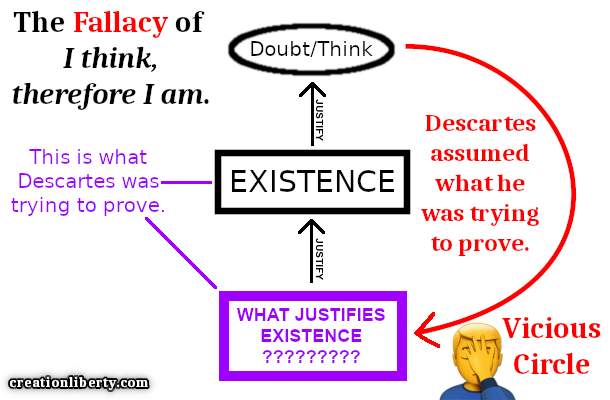
Decartes argued that because he had the capability to doubt, his existence was proven. Stating "I doubt" as proof of existence begins by acknowledging "I" or self, which is a TERRIBLE argument that assumes the very thing he is trying to prove.
I made the following diagram to help some readers understand this:
Modern followers of Decartes commonly adopt a philosophy that doubts everything, but the problem with that way of thinking is that no one can doubt everything. Such a ridiculous ideology is a self-defeating argument that destroys all philosophy and thought. The irony is that if you try to disprove me, then you have proven my argument for me, because by proving that you can doubt everything, you have proven that you can, without a doubt, doubt everything.
Rather than saying "I doubt," it would have been more intellectually honest to say, "doubting is occurring," although it could be argued (and I will argue) that even doubt itself relies on the inductive principle, and is therefore not substantial to prove anything. Regardless, it is an extraordinary leap of logic to claim that because doubting is occurring, therefore all existence has been proven.
Thinking or doubting relies on our experiences, because without experience, there is nothing on which we could think or doubt. So let's turn back to David Hume to consider an interesting point he made, and I will break it down into simpler terms afterwards:
"For all inferences from experience suppose, as their foundation [i.e. a presupposition], that the future will resemble the past, and that similar powers will be conjoined with similar sensible qualities. If there be any suspicion, that the course of nature may change, and that the past may be no rule for the future, all experience becomes useless, and can give rise to no inference or conclusion. It is impossible, therefore, that any arguments from experience can prove this resemblance of the past to the future; since all these arguments are founded on the supposition of that resemblance. "
-David Hume, An Enquiry Concerning Human Understanding (1748), Oxford University Press, 1999, p. 117, retrieved Oct 7, 2025, [https://archive.org/details/isbn_2700198752481/page/116/mode/2up]
I agree with Hume on this point. Though some claim to disagree, I have yet to hear a valid argument against it. He shows that all experience—thoughts, senses, memory, nature, consciousness, and the like—relies on the future resembling the past. When Hume wrote that "similar powers will be conjoined with similar sensible qualities," he meant that objects with similar traits will behave consistently if the future is like the past.
For example, a child may be warned not to touch the flame on the stove, but when his mother looks away, he reaches up, touches it, and burns his hand. After that experience he grows cautious of all fire. Why? How does he know every flame will burn him? Has he tested all fire everywhere?
It is impossible for anyone to test all fire, but without depth of thought, the child automatically presupposes the future will resemble the past. From birth, we take for granted the consistent reasoning God has given us, but if scoffers who love their sin reject the Christian God of the Bible, and therefore must find another way to justify these things—which is precisely what Hume tried to do.
Hume rightly noted that "
If the atheist has not tested the principles he relies upon in all places and at all times, his belief that the future will resemble the past rests on blind faith. Since he cannot possibly test these things in all places at all times at the same time, on what basis does he hold this belief?
If he answers, "Well, the future has always been like the past," he begs the very question being asked of him. Such atheistic responses are childish, for they are as nonsensical as saying, "All apples taste the similar because apples have always tasted the same."
I am not asking the atheist what data he claims to know, but HOW he justifies what he claims to know. These are the hard questions any philosopher worth his salt must face. An atheist's refusal to answer these simple questions exposes his inability to maintain a rational approach to his worldview.
Hume argued that if the future is not like the past, we can draw "no inference or conclusion" from experience. This means it is IMPOSSIBLE for an atheist's experience to prove the future will resemble the past, for all experience rests upon the very assumption that the future will resemble the past.
So what did Hume conclude? What was his justification for the problem of induction? Some readers may be surprised to learn that he never had an answer.
Hume concluded the problem was rationally unanswerable, but only because he refused to abandon his own irrational worldview. Though Hume never claimed outright to be an atheist, his philosophy was atheistic. Thus I agree with his conclusion: in an atheistic worldview, the problem of induction has no answer, which is why atheists often resort to childish tantrums or circular responses when confronted with it.
In the Christian worldview, we have an answer to the problem of induction: the omniscient, omnipotent, and omnipresent God of the Holy Scriptures, who knows all things, created all things, and designed our minds and senses to function according to the logical laws He established based on His own character. The laws of logic reflect the way God thinks and expects us to think. His all-knowing nature provides the foundation for reason, justifying the uniformity of nature and thereby upholding the laws of logic and morality.
Atheists hate this answer and reject it because it undermines their worldview, but their personal feelings are irrelevant. They may complain endlessly about the solutions offered by the Christian worldview, but until they provide their own answers, they have no logical ground to stand on. All reasoning must end in an ultimate authority, and for us Christians, that ultimate authority is the Christian God of the Bible.
However, atheists are pathetic gods because they cannot be present in all places at all times, nor can they know all things. Yet they foolishly appoint themselves the ultimate authority, without justification for the uniformity of nature, while relying on it daily because they have no choice.
I have posed this question to atheists in live discussion: "How do you know that everything in existence, including all your memories, was not created and implanted in you by some invisible being 10 seconds ago?" I have never had an atheist answer that question because, in their worldview, there is no answer for that question.
If an atheist is honest, he must admit that his worldview provides no way to prove anything he claims to know. If he says, "We may not know now, but we are confident we will know in the future," he has just proved my point: atheists live by faith. Do not let atheists deceive you into thinking the debate is reason versus faith; rather, it is faith versus faith—the Christian faith versus the atheist's materialistic faith.
Atheists often insist that atheism is merely a lack of belief in God, but as I have already shown, they place faith in themselves, faith in their supposed knowledge, faith in things they cannot justify, and faith in the hope that answers will someday appear and rescue their rotten, useless worldview. The denial of their faith is the "pretended neutrality" fallacy: they claim an unbiased approach while hiding a presuppositional bias—in most cases, a malicious bias against the Christian God of the Bible.
Because of their presupposition—a precommitment of faith in materialism and naturalism—atheists refuse to consider transcendental proofs (i.e. evidence outside of experience), and throw out all reasoning of the supernatural before they begin discussion.
transcendental (adj): to go beyond experience but not human knowledge
supernatural (adj): of or relating to an order of existence beyond the visible observable universe
(See 'transcendental' & 'supernatural', Random House Dictionary, 2025, [dictionary.com]; See also Collins English Dictionary, 10th Edition, William Collins Sons & Co, 2012)
"The method which has proved effective, as matter of actual fact, in providing a firm foundation for belief wherever it has been capable of application is what is usually called the scientific method. I believe firmly that the scientific method, although slow and never claiming to lead to complete truth, is the only method which in the long run will give satisfactory foundations for beliefs. "
Julian S. Huxley, Religion Without Revelation, 1929, p. 27, retrieved Oct 9, 2025, [https://archive.org/details/in.ernet.dli.2015.90330/page/n27/mode/2up]
This was comical to me because Huxley started out saying that the scientific method was effective "as [a] matter of actual fact," but then said it could "never... lead to complete truth," contradicting his claim to fact.
fact (n): that which actually exists or is the case; reality or truth
(See 'fact', Random House Dictionary, 2025, [dictionary.com]; See also Collins English Dictionary, 10th Edition, William Collins Sons & Co, 2012)
materialism (n): the philosophical theory that regards matter and its motions as constituting the universe, and all phenomena, including those of mind, as due to material agencies
naturalism (n): the view of the world that takes account only of natural elements and forces, excluding the supernatural or spiritual
(See 'materialism' & 'naturalism', Random House Dictionary, 2025, [dictionary.com]; See also Collins English Dictionary, 10th Edition, William Collins Sons & Co, 2012)
The atheist's precommitment to materialism forces him into a trap of his own making, because not all questions of fact are answered the same way. Many things in this world are concepts—love, hatred, beauty, politics, dreams, memory, and even the laws of logic—that cannot be resolved solely by the scientific method in a materialistic worldview.
Some readers might have noticed that, in the above quote, Huxley did not claim that all factual questions are answered in the same way, but two pages later, he wrote:
"Now that all this has been said,the ground is clear for more definite statements . In the first place, I believe, not that there is nothing, for that I do not know, but thatwe quite assuredly at present know nothing beyond this world and natural experience. "
Julian S. Huxley, Religion Without Revelation, 1929, p. 29, retrieved Oct 9, 2025, [https://archive.org/details/in.ernet.dli.2015.90330/page/n29/mode/2up]
On this basis, Huxley concluded that he "
How did Huxley determine that we can know nothing beyond this world? How does he know that things in this world are not like unto things beyond this world? Has he explored all things in this world? Has he talked to everyone who has explored this world? Huxley seems to be unaware that by making this claim, he would have to attempt the impossible by arguing a universal negative.
For example, suppose I claimed there is a pot of gold at the end of 1% of all rainbows and demanded you prove me wrong—that is shifting the burden of proof. You could reach the end of a rainbow and find no gold, yet I would say you must keep searching because you missed the 1%. You would be forced to endlessly chase rainbows to disprove my claim, but it not your job to disprove my claim, nor is it possible without being present at the end of every rainbow simultaneously throughout history.
The point I want readers to understand is that it is impossible to prove a universal negative. In most cases, the person making the positive claim must provide evidence of the claim, exceptions being aforementioned arguments such as the impossibility of the contrary, which does not apply to pot of gold argument, nor to Huxley's argument.
Huxley assumed nothing beyond this world resembles this world, yet this contradicts the laws of logic. If the laws of logic do not apply beyond this world, they lose their law-like character and become mere conventions or social customs, rendering them invalid and useless, which provides us yet another self-defeating argument.
In summary, Huxley first admitted the scientific method is insufficient, yet immediately dismissed knowing anything beyond it. My question is: how could he know either claim? As far as I know, Huxley never explained this; he merely asserted it based on the conjecture of his contradictory worldview.
Atheists demand that we grant them logic, science, mathematics, thought, knowledge, memory, and ethics without question or justification, then limit us to a materialistic worldview that cannot account for itself. They want the question "Does God exist?" to be answered in the same way we would look for milk in the refrigerator: open the door, look for the carton, and if none is found, conclude there is no milk, but more profound questions about God's existence cannot be resolved by such a childish method.
The atheist demands evidence of the supernatural without allowing supernatural evidence, such as God's revelation in Holy Scripture. He insists on proof only through materialistic means, but if the supernatural could be detected materially, it would cease to be supernatural and become material, and therefore, the very parameters of his own demands are nonsensical, expecting us to provide the impossible to satisfy his worldview.
If an atheist asked what evidence I have for God's existence, I would answer that God created the world and made it good, that He created me, and that He sent His Son to die for my sins. These evidences are quite convincing to me, but only because I use them within a worldview where they make sense and would be accepted as true. However, before any discussion, the atheist has already decided that all supernatural explanations are false and unacceptable, and thus, he restricts evidence to the material world alone, rejecting my evidence and claiming imaginary victory.
To put it another way, suppose an atheist demanded proof that apple trees exist, yet before I could present evidence, he restricted me from using apples as proof. The apple is the very thing that defines the tree, rendering the task impossible. This is the nonsensical philosophy of atheism: they disallow evidence of the very thing they demand to be proven.
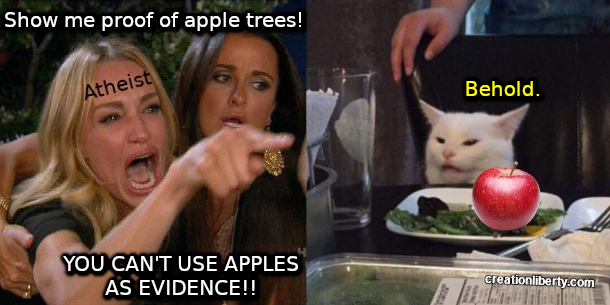
Therefore, since atheists reject the evidence for God's existence before even considering it, and restrict proof to a materialistic standard alone, we must challenge the foundation of their fallacious presuppositions. As I mentioned at the beginning of this book, we do this by arguing the impossibility of the contrary: nothing can be proven in an atheistic worldview, demonstrating that they cannot justify any knowledge without the Christian God of the Bible.
Atheist Gordon Stein (1941-1996) was a secular humanist author and head of the collection development department of the University of California. He wrote a book called The Encyclopedia of Unbelief, and he said:
"Although there are numerous religious accounts for the creation of life, a rigorouslynaturalist explanation for the emergence of the organic world rejects any appeal to religious interpretations and the assumed existence of a supernatural realm transcending material nature. An appeal to supernatural powers in order to explain the origin of living things is, in principle, outside the realm of scientific investigation. There is no evidence to support the belief that life is contingent upon the existence of a divine will and its intervention into the natural order of all things. Such a religious view is grounded in blind faith rather than science and reason."
-Gordon Stein, The Encyclopedia of Unbelief, Vol. 2, Prometheus Books, 1985, p. 416, retrieved Nov 4, 2025, [https://archive.org/details/encyclopediaofun0000unse_c1g9/page/416/mode/2up]
In short, Stein claimed supernatural explanations are forbidden in science. If that is the case, it confirms exactly what I said earlier: the atheistic commitment to materialism excludes any evidence outside their materialistic worldview. In other words, atheists prohibit evidence for the very thing they are demanding proof. This contradicts what I noted earlier: many things exist in this universe—used by everyone, including atheists—that are immaterial, such as the laws of logic.
I would presume most atheists know this because it is obvious even to a ten-year-old child that the laws of logic are not material. You cannot paint them or put them in a jar. However, what most atheists refuse to understand is that the laws of logic do not justify themselves, because no law can justify itself.
Only the lawgiver—the creator of the law—can justify it. If man appoints himself god and claims to create the laws of logic, he must justify them, but this is impossible because to justify the laws of logic, he must first use logic.
This leaves materialists without a path forward. They are stuck in hopeless circular reasoning because not only can materialism not justify itself, it creates parameters which make it impossible to prove anything.
How do atheists typically answer this? By claiming that we Christians are in the same predicament, but they say this only because they do not understand the transcendental argument.
As you might have expected, this brings us back to the Christian God of the Bible, which is a very simple and reasonable justification for knowledge, logic, and morality, but Living God is rejected by atheists on the grounds of appeal to authority. In other words, atheists claim that it is a logical fallacy to appeal to the Christian God of the Bible.
For example, atheist and Oxford professor Antony Flew (1923-2010) in his book God and Philosophy said:
"[I]n considering incoherences [i.e. illogical or meaningless points] which apparently vitiate [i.e. impair or weaken] the very concept of God, we had to insist thatan appeal to authority here cannot be allowed to be final and overriding. For what is in question precisely is the status and authority of all religious authorities. "
-Antony Flew, God and Philosophy, Hutchinson, 1974, p. 159, retrieved Nov 4, 2025, [https://archive.org/details/godphilosophy0000flew_l1l2/page/158/mode/2up]
For those who may not understand, Flew argued that God's Word in Scripture cannot serve as evidence for God. He claimed this commits not only the logical fallacy of "appeal to authority," but also begs the question by using God's Word to prove God's Word. He continues:
"[I]t is, for reasons given, inherently impossible for either faith or authority to serve as themselves the ultimate credentials of revelation. "
-Antony Flew, God and Philosophy, Hutchinson, 1974, p. 159, retrieved Nov 4, 2025, [https://archive.org/details/godphilosophy0000flew_l1l2/page/158/mode/2up]
When he referenced faith, authority, and revelation, Flew argued that we cannot use the Bible to prove the Bible, claiming an object cannot analyze or prove itself. To that I would ask Flew if he has ever been to a blind eye doctor because God forbid we ever use the eye to examine the eye.
What did you have to eat today? Whatever your answer, do you know that for sure? Are we not permitted to use memory to examine our memories?
Do we not use mathematics to examine mathematical problems? Can we examine history by first abandoning all history? Should we throw out the scientific method to examine the scientific method? Do we get rid of all philosophy to examine philosophy? And most importantly, did Antony Flew give up the laws of logic to make logical arguments?
We use tools and concepts to examine themselves every day, yet foolish men like Anthony Flew (and other atheists) demand that you abandon the Bible before examining it. They refuse to let you view the Bible through its own lens. Instead, they demand you examine the Bible through their straitjacketed atheistic worldview, restricted to materialism—a process limited in scope that cannot analyze immaterial things.
If an atheist is paying attention, he will likely concede that it is then acceptable to use reason to analyze reason. After all, he must know there is no way to argue against reason without using reason, but what he refuses to acknowledge is that reason does not justify itself. The atheist is stuck here because, though we Christians acknowledge that atheists use reason (as all men must do to live in this world), he has no way to verify that his reason is reasonable.
Atheists hate the fact that we Christians argue that the only way to justify the laws of logic, reason, science, and morality is through One who is omnipotent, omniscient, and omnipresent. In other words, we must rely on One who is all-powerful, all-knowing, and present in all places, at all times, at the same time.
The atheist rejects this premise, and in many cases, refuses to acknowledge this transcendental argument, yet he has no reason to reject it. He hates the Creator of the laws only because he refuses judgment for his sin. By rejecting this Creator, the atheist leaves himself unable to justify that his logic is logical, his reason is reasonable, his science is scientific, or his morality is moral.
This leads us to the accusation that we Christians commit an appeal to authority (i.e. argumentum ad verecundiam). The charge is absurd because atheists who accuse us of it are either lying or ignorant of the fallacy itself. An appeal to authority claims something is true solely because an authoritative figure or institution says so, by appeal to office, rank, or station, without any examination of the evidence or reasoning behind the claim.
It looks like this:
Therefore, atheism is logical.
An example might look like this:
Bob said atheism is logical, therefore, atheism is logical.
The error of appeal to authority lies in prioritizing who said it over why it is true. We Christians appeal to both—who said it and why it is true. The atheist, however, commits what is known as the genetic fallacy: rejecting an argument based on its origin rather than its merit.
Suppose I were debating the purpose and function of a car radiator, and while my opponent offered wild theories, I quoted Karl Benz—the German engineer who invented the internal-combustion engine in 1886. My opponent would be laughed at if he accused me of an appeal to authority because Karl Benz is the ultimate authority on the creation and design of the combustion engine and its radiator.
Likewise, the Christian God of the Bible is the ultimate authority because He created the universe and all the laws that govern it. Therefore, it is absurd for atheists to accuse us of an appeal to authority, but they do so anyway because they have no evidence for their worldview; they simply refuse to acknowledge the ultimate authority that alone justifies the laws of logic, reason, science, and morality.
If an atheist still foolishly claims that we Christians beg the question by using the Bible to examine the Bible, I will turn that accusation right back on him. He has not proven—by any empirical observation or logic—his precommitment to materialism. Rather, he assumes it as a severely limited presupposition, without justification, and like a child, rejects any other factual claims based on his unproven assumption.
The purpose of hypocritically condemning the use of the Bible to examine itself is simple: atheists do not want the Word of God to be the ultimate authority, for they love the sin God condemns. There is no other reason. They use logic to examine logic, but refuse to allow the Bible to examine itself. They reject any consideration of the Christian worldview on its own terms because they refuse to entertain the presupposition that God holds authority over them.
Atheists frequently boast that their worldview is logically and morally superior, but again, it is an empty claim because it is impossible to justify logic or morality in the atheistic worldview. For example, atheist Jeff Lowder was quoted on The Secular Web (a strictly atheist website) saying:
"Logical arguments for atheism attempt to show that the concept of God is self-contradictory or logically inconsistent with some known fact. "
-Jeffrey J. Lowder, "Logical Arguments," The Secular Web, retrieved Nov 5, 2025, [https://infidels.org/library/modern/nontheism-atheism-logical/]
The problem with Lowder's statement is that he takes for granted the validity of the laws of logic without justifying them in his worldview. As an atheist, on what basis has he justified the existence of immaterial, universal, invariant (i.e. unchanging) entities such as the laws of logic? How could he prove they exist in an atheistic universe? What scientific experiment did he perform to prove the existence of the laws of logic, and that they apply consistently throughout all time and space?
Atheist Tristan Vick asserted the same thing:
"When I say atheism is more rational it is because it doesn't make unnecessary assumptions and doesn't try to amend failed a priori assumption ad hoc with respect to God-belief. "
-Tristan D. Vick, "Is Atheism More Rational Than Theism?" Advocatus Atheist, Apr 10, 2014, retrieved Nov 5, 2025, [https://advocatusatheist.wordpress.com/2014/04/10/is-atheism-more-rational-than-theism/]
Be aware of the atheist's use of the word "unnecessary," because it is a subjective qualifier, meaning that they use it as a subtle defensive ploy. They know they make assumptions based on their own presuppositions, and they know that without those assumptions, they could not justify their own thoughts, so to fool people, they will claim to not make "
Always hold them to account.
Before I expose more of Vick's ridiculous argument, let me remind Christians that you need not fear those who use terms you do not understand. Humbly ask them to explain what they mean. If they cannot explain it in simple terms, it means they do not understand their own argument, and therefore, they will look foolish, not you.
Vick tosses in Latin terms to throw us off the scent of his fallacies, much like the Catholic cult (and many of its offshoots, such as Orthodoxy and Anglicanism), using unexplained Latin phrases to convince people of their feigned wisdom. This is one reason I avoid Latin names for logical fallacies, although I have included some in this book for the express purpose that readers would know the Latin phrases connected with the concepts I am teaching.
(Read Corruptions of Christianity: Catholicism & Corruptions of Christianity: Orthodoxy here at creationliberty.com for more details.)
A priori means logic comes from thought rather than from experience, and ad hoc means something done for a particular purpose, so translated, he is saying that to prove God, Christians make the argument that logic is not based on personal experience, which he asserts to be an "
This is a prime example of how atheists accuse Christians of being illogical for answer questions that atheists cannot answer. Once again, we see that atheists believe their worldview to be logical, while being unable to account for logic, and condemning the Christian worldview for having a reasonable justification.
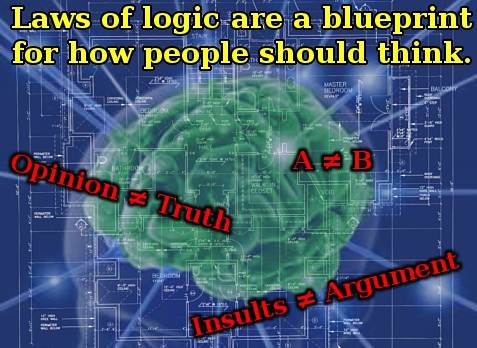
When a builder constructs a building, there is a blueprint (either on paper or in his mind) for how the structure should be built, and likewise, the laws of logic are a blueprint that God constructed—relecting His own character—directing us how we ought to think. If someone is accused of not being logical, it is take as a great offense and embarrassment, demonstrating that logic and morals are somehow tied together in the makeup of how we were created to be.
Once again, I reiterate that the laws of logic do not justify themselves. If mankind is the sole arbiter (i.e. the ultimate judge) of the laws of logic, they become nothing more than social conventions—losing their law-like character and making them meaningless. If the laws of logic are mere conventions (i.e. social agreements), then countless forms, methods, and rules of logic should exist across cultures, but that is not the case, nor would it yield anything useful because all argumentation would be reduced to one person's logic differing from another's, rendering all debate pointless.
Debate is possible only because the laws of logic are true laws that apply in all instances, and in the Christian worldview, this makes sense: the Christian God of the Bible created the laws of logic as a reflection of His character—the way He thinks and expects us to think. However, atheists reject the Christian God of the Bible and are left with the impossible task of explaining how the laws of logic maintain an unchanging, law-like nature in a supposedly ever-changing, chaotic universe.
If all knowledge is based on the scientific method in a materialistic worldview (as Huxley asserted in the previous chapter), then how do we account for immaterial laws? If everything beyond this world bears no resemblance to our world, how can we account for universal laws? If everything in this universe is constantly changing in an evolutionary process, how can we account for invariant laws?
immaterial (adj): not material
universal (adj): applicable everywhere or in all cases
invariant (adj): unvarying; constant
(See 'immaterial', 'universal' & 'invariant' Random House Dictionary, 2025, [www.dictionary.com]; See also Collins English Dictionary, 10th Edition, William Collins Sons & Co, 2012)
By having a worldview that precommits to materialism, atheists must reject an immaterial, universal, and invariant God, while attempting to argue in favor of immaterial, universal, invariant laws. This means atheists cannot form an argument without denying what they are trying to prove, and this is why the Bible calls them fools.
The fool hath said in his heart, There is no God. Corrupt are they, and have done abominable iniquity: there is none that doeth good.
-Psalm 53:1
- Have you seen God?
- Did you bring God with you to show us?
- Have you seen the laws of logic?
- Did you bring the laws of logic with you to show us?
To escape accountability for these glaring contradictions, some atheists I have encountered claim nothing can be known for certain. This begs the question: do they know that with certainty? If no absolute truth exists, then that very claim is an absolute truth, adding yet another self-defeating, nonsensical statement to the atheistic worldview.
Others go to the opposite extreme and make equally self-defeating statements, such as the aforementioned atheist scholar Gordon Stein, who said in a live debate:
"The use of logic or reason is the only valid way to examine the truth or falsity of a statement that claims to be factual. "
-Gordon Stein, "The Great Debate: Does God Exist?" University of California, Irvine, 1985, p. 3, retrieved Nov 6, 2025, [https://andynaselli.com/wp-content/uploads/Bahnsen-Stein_Transcript.pdf]
Ask yourself: how does Stein know that? What law of logic or reason did he invoke to prove that logic is the ONLY way to prove factual statements? If he claims to prove his statement by logic or reason, he begs the question, but if he claims the statement is proven some other way, he contradicts himself because he declared that logic or reason is the ONLY way to determine facts, and therefore, Stein deceived himself and lied to everyone.

Atheists cannot see, hear, smell, taste, or touch the laws of logic, they cannot conduct scientific experiments on them, nor can any technological devices detect them, but they believe in them without question. Atheists dismiss the transcendental nature of the laws of logic as a given, while contradicting their own worldview by blindly trusting them without justification, and the worst hypocrisy of all is that they condemn others for trusting in the Christian God of the Bible on the same principle.
Without the ability to justify the laws of logic, it is wildly absurd for atheists to think they can justify moral laws—a discussion almost impossible to avoid when speaking with an atheist because they are quite vocal about their alleged ethical superiority. Atheists commonly boast of their "goodness" while accusing others of evil, despite the Bible's clear teaching that no man—save the Lord Jesus Christ—is good.
As it is written, There is none righteous, no, not one: There is none that understandeth, there is none that seeketh after God. They are all gone out of the way, they are together become unprofitable; there is none that doeth good, no, not one.
-Romans 3:10-12
Perhaps someone will surprise me in the future, but despite their inability to justify the laws of logic, in my experience, these are the four logical fallacies atheists use to justify morality:
those who disagree must submit or be killed.
This is a common appeal by atheists, for the logical end of their worldview is a brutal "might-makes-right" ideology: whoever holds greater strength and firepower sets the rules, and whatever they decree becomes "moral." Some readers may think this uncommon for atheists to argue, but it is only uncommon to hear them admit it openly. Most atheists refuse to express this belief on a live broadcast due to the backlash they would receive.
This illogical argument would be easily defeated in a live podcast. To demonstrate, I will quote Josh Singer, an atheist who held a long-standing grudge against me years ago, who said the following on a live podcast:
"Throughout history, it doesn't matter who has the Bible or who believes in the right religion—it's who has the bigger fist and who has the more guns. [sic] It doesn't matter who's right, it matters who has the greater might... throughout history it's been proven that the might make the right. "
-Josh Singer, Debate with Gene Cook & Sye Ten Bruggencate, The Narrow Mind Podcast, Dec 8, 2008, [https://youtu.be/bPAnxs6XPcQ?t=8m7s]
I would defeat Josh with a simple question: "If a man overpowers a woman and rapes her, is that moral in your worldview?" Men have greater strength than women, and thus more power to impose their will on the weaker sex. This traps Josh in two options: either admit rape is wrong and concede his argument flawed, or embarrass himself by exposing the depravity of an atheistic worldview that justifies rape.
Neither of these are appealing options because, although Josh maybe believe in one or the other, stating it openly would result in public backlash. This is why you will typically see atheists attempt to side-step the question with a red herring, or go on the offense and attack the Christian worldview without responding.
In such a bleak worldview as atheism, what prevents a man from claiming moral justification for punching his wife in the face and breaking her nose to force her submission? What prevents a mother from claiming moral justification for grabbing a kitchen knife and stabbing her child in the leg for disobedience? On a larger scale, if Adolf Hitler and the German Nazis had won the war in Europe, would their actions to enslave the Jews and kill countless others have been morally justified because "
I have used similar questions in live podcast discussions with atheists, and the vast majority back down from their ridiculous idea immediately—not from moral degradation or logical inconsistency, but from nervousness. Abuse of women and slavery remain touchy political subjects in society, so to avoid upsetting the audience with their disgusting worldview, they quickly capitulate.
To detect when they are using the force fallacy, listen carefully for atheists using some of the following keywords when discussing morality:
- Might makes right
- Survival of the fittest
- Natural selection
- Alluding to weapons or armies
- Physical strength or dominance
Morality predicated on force alone make moral law impossible. It would ever change depending on who held force, making moral rules a fantasy. Once atheists realize this, they must quickly change their argument, and in my experience, they often switch to majority opinion.
Therefore, X is morally wrong.
OR...
Most people believe Z is morally right.
Therefore, Z is morally right.
In the early 20th century, the majority believed smoking cigarettes was a harmless pastime; in some cases, they even believed it was healthy. As I documented in my book, The Simple Solution to Cancer (free to read at creationliberty.com), some so-called medical experts—who secretly received payment from Big Tobacco—told Congress that smoking cigarettes was healthy, claiming "
(See United States Congress, Committee on Government Operations, "False and Misleading Advertising: Filter-tip Cigarettes," 85th Congress, Session #1, 1957, p. 233)
Thou shalt not follow a multitude to do evil; neither shalt thou speak in a cause to decline after many to wrest judgment:
-Exodus 23:2
"Hence it is that such democracies have ever been spectacles of turbulence and contention; have ever been found incompatible with personal security or the rights of property; and have in general been as short in their lives as they have been violent in their deaths. "
-James Madison, Federalist No. 10, "The Union as a Safeguard Against Domestic Faction and Insurrection," New York Packet, Nov 23, 1787, retrieved Nov 7, 2025, [https://guides.loc.gov/federalist-papers/text-1-10#s-lg-box-wrapper-25493383]
There is nothing wrong with taking a poll to obtain a majority viewpoint on a subject, such as asking an elementary school classroom to vote on whether vanilla or chocolate ice cream tastes better. Perhaps twelve students prefer chocolate while only eight prefer vanilla, but majority opinion does not make chocolate the best flavor, because such determinations remain subjective at their core; all we do is conglomerate opinions.
Gathering a mass of opinions does not determine truth, because truth exists independent of opinions. If truth were determined by opinions, then truth would constantly change—which would no longer make it truth by definition.
truth (n): actual state of a matter; conformity with fact or reality; actual existence
(See 'truth', Random House Dictionary, 2025, [dictionary.com]; See also Collins English Dictionary, 10th Edition, William Collins Sons & Co, 2012)
If 51% of the population votes and declares rape morally just, should men then be permitted to rape women freely? In most cases, atheists answer "No," but their disagreement with the majority exposes their contradiction—they claim the majority should rule, yet stand against majority rule when it comes to morals.
Many years ago, I privately debated political author and atheist Thomas Mullen. He had just finished writing a book called A Return to Common Sense and sent me a copy, but I found the book laughable because it was based on a nonsensical premise.
Since he previously requested that I show him where his book might contain error, I told him the first huge error was on page seven:
"The right to life is pretty easy to understand.Most civilized societies have laws against murder. Each individual has a right not to be killed. So far, so good."
-Thomas Mullen, A Return to Common Sense: Reawakening Liberty in the Inhabitants of America, 2009, p. 7, ISBN: 978-0-578-00683-3
I will not delve into the details of what constitutes a "right," because rights exist only as socially constructed declarations, such as those in the U.S. Constitution. (i.e. The Bible never teaches we have "rights"; it speaks only of graces and gifts from the Lord God.) That being said, Mullen's appeal to majority rule can be summarized as follows:
Therefore, murder is wrong.
↑ ↑ ↑
That is a STUPID argument.
What happens if most civilized societies decide murder is right? Would murder then become good? Mullen conveniently had no interest in further discussion with me after that point. For a man who claimed to desire a "return to common sense," he skipped over the difficult questions he could not answer, assumed moral standards without justification, and did not have the common sense to understand that his atheistic worldview cannot account for a "right to life."
Atheist Raymond Bradley, Professor of Philosophy at Simon Fraser University, gave a presentation at the University of Western Washington in which he argued for absolute moral truth:
"It is morally wrong to deliberately and mercilessly slaughter men, women, and children who are innocent of any serious wrongdoing. "
-Raymond D. Bradley, "A Moral Argument for Atheism," University of Western Washington, May 27, 1999, retrieved Nov 7, 2025, [https://infidels.org/library/modern/raymond-bradley-moral/]
Why Raymond? As an atheist, explain why is it wrong to slaughter men. Why is it wrong to torture and kill women and children? He offered no other justification than majority opinion:
"On all of these examples,I would like to think, theists and other morally enlightened persons will agree with me. "
-Raymond D. Bradley, "A Moral Argument for Atheism," University of Western Washington, May 27, 1999, retrieved Nov 7, 2025, [https://infidels.org/library/modern/raymond-bradley-moral/]
This is a lazy and pathetic appeal to majority, otherwise known as the "bandwagon fallacy." It is when the atheist claims that something should be accepted as true simply because many people already agree with it, rather than address the logic of the argument and provide reasonable justification.
He prefaced this by declaring that those who agree with him are "
Raymond spent the rest of his speech condemning the Christian God of the Bible, but never justified his own worldview. In his conceit, he asserted himself to be a morally and logically superior being, while clinging to a worldview that cannot account for either claim.
Answer a fool according to his folly, lest he be wise in his own conceit.
-Proverbs 26:5
This is the "snob appeal" form of the majority fallacy, which claims that a small group's view is superior because of their supposed status rather than evidence. Scripture condemns this sin as respecting persons (Jam 2:1-9), in part because it presumes that those with rank or accomplishments cannot be biased—which ties directly to the "pretended neutrality" fallacy.
But if ye have respect to persons, ye commit sin, and are convinced of the law as transgressors.
-James 2:9

"One of the big TV networks alone bought 29 of our Tinitron color sets.Why Sony, when they could have had any TV in the world? "
-SONY, "What sets did the press bring to Miami Beach?" LIFE, Oct 20, 1972, p. 63, ISSN: 0024-3019
In 1913, society allowed the elite to determine how our money system would work in the United States. After creating the U.S. Federal Reserve and instituting fractional reserve banking with paper money printing, the dollar—as of 2025—holds only about 3% of its original value, proving that snob appeal fails in practice just as it fails in logic.
I care nothing about a man's degrees or societal status, nor do I care how many people are in support of an issue, because logical arguments are the only things that hold weight. To detect atheists employing the majority fallacy, listen for these keywords:
- Society says...
- Nations decide...
- Most people believe...
- Laws are made...
- Everyone comes together...
- Experts agree...
Therefore, X is right.
OR...
People feel bad if someone does X.
Therefore, X is wrong.
When atheists face public rebuke for their fallacious appeals to force and majority opinion, they commonly turn to feelings, claiming that causing another person pain is "wrong" without ever justifying how wrong can exist in an atheistic worldview. They fail to understand that emotions cannot determine right and wrong because feelings are subjective, which is why God taught us:
Every way of a man is right in his own eyes:
but the LORD pondereth the hearts.
-Proverbs 21:2
Women more commonly manipulate others through emotional display, wielding real or feigned feelings to extract what they want from men. This is one reason feminists invented the absurd term "emotional intelligence," which does not exist, yet serves to belittle anyone who rejects the feminine perspective. When a woman is caught in wrongdoing and begins crying, others rush to her defense, enforcing her feelings before asking questions, as though her upset state somehow proves "intelligent" and justifies her corrupt words and wicked deeds before facts have been established.
(Read Feminism: Castrating America at creationliberty.com for more details.)
If whatever feels good is right and whatever feels bad is wrong, then many things in this world makes no sense. People feel bad while exercising, yet it benefits them. People feel good when eating fast food, yet it harms them. Therefore, emotion cannot serve as the basis for right, wrong, good, or evil.
Atheist author Adam Lee ignored basic logical processes by asserting that empathy and compassion are rational arguments for morality:
"You askedwhat reason an atheist can give to be moral , so allow me to offer an answer. You correctly pointed out thatneither our instincts nor our self-interest can completely suffice, but there is another possibility you've overlooked. Call it what you will—empathy, compassion, conscience, lovingkindness... Acts that contribute to the sum total of human happiness in this way are right, while those that have the opposite effect are wrong. A wealth of moral guidelines can be derived from this basic, rational principle. "
-Adam Lee, "The Basis for an Atheist's Morality," Patheos, July 14, 2007, retrieved Mar 3, 2017, [https://web.archive.org/web/20160415214340/patheos.com/blogs/daylightatheism/2007/07/basis-for-an-atheists-morality]
Why is human happiness right? Why is human unhappiness wrong? Why are empathy, compassion, and lovingkindness good? Lee never answered these questions—he simply assumed them to be true, begging the question.
Donatien Alphonse François, better known as the Marquis de Sade, was an eighteenth-century French atheist philosopher who declared, "
(See Carol A. Dingle, Memorable Quotations: French Writers of the Past, iUniverse, 2000, p. 149, ISBN: 9780595153701)
Do not misunderstand my argument; I am NOT claiming that atheists cannot perform good deeds or live morally to some degree. Such consistency, however, is possible only within the Christian worldview. Without the Christian God of the Bible, atheists must invent their own rules in a worldview that possesses no absolute standard and cannot justify immaterial, universal, invariant laws of morality, so their efforts to establish ethics remains futile, which explains why they have never come up with a logical answer to these basic questions.
Atheist author Robert Wright said:
"The conscience... makes us feel as if we have done something that's wrong or something that's right. Guilty or not guilty. It is amazing that a process as amoral and crassly pragmatic as natural selection could design a mental organ that makes us feel as if we're in touch with higher truth. "
-Robert Wright, The Moral Animal: Evolutionary Psychology and Everyday Life, Random House Digital, 1995, p. 212, ISBN: 9780679763994
In July 2025, Gildardo Amandor-Martinez entered the United States illegally, and because it felt good and right in his view, he broke into a Kentucky home, assaulted a woman, and attempted to rape her. During the assault, the woman's son, Luis Lopez, did not feel like it was good and right, so he attacked Martinez, but Martinez felt like it was evil and wrong for that 15-year-old boy to interfere with his feel-good rape, so Martinez shot Lopez three times in the chest, killing him.
(See Homeland Security, "Criminal Illegal Alien Accused of Murdering 15-Year-Old and Attempting to Rape Mother," July 23, 2025, retrieved Nov 11, 2025, [https://www.dhs.gov/news/2025/07/23/criminal-illegal-alien-accused-murdering-15-year-old-and-attempting-rape-mother])
Martinez the rapist's conscience told him his actions were right, while Lopez's conscience told him they were wrong. So in an atheistic worldview, who was right and who was wrong? If we rely on the force fallacy, the murdering rapist was in the right, if we rely on the majority fallacy, the victims' family was in the right until the boy died, leaving only two to decide (so we will call that a draw), but if we rely on the emotional fallacy, they were all right—leaving no moral justification whatsoever.
Everyone involved in the incident felt "right" in his actions; therefore, if an atheist bases morality on conscience or feelings, he will be forced to adopt a different standard beacuse people can clearly feel differently about the same act. Agreement on feelings is impossible. If a man's daughter fornicates with a neighbor boy, the boy likely feels great pleasure, while the father feels only grief, so whose feelings are "right" in that situation?
There are no answers to these questions, which is why atheists flee from one fallacy to another when confronted with real-world examples, proving they cannot sustain a rational approach to morality. For instance, atheist Richard Holloway wrote a very boring book titled Godless Morality in which he employed all these fallacies together at the same time because he could find no way to establish a moral standard in his atheistic worldview, and instead surrendered by claiming morality is like art.
(See Richard Holloway, Godless Morality, WSOY, 1999, ISBN: 08624190993; Holloway claims to attack "religion" in general, but throughout his book, he only attacks the Christian God of the Bible.)
This begs the question once again because art expresses emotion through depiction. Give ten artists the same description, and they will produce ten different interpretations in their own styles. Declaring morality to be like "art" merely kicks the can down the road because if that were true, then no thief, rapist, or murderer could ever be convicted, for they would simply be "moral artists" expressing their ethical visions.
If atheists truly believe feelings provide the path to moral law, then I offer the example I have given to many atheists based on their appeal to emotion, for which I have yet to received a logical answer. Suppose a woman lies in a coma and a man chooses to have sex with her, was it morally acceptable since she felt nothing?
Every atheist I have asked that question will immediately depart from appeal to emotion and try some other fallacy. I have never had an atheist every say "Yes, it is morally acceptable," rather, they always say it is wrong, and they do not realize that by saying it is wrong, they proved that they do not use emotion as a standard of morality.
If they truly believed that feelings were the path to moral goodness, then they would quickly and gladly acknowledge that a man who raped an unconscious woman is morally justified. By condemning his feelings, the atheist begs the question yet again: why is his action wrong in an athestic universe?
If a man is paralyzed from the neck down, is it morally acceptable in an atheistic universe for a woman to use a knife to stab him in the heart while he sleeps? If a child died, is it morally acceptable in an atheistic universe for a man to have sex with the body?
The atheist can say "no," but they have no reason to say "no." They can say it is wrong, but they have no reason to say it is wrong. The only reason a true atheist has to object to these vile actions is peer pressure, because their grim worldview is abhorrant to a society that has the law of God written on their hearts.
For when the Gentiles, which have not the law, do by nature the things contained in the law, these, having not the law, are a law unto themselves: Which shew the work of the law written in their hearts, their conscience also bearing witness, and their thoughts the mean while accusing or else excusing one another;
-Romans 2:14-15
- Harm
- Feel
- Well-Being
- Empathy
- Sympathy
- Pain
- Suffering
Therefore, X is moral.
If any reader thinks this argument is so unbelievably stupid that it must be rarely used, you are sorely mistaken. Never underestimate the desperation of atheists to validate their ridiculous worldview. Some may be surprised how often atheists attempt this argument, because once we have backed them into a corner by exposing their other common fallacies, they have nowhere left to turn except nature, and it is difficult not to laugh when they do.
Atheist Marc Bekoff, ecologist at the University of Colorado, gave a presentation at the "Compass of Morality" conference in Windsor, England, in which he argued that animals possess a sense of morality that allows them to detect right from wrong. In his speech, he said:
"There are many examples of animals having a sense of morality. Chimpanzees will not share food with other chimpanzees who they know will not share food with them in return. Dogs also display a range of emotions including jealousy, empathy and playfulness. They will stop playing if they feel the game is becoming unfair. Even mice display a range of emotions and empathy. They will avoid causing pain to other mice if they know it will cause them distress. The belief that humans have morality and animals don't is a longstanding myth."
-Marc Bekoff, quoted by Richard Gray, "Animals Can Tell Right From Wrong," The Telegraph, May 23, 2009, retrieved Nov 11, 2025, [https://www.telegraph.co.uk/news/earth/wildlife/5373379/Animals-can-tell-right-from-wrong.html]
We have already established that atheists have no method to define right, wrong, good, or evil, but they plow forward anyway, claiming they can recognize it in animals, which makes no sense. That is effectively putting the cart before the horse. How is someone supposed to justify morality in animals when they cannot define morality in their worldview?
Atheists believe in evolutionism and therefore claim mankind is merely another animal species; thus they argue that since we are both animals, we share a common morality. Setting aside the ridiculous, unscientific notion of macro-evolution, this still begs the question, since a moral standard must first exist and be justified before anyone can claim to find it in man or beast.
Bekoff has clearly never faced public debate to have his ideas challenged because his house of cards would collapse quickly. If one chimp refuses to share food with another that does not share, why is that moral? Why is it right for a chimp to share food only with those who share in return? Why would it be immoral for a chimp to share with those who refuse to share—or could it be more moral to do so, and if so, why?
If a mouse avoids causing pain to another because pain brings distress, what happens when pain causes no distress? What if the mouse lies comatose or drugged and feels nothing? Is it then moral to inflict pain since no distress occurs? For that matter, why is causing distress immoral in the first place?
Claiming that animals possess emotions—like the dogs Bekoff cited—merely combines the naturalistic fallacy with an appeal to emotion, a standard we have already proven to be entirely unfit as a standard for morality. If a man burns with overwhelming desire to have sex with an unwilling woman, should she show empathy for his feelings and allow him to rape her without resistence?
I am not merely posing loads of questions without a desire for an answer. I would love to hear a reasonable argument for these points, but in atheist circles, these are almost never discussed, and few atheists open themselves to be challenged on these points in debate.
L. Aron Nelson (who goes by the username "AronRa"), former director of the Texas American Atheists organization, gave a presentation in which he showed a video of a herd of bison coming to rescue a single bison that had been attacked by some lions. He commented:
"This is where morality comes from. "
-AronRa, "The Evolution of Morality," Ft. Lauderdale, Feb 17, 2010, retrieved Nov 11, 2025, [https://youtu.be/lUW5J-6M5Hw?t=172]
Years ago, I visited a local pond and saw some ducks fighting, and after observing them for a bit, I discovered that it was two male ducks fighting over a female duck. They had forced themselves upon her sexually, drawing blood on her neck while she was trying to get away, and it left me curious why atheists do not show these types of examples while declaring "
If ducks can force themselves on a random female, should men then do the same to women? This simple example shatters Aron's absurd naturalistic fallacy in an instant, and most readers should now understand why, many years ago, Aron Nelson refused to debate me on a live podcast.
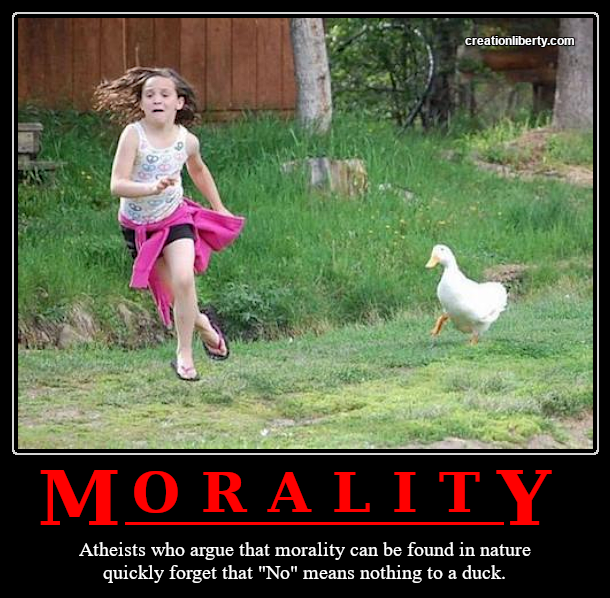
Atheists only cling to the naturalistic fallacy whenever animals perform acts they deem agreeable. The following University of California, Berkeley, article titled "Finding Morality in Animals" presents primatologist Frans de Waal's argument that moral behavior in mankind evolved from monkeys:
"De Waal makes his case for animal morality by citing scientific studies demonstrating animal benevolence. In one experiment, researchers show thata chimp, if given the choice, would rather share food rewards with another chimp than keep it all for himself —as long as he knows that the other chimp actually receives the reward."
-Jill Suttie, "Finding Morality in Animals," University of California, July 9, 2013, retrieved Mar 3, 2017, [https://greatergood.berkeley.edu/article/item/morality_animals]
Although we already covered the chimp problem, let's assess it further by considering the philosophy of evolutionism, which teaches an ever-changing biological system. How do atheists justify immaterial, universal, invariant principles, such as laws of morality, in a biological system that is constantly changing?
How do we know the morals of tomorrow will match those of today? How do they know one chimp's morals are not different from—or superior to—another chimp's morals? Why should a chimp whose biology allegedly produces a certain moral system be forced to follow the rest of the group, when natural selection is predicated on picking traits that differ from the norm of the species?
Here is an even more interesting question: what happens when the so-called "morals" of monkeys clash with those of mankind? For example, if I scoop up feces and fling it into an atheist's face, would he call that a moral act because it is what a chimp would do?
Of course, no atheist would say that flinging feces is a moral act—primarily because he fears the consequences if his opponent decides to test that principle on him. He condemns it only out of selfish motivation, not out of reasoning from his atheistic worldview. It never ceases to amaze me that when an enraged monkey hurls feces into a little girl's face at the zoo, those incidents never appear on atheist websites about chimp ethics, nor in their speeches praising the alleged morality of animals.
(See Kelly-Ann Mills, "Angry monkey throws poo in little girl's face during family day out to zoo," Mirror, Aug 15, 2016, retrieved Mar 9, 2017, [mirror.co.uk/news/world-news/angry-monkey-throws-poo-little-8635195])
This is called "cherry-picking"—another logical fallacy in which the atheist selects examples that make his argument look good while ignoring all those that contradict it. That spurs me to ask: Is it morally good for mankind to eat their own children?
Photographers Andy and Gill Parker were on a safari at Tanzania National Park, and took pictures of a male lion asserting his authority over the pride by killing and eating one of his cubs. Again, I ask: why do we not see atheists showing these photographs with a caption that reads, "
(See James Dunn, "The shocking moment a lion rips apart and EATS a helpless cub: Cannibal cat asserts its dominance on his pride in brutal fashion," Daily Mail, Sept 14, 2015, retrieved Mar 3, 2017, [https://www.dailymail.co.uk/news/article-3233758/The-shocking-moment-lion-rips-apart-EATS-helpless-cub-Cannibal-cat-asserts-dominance-pride-brutal-fashion-lioness-looks-doing-nothing.html])
Atheists who employ the naturalistic fallacy do so without any justification for morality in their worldview, then cherry-pick examples to deceive their audience. The following keywords and descriptions will help you detect when an atheist uses the naturalistic fallacy:
- The behavior of animals
- The behavior of plants
- Inherit/Inherently...
- Instinct/Instinctively...
- Nature/Naturally...
- Evolution/Evolved...
To summarize, here are the four fallacies:
- Appeal to Force
- Appeal to Majority
- Appeal to Emotion
- Appeal to Nature
In earlier drafts of this book, I listed five fallacies, but I later removed "begging the question" because every one of these fallacies already engages in it. For example, when an atheist appeals to force while objecting to a strong man committing evil, his objection begs the question of his own moral standard. The moment atheists reject an example that contradicts their chosen argument for morality, they beg the question—exposing the flimsiness of their position.
In 2014, I interviewed atheist Dan Courtney, former leader of the New York Free Thought Society. During that podcast he claimed survivability forms the basis for moral standards and labeled anything promoting "well-being" as morally right. When I asked him to define "well-being," he said it meant whatever helps mankind survive—which only begs the question: In an atheistic universe, why is it morally right for mankind to survive?
(See Christopher Johnson, "We're Moral 'Cause We Exist - Atheist Guest Dan Courtney," CLE Podcast, Mar 16, 2014, retrieved Nov 12, 2025, [https://www.youtube.com/watch?v=1i7J8ZC5tlg])
Consider Robert Hess, who put his wife in the hospital for nine weeks by driving the claw end of a hammer into her skull. He claimed he panicked over finances—his paycheck could not cover their living expenses—and to survive he needed to eliminate some costs. If atheists insist survivability forms the basis for moral action, they have no consistent argument against Hess's conduct and should demand his release from prison.
(See Giacomo Bologna, "Springfield man who nearly killed wife with hammer: 'I'm not a monster'," Springfield News Leader, Feb 27, 2017, retrieved Mar 7, 2017, [https://www.news-leader.com/story/news/crime/2017/02/27/springfield-man-who-nearly-killed-wife-hammer-m-not-monster/98247972/])
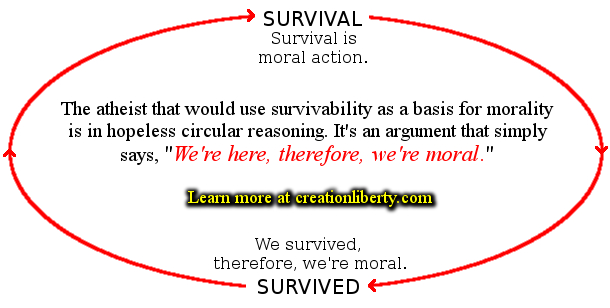
Claiming survival is moral creates a vicious circle that is no less absurd than saying "eating is moral because we eat" or "existence is moral because we exist." Ultimately, the argument is a nonsensical attempt to justify mankind's actions by mankind's actions, but our actions cannot justify themselves. If Christians argued "the Bible is moral because we have the Bible," atheists would rightly reject such irrationality, but they hypocritically present the same circular reasoning and expect Christians to accept it without question.
Furthermore, to establish survival as a moral standard, atheists must first rely on one of the four fallacies we already covered. Why is survival good? Why would mankind's extinction not be morally good? To answer, atheists must argue how things work in the wild (i.e. appeal to nature), or how they feel (i.e. appeal to emotion), or what many people do (i.e. appeal to majority), or it is just that way because mankind said so. (i.e. appeal to force)
In my experience, atheists commonly give up and declare, "This conversation is not going anywhere." This is nothing more than an escape mechanism—a large red emergency button they press to flee the philosophical consquences of their nonsensical worldview. It is called the dismissal fallacy: refusing to engage the arguments and instead waving them off as irrelevant or pointless, proving once more that atheists cannot maintain a rational approach to morality.
Atheists frequently condemn the words or deeds of others as "wrong" or "evil," yet overlook that neither "wrong" nor "evil" can be justified in their worldview. In discussion with an atheist, never let him escape these moral questions. If he presumes to accuse the Christian God of the Bible of evil, he must first establish a moral foundation that allows him to judge the Almighty. How can a man whose worldview provides no basis for morality dare bring moral accusations against one whose worldview does account for morality?
I have watched Christians crumble under pressure in live debate when atheists ask them tough questions about slavery in the Bible. The unprepared Christians fumble over their words while atheists jeer and mock. However, it is remarkably simple to handle atheists on every one of these tough Biblical subjects without needing to know their specific objections in advance.
Remember, when an atheist questions the supposed wrongness of slavery, he assumes slavery is wrong, so simply ask him: "Why is slavery wrong in an atheistic worldview?" The atheist must first possess a moral foundation before he can accuse anyone of anything. If he brings up God sending two bears to kill children (a common atheist argument based on 2Ki 2:23-24), just ask: "Why is killing children wrong in an atheistic worldview?"
At that point, all you need to do is listen as the logical fallacies pour from their mouths, and call them out on it. Not every conversation will proceed exactly as expected, but I have never encountered an atheist—whether in person or in books and articles—who does not rely on these fallacies when discussing morality.
or else, relinquish using them.
In the Christian worldview, logic and morality are easily justified by the omniscient, omnipotent, omnipresent Creator—the Christian God of the Bible—who established the laws of logic and moral precepts in His Word as a reflection of His own character. The Lord God Himself is the standard of good; apart from Him no good can exist or be defined.
Atheists have themselves helped prove the Christian God of the Bible is the only foundation, because thousands of years of failure have left them unable to justify logic or morals in their worldview. Due to this, they are the most extreme of hypocrites: constantly relying on the very things they cannot account for.
I remember being in discussion with an atheist who once told me that morality is quite simple: we should just rely on the "Golden Rule." The Golden Rule generally says, "do unto others as you would have them do unto you." I asked if he knew where that rule came from, but he had no clue—obviously, or he would never have offered it as his own idea.
In the atheist's mind, the Golden Rule is just a piece of universal human wisdom that works perfectly well on its own. However, the Golden Rule was given to us by God the Father through Jesus Christ His Son—a law of charity that fulfills all the moral law and the prophets in Holy Scripture:
Therefore all things whatsoever ye would that men should do to you, do ye even so to them: for this is the law and the prophets.
-Matthew 7:12
The atheist then asked what was wrong with that. Why, he wondered, could atheists not live by the same standard Christians do without becoming Christians? The answer is simple: because it makes no sense in an atheistic worldview.
Atheism cannot justify why charity is good. If a man chooses to steal whatever he wants, the atheist has no basis to oppose the thief except an appeal to the Christian God of the Bible—the very God his worldview hates and rejects outright.
We Christians justify why theft is wrong through the Christian God of the Bible, who established moral standards as a reflection of His own charitable nature. He created us in His perfect image (Gen 1:26) and gave us free will to choose. Mankind chose sin and now suffers its consequences, but God showed us the greatest charity by offering His own Son as a sacrifice to pay for the sins of men, if they will come to Him in the humility of repentance and faith in His Word.
Thou shalt not steal.
-Exodus 20:15
For this, Thou shalt not commit adultery, Thou shalt not kill, Thou shalt not steal, Thou shalt not bear false witness, Thou shalt not covet; and if there be any other commandment, it is briefly comprehended in this saying, namely,
-Romans 13:9
Thou shalt not bear false witness against thy neighbour.
-Exodus 20:16
Lie not one to another, seeing that ye have
put off the old man with his deeds;
-Colossians 3:9
A naughty person, a wicked man, walketh with a froward [i.e. a perverse and undisiplined] mouth. He winketh with his eyes, he speaketh with his feet, he teacheth with his fingers; Frowardness is in his heart, he deviseth mischief continually; he soweth discord.
-Proverbs 6:12-14
For when the Gentiles, which have not the law, do by nature the things contained in the law, these, having not the law, are a law unto themselves: Which shew the work of the law written in their hearts, their conscience also bearing witness, and their thoughts the mean while accusing or else excusing one another;
-Romans 2:14-15
Now the Spirit speaketh expressly, that in the latter times some shall depart from the faith, giving heed to seducing spirits, and doctrines of devils; Speaking lies in hypocrisy; having their conscience seared with a hot iron;
-1 Timothy 4:1-2
This perfectly describes Richard Dawkins, whom I quoted at the start of this book, condemning the Christian God of the Bible at length. In The God Delusion, he devoted a chapter titled "The roots of morality: why are we good?"—a loaded question that fallaciously assumes we ARE good instead of first establishing IF or HOW goodness exists in the atheist worldivew.
(See Richard Dawkins, The God Delusion, 2007, Black Swan, p. 241, ISBN: 9780552773317)
For example, I wrote a book called Why Millions of Believers on Jesus are Going to Hell, which rests on direct quotations from Christ's Sermon on the Mount. Jesus already established the if and how of the doctrine; therefore, in my book I need only explain the why. However, Dawkins' "why are we good?" questions skips straight past if and how to arrogantly presume morality as a given, because justifying those foundations in an atheistic worldview is too difficult.
At the beginning of the chapter, Dawkins makes a statement I mostly agree with:
"I receive a large number of letters from readers of my books, most of them enthusiastically friendly, some of them helpfully critical, a few nasty or even vicious. And the nastiest of all, I am sorry to report, are almost invariably motivated by religion. Such unchristian abuse is commonly experienced by those who are perceived as enemies of Christianity. "
-Richard Dawkins, The God Delusion, 2007, Black Swan, p. 241-242, ISBN: 9780552773317, retrieved Nov 18, 2025, [https://archive.org/details/isbn_9780552773317/page/242/mode/2up]
I believe Dawkins' testimony here because he is actually much better off than I am when it comes to emails. I regularly get venomous letters from churchgoers and almost exclusively hateful ones from atheists. This is not a case of religion versus atheism; it is simply the reaction of hateful hearts that lash out at anyone who disagrees with them; the internet making it much easier for people to do since they can hide behind usernames. Both groups (i.e. churchgoers and atheists) expose their hypocrisy in conversation by violating the very moral standards they claim to uphold.
Even so, Dawkins is either blind to his own hypocrisy or deliberately deceiving others because, at the beginning of this book, I quoted his description of the Christian God of the Bible as a "
But the most important question remains: Why are any of those things wrong in an atheistic universe? Atheists cannot justify morality in their worldview, so why do they continue to pridefully virtue-signal when virtue itself cannot exist in their universe?
At one point, Dawkins rightly says:
"Perhaps because I don't live in America, most of my hate mail is not quite in the same league, but nor does it display to advantage the charity for which the founder of Christianity was notable."
-Richard Dawkins, The God Delusion, 2007, Black Swan, p. 244, ISBN: 9780552773317, retrieved Nov 18, 2025, [https://archive.org/details/isbn_9780552773317/page/244/mode/2up]
Dawkins remains blind to the fact that the very leverage for his accusation of hypocrisy comes from the moral teachings of Jesus Christ, not from atheism. Why is it "wrong" to be a hypocrite in an atheistic universe? Why is it "right" to be charitable in an atheistic universe? Once again, this proves that atheists must borrow from the Christian God of the Bible to have any basis for moral judgment.
After his hypocritical accusations, Dawkins continues to argue the naturalistic fallacy we covered in the previous chapter:
"On the fact of it, the Darwinian idea that evolution is driven by natural selection seems ill-suited to explain such goodness as we possess, or our feelings of morality, decency, empathy and pity. Natural selection can easily explain hunger, fear and sexual lust, all of which straightforwardly contribute to our survival or the preservation of our genes. "
-Richard Dawkins, The God Delusion, 2007, Black Swan, p. 246, ISBN: 9780552773317, retrieved Nov 18, 2025, [https://archive.org/details/isbn_9780552773317/page/246/mode/2up]
Evolutionism cannot explain hunger, fear, or sexual lust, because it offers no account of how such things arose in the first place. This is wishful thinking. Since atheism teaches that the universe arose by random chance, all meaning remains subjective—mere opinions produced by brains governed by random chemical reactions.
Atheists offer nothing beyond ridiculous, baseless theories unsupported by tangible, replicable scientific, logical, or historical evidence. They use logic, math, and science in a worldview that cannot account for them. In short, they argue, "These things exist, therefore evolution must have produced them." Since the foolish religion of evolutionism cannot account for these basic realities, it holds no hope of explaining immaterial, universal, invariant entities such as the laws of logic or morality.
(Read "Evolutionism: Another New-Age Religion" at creationliberty.com for more details.)
Dawkins at least admits that his religious ideology—evolutionism, a foundational principle of atheism—cannot explain morality by saying that "
Dawkins has already employed three of the four morality fallacies I listed earlier: he appealed to nature through evolutionism, he appealed to emotion by presuming universal empathy, and he appealed to majority by subtly assuming all mankind inherently possesses this morality and should grasp his position without explanation. Now imagine if I argued the points in this book the same way (i.e. "God simply exists, we all feel it, and everyone knows it by default")—atheists would outright reject it, and rightly so, but as Dawkins' book clearly demonstrates, they freely use the very arguments they refuse to accept from Christians.
To save time, I will summarize Dawkins' remaining arguments from this point forward, showing how he begs the question in nearly every paragraph. If you think I am misrepresenting or exaggerating what he said, I encourage you to read chapter six of his book yourself, and you will see that I steel-man his position accurately. (i.e. I present his claims as accurately as he made them.)
(See Richard Dawkins, The God Delusion, 2007, Black Swan, p. 248-249, ISBN: 9780552773317, retrieved Nov 18, 2025, [https://archive.org/details/isbn_9780552773317/page/248/mode/2up]
Dawkins claimed that cooperation in nature aids survival, yet never explained why mankind's survival is morally "good." He asserted that cooperation helps people obtain what they need, but why is it "right" to obtain what we need in an atheistic universe? Dawkins simply assumed whatever benefits mankind is good, without first justifying it i his worldview, and I exposed this same question-begging earlier when atheists in personal debate could not answer: "Why is it morally right for mankind to survive?"
Since atheists assume survival is "good," let us assume the opposite: What if survival is morally "evil"? For the sake of argument, if the world would be better off without mankind, then survival becomes evil. Our natural instincts would then oppose moral goodness, and every act of eating, drinking, or breathing becomes a wicked deed.
Under that premise, the atheist faces a dilemma he cannot escape: he has no way to prove or disprove either claim. He cannot say for sure that his existence is not evil. Though he has no argument against it, he must reject the idea that mankind's survival is evil, simply because that conclusion is unhelpful to his personal desires.
These personal desires spring from inner feelings, bringing us straight back to the appeal to emotion. If the argument grew heated and society decided mankind's destruction was right, the atheist would resist with force, thereby appealing to force for moral victory, and completing the full circle of all four logical fallacies I listed in the previous chapter.
Remember that Dawkins' chapter was called "WHY we are good," not IF or HOW, but even in that regard, he did not do his job explaining why. After repeatedly begging the question, he said:
"We now have four good Darwinian reasons for individuals to be altruistic, generous or 'moral' towards each other."
-Richard Dawkins, The God Delusion, 2007, Black Swan, p. 251, ISBN: 9780552773317, retrieved Nov 18, 2025, [https://archive.org/details/isbn_9780552773317/page/250/mode/2up]
Dawkins never answers IF we are good, nor HOW we are good, nor WHY we are good, and instead, he simply declares that we SHOULD act in the way he deems good—without ever proving that good exists in an atheistic universe. I could just as well insist that someone SHOULD drink a glass of milk, but that does not prove a carton of milk is in the refrigerator, and thus, it is pointless to tell people what to do with the milk if the milk has not yet been verified to exist.
Some readers will recall that in chapter three I explained that not all questions of fact are answered the same way, and I showed that questions about immaterial, universal, invariant truths cannot be settled by simply opening the refrigerator to look for a carton of milk. That is why I used the milk analogy again: to prove the matter is not so simple, and this, I believe, is precisely why Dawkins never attempted a valid explanation for the transcendental question of morality.
In summary, Dawkins spent the rest of the chapter begging the question, cycling through the same logical fallacies already listed, and accusing non-atheistic worldviews of shallow thinking. I know this sounds repetitive, but the fault lies not in my telling; atheistic philosophy is just hopelessly circular by nature. In later chapters he continues condemning his most hated enemy—the Christian God of the Bible—while clinging to a worldview that cannot justify condemning anyone or anything.
Throughout his book, Dawkins repeatedly condemns "religion," and this is a crafty tactic that many atheist authors use. I could readily agree with his condemnation of religion depending on his definition. In context, he appears to target pompous, pointless rituals of various church buildings and religious cults, and if that is indeed his meaning, then I would gladly join him in condemning those ridiculous practices.
In fact, I have various books covering some of them:
Corruptions of Christianity: Catholicism
Catholicism is the largest pseudo-Christian cult in the world, and they have done untold evils, from the corruption of God's Word to the torture, rape, and murder of countless people. For the past 1700 years, they have taught a false gospel of salvation, leading billions to the wide gates of hell.
Corruptions of Christianity: Orthodoxy
The Eastern Orthodox cult is nothing more than paganism repackaged. They have commited many of the same crimes as the Catholic cult. Orthodox cultists are idolaters who practice witchcraft, and worship an assortment of gods they call "saints," but slap a Jesus sticker on it and called it "good."
Corruptions of Christianity: Seventh-day Adventism
The Adventists are the result of false prophets gathering emotionally-charged followers. The Seventh-day Adventists follow false prophetess Ellen G. White, who is notorious for her works-based heresies, her hypocrisy against her own teachings, and who plagiarized anywhere from 50-80% of her writings.
Corruptions of Christianity: Mormonism
The Mormons are well-known to be dedicated followers of false prophet Joseph Smith, who taught a myriad of false doctrines. There is no evidence that supports his visions, which is unintentionally admitted by Mormons because to know if it is true, you have to feel a "burning in the bosom," or rather, an appeal to emotion.
Corruptions of Christianity: Jehovah's Witnesses
Jehovah's Witnesses, or the Watchtower Society, is the invention of Charles Russell, a false teacher who developed his corrupt doctrine from the Adventists. He made false prophecies based on religious pyramidology and numerology, both of which are divination, a practice that is condemn by God in the Scriptures.
Islam: A Religion of Terror
Islam is a pagan religion based on the writing of the false prophet and pedophile Muhammad, who took a Middle-Eastern heathen moon god and made him into "Allah." Today, Muslims have many ridiculous practices based on heathen superstitions, and their hatred of other cultures stems from the vile doctrines of their false prophet.
Pure religion and undefiled before God and the Father is this, To visit the fatherless and widows in their affliction, and to keep himself unspotted from the world.
-James 1:27
I have never argued that an atheist cannot do good deeds; of course, they can, but only in the Christian worldview. Until they justify their actions to be moral in their own worldview, then they hold a worldview that is contrary to what they are doing.
| Atheists do not live the way they claim to believe. |
If atheists truly believed their worldview, they would show no concern for moral issues and have no reason to debate them. Only by first assuming—through conjecture—that moral goodness exists (as Richard Dawkins did) can they claim moral concern. Atheism offers no logical path to establish that goodness or evil exists, rendering their claims a direct contradiction to their own daily living.
In atheism, there is no good or evil—only action or inaction. Their worldview cannot account for reality, but even if it could, all moral depravity—rape, incest, murder, torture, and the like—is merely action: things that simply happen. Atheists cannot label any action evil unless they first borrow from the Christian worldview.
Countless times I have heard desperate atheists turn to science as the answer to the problem of induction—to account for logic, reason, and morality, but as I showed in chapter two, science presupposes that the future will resemble the past, which begs the question. Furthermore, science rests upon the laws of logic, and this brings us back to the question: In an atheistic universe, how do you justify immaterial, universal, invariant laws of logic?
In discussions with atheists, I have asked how they know the sun will rise tomorrow, and without exception, they answer, "Because it has always been that way." However, if an atheist asks how I know God exists, and I reply, "Because it has always been that way," would he accept that answer?
We all know atheists would reject that answer from me—as would I also, because it is not logical, but they regurgitate the same hypocritical answer time and again. I do not pose these questions as unsolvable riddles. On the contrary, as a Christian, I have answers because they pose no problem for my worldview. I seek to show atheists that by answering "it has always been that way," they rely on probability, and probability presupposes the future will resemble the past, once again begging the question.
Only once do I recall an atheist turning the question back on me. I appreciate that rare occurrence, since most atheists care nothing for answers and typically do not return the same questions. The omniscient, omnipotent, omnipresent Christian God of the Bible has answered this for us:
While the earth remaineth, seedtime and harvest, and cold and heat, and summer and winter, and day and night shall not cease.
-Genesis 8:22
Despite all their claims of logical and moral superiority, atheists arrogantly charge Christians with foolishness and ignorance, but those same atheists cannot answer such basic questions. It is the height of hypocrisy for an atheist to levy accusations against Christians when his own worldview cannot answer truths a child could learn in Sunday school classroom.
Atheists sometimes shift the goalpost by claiming that asserting God's existence and His creation of the world fails to explain HOW He created everything. It is illogical to demand intimate knowledge of what something is—or how it was made—before acknowledging its existence.
For example, at the molecular level, scientists still do not know what electricity truly is. Can you put it in a jar and paint it red? We know how electricity behaves and how to harness it, but we cannot fully classify an electric charge, but we rightly believe electricity exists, even though we cannot explain its essence or origin at the most fundamental level.
Gravity provides another example—even worse than electricity in our capacity to explain what is and how it works, but atheists still believe gravity exists. Thus, atheists routinely accept things they cannot model with a "how-to" explanation, while demanding the impossible from Christians: complete models of matters beyond human understanding to justify their existence.
Atheists attempt this argument because they cannot defeat the Christian worldview on logical merit. Instead, they try to portray it as meaningless or pointless, and employ ridiculous examples as red herrings to distract from the real issue.
Red Herring (ignoratio elenchi)
Christian presents argument X.
Atheist introduces argument Z.
Argument X is abandoned.
This is a logical fallacy everyone should consider when listening to speakers, especially politicians who employ it often. For example, a red herring might appear as follows:
JOURNALIST: "Sir, you said you would increase taxes. Would you explain to everyone watching why you want to tax Americans more?"
POLITICIAN: "That is an excellent question. Have you always been a person who asks intelligent questions?"
JOUNRALIST: "Uh... I suppose."
POLITICIAN: "Of course you do because you're an intelligent American. American is the land of the free because of intelligent people."
For example, 2024 Democratic presidential candidate Kamala Harris—who was conveniently appointed her party's primary candidate despite not receiving a single vote in the primaries—gained infamy for her red herrings. No matter the question asked in interviews, she answered almost none of them; instead, she commonly diverted into a speech about growing up in a middle-class family, which sparked a worldwide comedy meme.
The term "red herring" comes from a smoked, salted kipper—a fish that turns reddish and emits a strong smell. In the nineteenth century, British fugitives would drag it along a trail to distract hunting dogs from their scent, and today, a "red herring" now serves as a metaphor for deliberately diverting attention from the issue at hand.
I once heard an atheist in debate present a hypothetical: suppose a car sits in a parking lot, and the atheist asks, "How did the car get there?" and claims a Christian might answer, "It was designed by GM." (i.e. General Motors) Of course, that does not fully explain how the car arrived in the parking lot, but how the car got there is not a prerequisite to believing GM exists—or that the car itself exists—making the question a red herring.
Similarly, we could ask, "How did God make a cow?" but that has nothing to do with the question, "Did God make a cow?" It is striking hypocrisy for atheists to demand a "how-to" manual from Christians before believing in God, when they embrace the absurd "Big Bang" notion that offers no answers or repeatable scientific experiments for how it supposedly occurred.
(Read "The Big Dud Theory" at creationliberty.com for more details.)
When the atheist sees a car in a parking lot, he does not conclude that General Motors does not exist. Yet when he sees a cow, he automatically concludes that the Creator of that cow does not exist. This makes no logical sense. If atheists claim it is logical, they remain philosophically stuck—forced to the impossible task of justifying the laws of logic in their preposterous worldview.
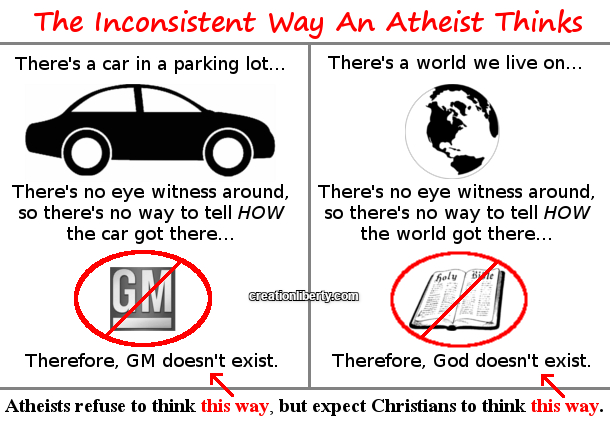
Atheists expect us Christians to think the absurd way they think—to give up all path to knowledge, truth, and reason—to join them in hopeless circular reasoning. Why, you may ask? Because in the end, they know the truth, they know who the Christian God of the Bible is, but they hold that truth to maintain their ungodly lifestyle of unrighteousness.
For the wrath of God is revealed from heaven against all ungodliness and unrighteousness of men, who hold the truth in unrighteousness; Professing themselves to be wise, they became fools,
-Romans 1:22-23
And even as they did not like to retain God in their knowledge, God gave them over to a reprobate mind, to do those things which are not convenient;
-Romans 1:28
It is common for atheists to question why Christians limit themselves to the Christian God of the Bible alone, pointing out that many religions and many gods exist all over the world. I have no need to defend countless false religions because I do not follow their worldviews, but in the interest of giving an answer for the reason of the hope that is in me, I will address this subject briefly in this chapter.
But sanctify the Lord God in your hearts: and be ready always to give an answer to every man that asketh you a reason of the hope that is in you with meekness and fear:
-1 Peter 3:15
Although no man can claim expertise in every religion of the world—as there are far too many to address in a single chapter of a book—the Christian God of the Bible alone provides a worldview consistent with the logical thought processes He created. The Christian God created us, as well as the logical process, and designed our minds to reason according to logic, enabling us to think in the same consistent manner He does. Other religions, with their irrational gods, contain too many conceptual flaws to be taken seriously.
Unlike other religious worldviews, the Christian God of the Bible can be known through His Word. By revealing Himself to the world in various ways, He confirms His presence as a watchful judge, gracious Savior, and wise counselor. The invented gods of this world offer no consistency with the laws of logic, and their contradictory doctrines reflect personalities incapable of knowing or finding truth.
Hinduism's concept of "Maya" provides a stunning example of absurdity because it teaches that everything experienced in this world is illusion—a fake perception not part of true reality. They claim their god, Brahman, alone is real, while all else is mere illusion. This is a self-defeating ideology because if one cannot account for the reality of nature, thought, and experience, then he cannot account for the reality of his god either.
Although some may think I oppose the transcendental argument made in this book, they would only think that if they misunderstand Hinduism's argument. We use the Christian God of the Bible as the foundation for knowledge, logic, and morals, but Hindus use their god as a foundation for nothing, thereby failing to prove anything because they claim our perceptions are all lies.
The following is from the Svetasvatara Upaniad, an ancient text in the Yajurveda, one of the four primary texts (i.e. Vedas) considered to be sacred Hindu doctrine:
"Know, then, that prakriti [i.e. nature] is maya [i.e. illusion] and that Great God is the Lord of maya. The whole universe is filled with objects which are parts of His being. "
-Svetasvatara Upanisad, 4:10, retrieved Nov 25, 2025, [https://yogananda.com.au/upa/Svetasvatara_Upanishad.html]
illusion (n): something that deceives by producing a false or misleading impression of reality
(See 'illusion', Random House Dictionary, 2025, [dictionary.com]; See also Collins English Dictionary, 10th Edition, William Collins Sons & Co, 2012)
India is notorious for widespread litter, as people often discard trash from windows, off cliffs, and out of moving vehicles without regard for how it defiles the land. Since philosophy affects behavior, perhaps this explains why India has become such a trash heap—a nation dominated by Hindus who, under the doctrine of Maya, view the material world, including their garbage, as mere illusion.
Because Brahman is the "Lord of illusion," we must conclude that Brahman cannot be trusted. If all our experiences are lies, then Brahman is therefore a great liar and deceiver by nature. How can we trust someone who deceives us? This destroys any path to knowledge because, under Hindu ideology, the world cannot operate according to logical law, for all experience violates the laws of identity and non-contradiction.
In Kena Upanishad, it says:
"He [i.e. Brahman] who cannot be seen by the eyes, but who causes the eye to perceive all visible objects, "
-Kena Upanishad, 1:6, retrieved Nov 26, 2025, [https://www.wisdomlib.org/hinduism/book/kena-upanishad-madhva-commentary/d/doc486070.html]
Since all is illusion, visible objects are illusion—and the eye itself is illusion—which renders this meaningless drivel that sounds like it was thought up by a bunch of marijuana-smoking teenagers. How do Hindus know they cannot see Brahman if all perception of reality is illusion?
How could Hindus prove that Brahman is not distorting reality to conceal his wicked nature—an evil god deceiving them into eternal hellfire? They have no way to argue against that question because they destroyed the foundation for knowledge from the very outset.
You can see this absurdity in countless places throughout the Hindu scriptures. Here is another example from the commentaries on Brahma Sutra:
"Well then, as dreams are mere illusion, they do not contain a particle of reality?—Not so, we reply; for dreams are prophetic of future good and bad fortune. For scripture teaches as follows, 'When a man engaged in some work undertaken for a special wish sees in his dreams a woman, he may infer success from that dream-vision.' "
-Shankara Bhashya commentaries on Brahma Sutras, Third Adhyaya, Second Pada, verse 4, retrieved Nov 25, 2025, [https://www.wisdomlib.org/hinduism/book/brahma-sutras-thibaut/d/doc64003.html]
Women are part of nature, so women are illusion; therefore, how can success be inferred from something that is not real? Success is drawn from experience, but experience is illusion in Hinduism, so how can success be determined from a false impression of reality?
I have received a few letters from some Hindus over the years disgruntled at my mention of this glaring contradiction, and though I tried to engage with them in discussion, none of them were willing to debate the matter. The responses I received were just rambling nonsense—a complete refusal to even consider the matter.
But if we think about their worldview, why should they engage with me at all? I do not exist. In their philosophy, I am just an illusion, which leaves us to wonder why they wrote an email that is not real, from a computer that is not real, to an evangelist who is not real, with rambling words from their brain that is not real.
This gets worse because dreams are interpreted by the brain, and since the brain is part of nature, that makes dreams an illusion, as well as all thought and memory. Hindus must read their verses with eyes or hear them with ears, which are both illusions, and thus, Hindus cannot know whether their scriptures exist in reality.
If the Hindu scriptures are illusion, then the concepts of Brahman and Hinduism are also illusion. Hindus may object, but they have no basis for the objection because they can provide no justifiable reason that their objections exist in reality.
Their worldview is reduced to mere conjecture, but that is giving them more credit that we should because conjecture is an illusion. There is no logical escape from this, demonstrating the absurdity of Hinduism in very short order, which is why you will rarely find Hindus willing to participate in formal debate.
Hindus sometimes retort that Brahman is self-evident, but that self-evidence rests on thoughts in their minds, which are illusion according to their own doctrine. They will say that empirical tools cannot reach Brahman, but they do not stop to consider that the brain is an empirical tool—another self-defeating argument proving that Brahman's existence cannot be known through the mind.
empirical (n): derived from or guided by direct experience or by experiment; provable or verifiable by experience or experiment
(See 'empirical', Random House Dictionary, 2025, [dictionary.com]; See also Collins English Dictionary, 10th Edition, William Collins Sons & Co, 2012)
As you can see, it does not take much to conclude that Brahman is an illusion. Even their own scriptures and commentators acknowledge the direct connection between Brahman and illusion:
"'I am Brahman'—such is the truth. 'I am free from all defects, I am the all, I do not seek anything nor do I abandon anything, I am Brahman'—such is the truth. 'I am blood, I am flesh, I am bone, I am body, I am consciousness. I am the mind also, I am Brahman'—such is the truth. 'I am the firmament, I am space, I am the sun and the entire space, I am all things here, I am Brahman'—such is the truth. "
-Marietta Stepaniants, Introduction to Eastern Thought, Bloomsbury Publishing, 2002, p. 138-139, ISBN: 9780742504349
Earlier, we learned from Hindu scriptures that all nature is illusion, and now we are told that Brahman is all nature, which means Brahman is also illusion. Do not misunderstand the common Hindu claim that Brahman is merely the "Lord" of illusion—no, these verses declare Brahman to be a laundry list of things found in nature, meaning Brahman IS illusion itself.
Therefore, the concept of Brahman is itself a false perception of reality, and by following the logic of their own scriptures, we can conclude Brahman is not real. No matter how often Hindus insist Brahman is reality, they cannot prove it by any conceptual means—their doctrine contradicts itself, and this makes Hinduism one of the easiest, self-defeating religions to expose.
It should be noted that Hinduism is not a scripture-based religion, meaning that Hindus do not hold their supposedly "sacred" writings as authoritative for faith and practice, so what is their religion predicated upon? If they claim oral tradition, that merely begs the question, and thus, when conversing with a Hindu, I would advise to keep one vital question ready and use it against them often: "How do you know that?"
If Hindus refer to scriptures like the Bhagavad Gita, they often do so to justify their faith by claiming "sacred scriptures" akin to the Christian worldview, but we Christians use the Word of God in Holy Scripture as the foundation for a consistent worldview—without which nothing can be proven. Hindu scriptures serve no such purpose, for no logical law, scientific inference, or moral absolute can be drawn from such a flimsy, contradictory, self-defeating document as the Bhagavad Gita.
Buddhism also has no shortage of inconsistencies, as it rests on contradiction from its very foundation. Siddhartha Gautama, the founder of Buddhism, claimed he attained enlightenment under a fig tree while tempted by "Mara," a Hindu god of death and sin.
Some sharp readers may already see the absurdity: Hinduism provides no logical basis for morality, since all is illusion, so how can an evil god exist? This makes no sense. Since Buddhism's foundation rests on Hindu mythology, that means Buddhism is also illusion.
Worshipers of various religious cults imagine gods that are generally immortal, but Gautama taught that the gods of Hinduism are not immortal—they are finite and can cease to exist. This begs two questions:
- How does he know his gods are not immortal? Gautama never answers this question—he simply asserts it without reason.
- How does he know Brahman or Mara exist? To know such things would require divine revelation, but those revelations are interpreted by the brain. According to Hindu doctrine, such empirical tools as the brain are illusion and cannot reach Brahman, which leaves us at an impasse.
"Due to eating so little, my major and minor limbs became like the joints of an eighty-year-old or a dying man, my bottom became like a camel's hoof, my vertebrae stuck out like beads on a string, and my ribs were as gaunt as the broken-down rafters on an old barn. Due to eating so little, the gleam of my eyes sank deep in their sockets, like the gleam of water sunk deep down a well. Due to eating so little, my scalp shriveled and withered like a green bitter-gourd in the wind and sun.Due to eating so little, the skin of my belly stuck to my backbone, so that when I tried to rub the skin of my belly I grabbed my backbone, and when I tried to rub my backbone I rubbed the skin of my belly. Due to eating so little, when I tried to urinate or defecate I fell face down right there. Due to eating so little, when I tried to relieve my body by rubbing my limbs with my hands, the hair, rotted at its roots, fell out. "
-Mahasaccaka Sutta, Middle Discourses #36, retrieved Nov 26, 2025, [https://suttacentral.net/mn36/en/sujato]
This is not a matter of mere fasting; this is torturing oneself to death, otherwise known as masochism.
masochism (n): the act of turning one's destructive tendencies inward or upon oneself; the tendency to find pleasure in self-denial
(See 'masochism', Random House Dictionary, 2025, [dictionary.com]; See also Collins English Dictionary, 10th Edition, William Collins Sons & Co, 2012)
"I would go on all fours into the cow-pens after the cattle had left and eat the dung of the young suckling calves. As long as my own urine and excrement lasted, I would even eat that. Such was my eating of most unnatural things. "
-Mahasaccaka Sutta, Middle Discourses #12, retrieved Nov 26, 2025, [https://suttacentral.net/mn12/en/sujato]
It seems there is little—if any—wisdom to be found in Gautama. Frankly, he sounds like an idiot. I do not dispute that suffering can alter one's philosophy, but even assuming all of Gautama's accounts are not hyperbolic, he was fortunate not to have died during his extreme self-torture.
By overcoming the temptation of this evil god—who he cannot verify ever existed, for any verification process would itself be illusion—Gautama claimed to attain "enlightenment": the ability to recall past lives with a "divine eye." In Hinduism, past lives are part of nature, and nature is illusion, so how can one attain enlightenment—a memory of past lives—through false perceptions of reality?
If we take this to its logical conclusion, all people—including ourselves—are a false perception of reality. All aspects of men, including the dung he ate and the urine he drank, were illusion. His suffering was illusion. This means that if Buddhist enlightenment were true, then all you are perceiving is not real—it is a lie and deception, so how could Gautama prove he was not deceived by Mara in the first place?
Furthermore, are we to presume all men should live in such disgusting, nonsensical ways to attain enlightenment? If so, children and families would be impossible, leaving no new generations to arise and seek enlightenment, rendering the entire process pointless.
Gautama's philosophy was utterly selfish. He provided for no one's needs. He helped no one but himself—if one can even call that "help." By sending others down the same path, urging them to do as he did, he would ultimately consign mankind to extinction.
Now we get to what is likely the most absurd and self-defeating teaching of Buddha, from one of the most famous quotes in their religious texts:
"It is fitting for you to be perplexed, Kalamas [i.e. a tribe in northern India], fitting for you to be in doubt. Doubt has arisen in you about a perplexing matter. Come, Kalamas,do not go by oral tradition, by lineage of teaching, by hearsay, by a collection of scriptures, by logical reasoning, by inferential reasoning, by reasoned cogitation, by the acceptance of a view after pondering it, by the seeming competence of a speaker, or because you think: 'The ascetic is our guru.' But when, Kalamas, you know for yourselves: 'These things are unwholesome; these things are blameworthy; these things are censured by the wise; these things, if accepted and undertaken, lead to harm and suffering,' then you should abandon them. "
-Kesaputtiya, 3:65, retrieved Nov 26, 2025, [https://suttacentral.net/an3.65/en/bodhi]
Think about this carefully: Buddha instructed his followers not to place trust in oral tradition, written teachings, logic, or reason. This alone exposes Buddhism as an illogical and unreasonable religion, and if taken seriously, Buddha's disciples should not trust Buddha's own words.
Buddhist (n): of or relating to Buddhism; promoting or making use of ideas or principles of Buddhism
(See 'Buddhist', Random House Dictionary, 2025, [dictionary.com]; See also Collins English Dictionary, 10th Edition, William Collins Sons & Co, 2012)
You can only be a Buddhist by adhering to Buddha's teachings, but Buddha commanded his followers not to trust teachings—his own included. This makes it impossible to be a true Buddhist. The logical conclusion of Buddhism is that there is no such thing as a Buddhist.
I should end this section here, but the absurdities get worse upon deeper examination. Buddha instructs his disciples to follow their own experiences, so if a man's experiences lead him to conclude that Buddhism is a lie, does that make it a false religion?
This subjective "experience-it-as-you-go" ideology resembles a Mr. Potato Head religion, where followers piece it together as they like while ignoring the obvious dilemma that opposite experience-based conclusions make the religion meaningless. These basic contradictions explain why Buddha warned against following logic or reason, directing students instead to their own experiences—placing them in the same boat as atheists, whose worldview cannot justify experiences.
For that matter, if Buddhists must reject logic and reason, how were their temples constructed? Do they not see that men must employ logic and reason—the foundations of mathematics and science—to build those temples? If they truly believed their own doctrine, Buddhists would reject their temples too, but they have to have some place to make themselves appear "sacred" to gain political clout.
Buddhist teaching—which followers are not supposed to adhere to, for doing so would violate Buddha's own instructions—insists that Buddhists must be free from lust, yet never explains why lust is wrong. They offer this general principle of avoiding lust to avoid personal suffering, but also fail to explain why suffering itself is wrong.
Although Buddhists are taught to avoid sexual lust, sex scandals are not an uncommon problem among Buddhists. Sogyal Rinpoche, author of The Tibetan Book of Living and Dying, founded Rigpa in 1979, an international Buddhist organization offering teaching for Buddhist study and practice, only to have his own organization commission an independent investigation that found him guilty of non-consensual sex and violence against his students.
This is just one example of many sex scandals in the Buddhist religion, from a variety of countries. These often involve senior monks—the very hypocrites who are teach abstaining from sexual lust. Celibacy is required for monks, and so by teaching something that is contrary to God's natural created order, these men and women burn in their lust and end up doing despicable deeds.
Speaking lies in hypocrisy; having their conscience seared with a hot iron; Forbidding to marry, and commanding to abstain from meats, which God hath created to be received with thanksgiving of them which believe and know the truth.
-1 Timothy 4:2-3
If we ought not rely on the wisdom or instruction of others and base our principles solely on personal experiences, then no argument exists against a Buddhist achieving enlightenment by placing his head in a functioning wood chipper. How do you know it is not beneficial until you experience it? If you claim it would not be beneficial beforehand, you rely on "
These are self-defeating doctrines, and some atheists might agree that these religions are ridiculous, but atheism is no better. Atheists cannot justify moral absolutes any more than Hindus or Buddhists, nor can any of them justify the laws of logic—all of them, in one way or another, turn people away from logic and reason to promote their worldview.
Islam is another religion often questioned for promoting violence, and though some Muslims claim it teaches peace, one need look no further than the Quran—the teachings of their prophet Muhammad—to see that its foundation rests on bloodshed. Islam is warmongering evangelism by the sword; not personal sacrifice through charity toward one's neighbor, but forcing the neighbor to suffer unless he submits to Islam.
This is why I wrote a book called Islam: A Religion of Terror, free to read at creationliberty.com. It demonstrates that their god, Allah, is a pagan moon god chosen from the myriad of false gods the Arabs once worshiped.
Atheists cling to a worldview that provides no foundation to declare Islam wrong for murdering those with opposing beliefs because atheism cannot justify moral absolutes. Neither can Hindus or Buddhists condemn Muslims for killing to advance their religion, for they must first account for the laws of logic and morality, which their worldview cannot accomplish.
It has been widely speculated that Muhammad suffered epileptic seizures during his supposed receptions of visions from Allah. This renders Islam similar to Seventh-day Adventism, whose prophetess—Ellen G. White—experienced epileptic seizures from a head injury, which produced her alleged visions.
(Read Corruptions of Christianity: Seventh-day Adventism at creationliberty.com for more details.)
Based on his own testimony and that of his child bride Aisha—whom he consummated marriage with when she was only nine years old—Muhammad experienced ringing or buzzing in his ears (Sahih al-Bukhari 1:2), cold sweats requiring blankets (Sahih Muslim 160a), severely increased heartbeat (Sahih al-Bukhari 1:3), flushed face with heavy breathing (Sahih al-Bukari 66:7), and episodes of passing out while drooling at the mouth. (Surah An-Najm, Tafsir Ibn Kathir 53:6-7) These are classic signs of seizures, well-known today to produce auditory and visual hallucinations often mistaken for "prophetic" messages from gods.
(See Sahih al-Bukhari, 1:2-3, sunnah.com, retrieved Dec 2, 2025, [https://sunnah.com/bukhari:2]; See also Sahih Muslim, 160a, sunnah.com, retrieved Dec 2, 2025, [https://sunnah.com/muslim:160a]; See also Sahih al-Bukhari, 66:7, sunnah.com, retrieved Dec 2, 2025, [https://sunnah.com/bukhari/66/7]; See also Surah An-Najm, Tafsir Ibn Kathir on Quran, 53:6-7, alim.org , retrieved Dec 2, 2025, [https://www.alim.org/quran/tafsir/ibn-kathir/surah/53/6/])
Muhammad insisted that these "revelations" be recorded, but Muslim tribes in that era were largely nomadic and barbaric, possessing few writing tools. Most of the Quran—their supposed "sacred" text—was rarely inscribed with ink on papyrus as some imagine; rather, the vast majority consisted of sentence fragments etched on bones, stones, or leaves available at the moment, leaving us with highly suspicious records with very low credibility.
If that were not bad enough, a glaring contradiction in the Quran almost never comes up in public discussion: the Quran testifies that the Gospel of Christ is truth. Some readers unfamiliar with this may be surprised—as they should be—because anyone knowing the basics of Muslim belief versus Christian belief understands that the two cannot coexist in harmony.
The Quran teaches that "
"Indeed, We revealed the Torah, containing guidance and light, by which the prophets, who submitted themselves to Allah, made judgments for Jews. "
-Al-Maidah, 5:44, quran.com, retrieved Dec 2, 2025, [https://quran.com/5/44]
When Muslims read "we" in the Quran, they understand it as Allah speaking, although they insist their god is singular and condemn the biblical Godhead as heresy. This usage resembles a royal "we"—as when a king arrogantly declares, "We are not amused." It is merely a linguistic feature in the text that, according to Muslims, implies no pluralism in their doctrine.
The Quran teaches that Allah sent other prophets, naming David and Solomon, which indicates that Muslims should believe the Psalms, Proverbs, and Ecclesiastes are all inspired texts:
"Indeed, We have sent revelation to you O Prophet as We sent revelation to Noah and the prophets after him. We also sent revelation to Abraham, Ishmael, Isaac, Jacob, and his descendants, as well as Jesus, Job, Jonah, Aaron, and Solomon. And to David We gave the Psalms. "
-An-Nisa, 4:163, quran.com, retrieved Dec 2, 2025, [https://quran.com/4/163]
The Quran also confirms the Gospel of Jesus as a proper doctrine:
"Then in the footsteps of the prophets, We sent Jesus, son of Mary, confirming the Torah revealed before him. And We gave him the Gospel containing guidance and light and confirming what was revealed in the Torah—a guide and a lesson to the God-fearing. "
-Al-Maidah, 5:46, quran.com, retrieved Dec 2, 2025, [https://quran.com/5/46]
This leaves many glaring contradictions because if Mulims believe Noah, Abraham, Isaac, Jacob, Moses, Aaron, Solomon, David, and Jesus were true prophets of the one true God, then rejecting their doctrine places them at odds with those very men—and thus in contradiction with their own Allah. However, this contradiction arises solely because the Quran conflicts with its own teachings, as seen when compared to the doctrine of Jesus Christ.
But I say unto you, Love your enemies, bless them that curse you, do good to them that hate you, and pray for them which despitefully use you, and persecute you;
-Matthew 5:44
And whosoever shall not receive you, nor hear your words, when ye depart out of that house or city, shake off the dust of your feet.
-Matthew 10:14
Then came his disciples, and said unto him, Knowest thou that the Pharisees were offended, after they heard this saying? But he answered and said, Every plant, which my heavenly Father hath not planted, shall be rooted up. Let them alone: they be blind leaders of the blind. And if the blind lead the blind, both shall fall into the ditch.
-Matthew 15:12-14
This verse of the Quran tells Muslims to kill unbelievers wherever they find them, in opposition to what Jesus taught:
"Kill them wherever you come upon them and drive them out of the places from which they have driven you out. For persecution is far worse than killing. And do not fight them at the Sacred Mosque unless they attack you there. If they do so, then fight them—that is the reward of the disbelievers."
-Al-Baqarah, 2:191, quran.com, retrieved Dec 2, 2025, [https://quran.com/2/191]
"They wish you would disbelieve as they have disbelieved, so you may all be alike. So do not take them as allies unless they emigrate in the cause of Allah. Butif they turn away [i.e. from the Islamic religion], then seize them and kill them wherever you find them , and do not take any of them as allies or helpers,"
-An-Nisa, 4:89, quran.com, retrieved Dec 2, 2025, [https://quran.com/4/89]
"Fight against them until there is no more persecution —and your devotion will be entirely to Allah."
-An-Nisa, 8:39, quran.com, retrieved Dec 2, 2025, [https://quran.com/8/39]
Ultimately, Allah commands Muslims to kill unbelievers and fight those who oppose them until no opposition remains. However, this is the same Allah who declared Christ's teachings were a guiding light—exposing the blatant hypocrisy and inconsistency in Islamic doctrine.
I find it hilarious that, although Jews generally hate Muslims and Muslims generally hate Jews, both have killed Christians for the same reasons, showing they have more in common than they think. Of course, they might point to the Catholic Crusades as justification, but Catholics are not Christians, nor do they worship the Christian God of the Bible—a subject I will cover briefly later in this chapter.
(Read Corruptions of Christianity: Catholicism at creationliberty.com for more details.)
To violate one's own teaching is a direct breach of the law of non-contradiction. This places Muslims in the same boat as Hindus and Buddhists: their deity is inconsistent. Such inconsistency disqualifies their gods from serving as justification for the laws of logic because they openly violate logic and reason.
Muslims argue that the Quran's revelation corrects all previous revelations. More specifically, the Quran supposedly corrects the Biblical books it endorses—Genesis, Exodus, Leviticus, Numbers, Deuteronomy, Job, Jonah, Psalms, Proverbs, Ecclesiastes, Matthew, Mark, Luke, and John. However, if those books of Holy Scripture contain contradiction and error requiring correction by the Quran, they were not true revelation to begin with—which makes the Muslim argument moot.
One cannot consistently claim to serve a God who is omniscient, omnipotent, and omnipresent while believing He makes mistakes. If He is all-knowing, He cannot err. If alleged errors in Scripture are blamed on men, then why would this all-knowing, all-powerful, ever-present God fail to preserve His Word accurately for mankind? Immaterial, universal, invariant truths—such as the laws of logic and morality—require an immaterial, universal, invariant God to ground them, so without His omniscience, there is no basis to justify knowledge itself, let alone the authority of any religious text.
Even though Muslims claim the Quran to be the great corrector of errors, the Quran contains its own errors. To give just one example, the Quran repeatedly identifies Mary, the mother of Jesus, as a member of the immediate nuclear family of Moses and Aaron.
In Surah Al-Imran 3:35-36, the wife of Imran (i.e. the Arabic form of Amram) dedicates her unborn child to God, and that child is Maryam (i.e. Mary), the mother of Isa (i.e. Jesus). The same Maryam is called the "
(See Surah Al-Imran 3:35-36, quran.com, retrieved Dec 2, 2025, [https://quran.com/3/35-36]; See also Surah Maryam 19:28, quran.com, retrieved Dec 2, 2025, [https://quran.com/19/28]; See also Surah At-Tahrim 66:12, quran.com, retrieved Dec 2, 2025, [https://quran.com/66/12])
Muslim scholars have attempted to make excuses for this, but no interpretation escapes the plain text presenting Mary, the mother of Jesus, as the biological daughter of Imran—the father of Moses and Aaron. This was very likely mistaken identity, confusing Mary with Miriam, and no amount of interpretive gymnastics can fix such a glaring error in the Quran—the book laughably claimed to correct all previous errors.
Although we just established that the Quran claims to align with the inspired book of Genesis, it makes huge philosophical blunders that depart entirely from the nature of God revealed in Genesis. For example, the Quran declares that nothing is like Allah:
"He is the Originator of the heavens and the earth. He has made for you spouses from among yourselves, and made mates for cattle as well—multiplying you both.There is nothing like Him , for He alone is the All-Hearing, All-Seeing."
-Ash-Shuraa, 42:11, quran.com, retrieved Dec 3, 2025, [https://quran.com/42/11]
And the following verse tells us:
"Andthere is none comparable to Him ."
-Ash-Shuraa, 112:4, quran.com, retrieved Dec 3, 2025, [https://quran.com/112/4]
If there is no one comparable to Allah, and nothing like Him, then Allah is so transcendent that no human experience or language can describe Him. However, this begs the question: What, then, is the Quran?
Because nothing is comparable to Allah, language becomes meaningless when attempting to describe Him, and since we cannot describe Him, we cannot attribute moral qualities to Him. Since earthly actions cannot be compared to Allah according to the Quran, this renders Allah meaningless as a foundational presupposition for morals because Muslims have no way to discern morals in relation to Allah, and any attempt to do so creates contradiction.
The irony is that, once again, the Quran is said to be the corrector of other revelation, but Genesis solves these problems at the very beginning:
And God said, Let us make man in our image, after our likeness: and let them have dominion over the fish of the sea, and over the fowl of the air, and over the cattle, and over all the earth, and over every creeping thing that creepeth upon the earth.
-Genesis 1:26
This allows Holy Scripture to employ metaphors for the Christian God that we can understand, but the Quran cannot make sense of metaphors applied to Allah. When Allah is described with hands, face, eyes, or throne, we have no idea what those words mean in relation to him because he cannot be known in the way we know one another.
Since nothing is like Allah, he cannot be known by any means of nature or rational thought—all of which rest on the transcendental Christian God, who remains unknowable in the Islamic worldview. This not only leaves the laws of logic without a justifiable basis, it leaves no common ground between the conscience of men and Allah's unknowable nature.
When we Christians declare that the Christian God of the Bible dictates morality through His Word, He not only revealed it to us but also demonstrated it through His interactions with mankind—most notably through His Son, the Lord Jesus Christ. However, in the Islamic worldview, Muslims are left with a hopelessly circular argument, that morality comes from Allah's commandments in the Quran only because the fallacious Quran says so.
If any readers do not understand the heresies and blasphemies of the Catholic institution, I highly recommend my free-to-read book Corruptions of Christianity: Catholicism. Much of what I mention here will be a brief overview of that full exposé. I obviously cannot cover all the fallacies of Catholicism in a short segment of one chapter, but I thought it prudent to include this dangerous organization because a surprising number of atheists are former Catholics.
Although Catholics have taken great pains to obtain the label of "Christian," Catholicism is far removed from Christianity because roughly 95% of what they teach concerning the Gospel of Salvation in Christ is error. Perhaps "error" is too weak a term, since the Catholic institution has warred against the Lord Jesus Christ and His saints for roughly 1700 years.
As we already know, I argue that faith in the Christian God of the Bible is the only presupposition that justifies the abstract entities shaping our lives—knowledge, logic, reason, science, mathematics, morals, love, and justice. However, who is the god of the Catholics?
A Catholic will claim to worship the Christian God of the Bible, but Catholic faith and practice contradict that claim entirely, since Catholic tradition maintains that the Roman Pontiff—the Pope of Rome—is God. This is blasphemy. The following ancient Roman Catholic document (Gloss in Extravagantes Johannes) calls the Pope the "
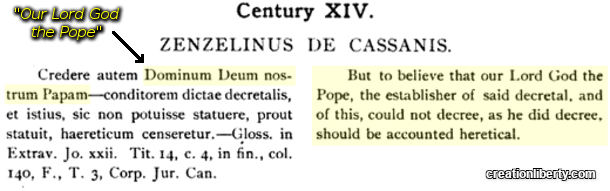
"But to believe thatour Lord God the Pope , the establisher of said decretal, and of this, could not decree, as he did decree, should be accounted heretical."
-John H. Treat, The Catholic Faith, Or, Doctrines of the Church of Rome Contrary to Scripture and the Teaching of the Primitive Church, Bishop Welles Brotherhood, 1888, p. 536, [Harvard University]
Keep in mind that most Catholics remain unaware of these facts, and many would dismiss this as fabrication—a false accusation meant to lure people away from Catholicism. That is wishful thinking. What they do not want to consider is that I care enough about Catholics to tell them the truth, even if they hate me for it.
Pope Boniface VIII (i.e. 8th, 1294-1303) declared that salvation was contingent on all mankind being subject to the Pope of Rome:
"Furthermore,we declare, we proclaim, we define that it is absolutely necessary for salvation that every human creature be subject to the Roman Pontiff. "
-Pope Boniface VIII, "Unam Sanctam", Papal Encyclicals Online, Nov 18, 1302, retrieved Apr 27, 2018, [papalencyclicals.net/Bon08/B8unam.htm]
According to the Scriptures, all salvation is contingent upon God the Father and Christ the Son:
So also Christ glorified not himself to be made an high priest; but he that said unto him, Thou art my Son, to day have I begotten thee... And being made perfect, he became the author of eternal salvation unto all them that obey him;
-Hebrews 5-9
And that from a child thou hast known the holy scriptures, which are able to make thee wise unto salvation through faith which is in Christ Jesus.
-2 Timothy 3:15
For the grace of God that bringeth salvation hath appeared to all men... Looking for that blessed hope, and the glorious appearing of the great God and our Saviour Jesus Christ;
-Titus 2:11-13
Catholic hierarchy knows that openly declaring these blasphemies would, at the very least, raise eyebrows. Perhaps not at the time, but now that the Bible has been compiled, perserved, and quickly and easily accessed by all, it would be a heavily controversial statement. Claiming this is but a mere "declaration" heavily understates the matter because Pope Boniface stated "
This logically follows, since Christ is God (John 10:30), God is holy (Psa 111:9) and the Pope is called the "Holy Father" (despite the fact that Jesus said to call no man "father" in the spiritual sense, Mat 23:9): in Catholic ideology, their Pope is God. Some readers may be shocked that I point this out, and Catholics may object to it, but the Pope has been addressed this way in Catholic hierarchy for many centuries.
Please keep in mind that the word "vicar" means a deputy or substitute, and the Pope is called the "Vicar of Christ." The following letter was received by Friar Septimus Andrews from Venetian Priest Don Marino, who translated the words of the letter he received from Cardinal Joseph Sarto, January 10, 1896:
"Dear Don Marino—I have read all the homilies I have made since my coming here in Venice, and only in the sermon for the anniversary of the election of the Holy Father, I said these exact words: 'The Pope represents Jesus Christ Himself, and therefore is a loving Father. '"
-Joseph Sarto, quoted by Marino Tommates, Publications of the Catholic Truth Society, Vol. 29, 1896, p. 11, [New York Public Library]
Thus, when I ask a Catholic who God is, and he responds with any answer except "the Pope," he does not believe Catholic doctrine. They may have taught him to say that, and he is unaware that he is spreading a false narrative. Catholicism denounces the Christian God of the Bible by making Him into a man—which carries grave doctrinal consequences.
Earlier, when discussing Muslim fallacies, I pointed out Genesis 1:26, in which God created man "in our image, after our likeness." However, if the Pope is God and Christ, then man is made in the image of man—a vicious circle that does not logically follow and amounts to nothing more than saying a thing is what it is.
This ideology violates the preconditions for intelligibility because the thoughts and reasons of men cannot justify the thoughts and reasons of men. Such a ridiculous religious system cannot justify morals, as moral goodness would then depend solely on a democratically elected Pope—stripping morality of all transcendental characteristics.
Modern Catholics will argue that the Council of Trent declared the Pope merely a "representative" of Christ. However, setting aside a vote-by-committee cult (as opposed to seeking Scriptural authority from Christ and His apostles), this creates even more problems.
Where is the authority to declare a single "representative" of Christ to speak on His behalf? If they say it is the Pope, we return to their claim of the Pope to be God. If they say themselves, then they are claiming their godhood, to exert their imagined divine will onto mankind. No such singular authority exists in Holy Scripture. These pathetic men invented their own authority by a council of hypocrites. All Christians are called to preach the Gospel of Christ; thus, there is no singular representative, for we are all ambassadors for His Kingdom.
And I will set up one shepherd over them, and he shall feed them, even my servant David; he shall feed them, and he shall be their shepherd.
-Ezekiel 34:23
God's "servant David."
And other sheep I have, which are not of this fold: them also I must bring, and they shall hear my voice; and there shall be one fold, and one shepherd.
-John 10:16
For ye were as sheep going astray; but are now returned unto the Shepherd and Bishop of your souls.
-1 Peter 2:25
And when the chief Shepherd shall appear, ye shall receive a crown of glory that fadeth not away.
-1 Peter 5:4
Catholics may retort that they can hold to the transcendental nature of God while upholding the tenets of Catholic councils, but remember how we easily exposed the inability of Hindus, Buddhists, and Muslims to account for logic and morals in their ideologies. Keep that in mind as we briefly look at Pope John Paul II's book, Crossing the Threshold of Hope, revealing that he claimed truth, holiness, and salvation can be found in all those religions:
- The Catholic Church accepts truth and holiness from all false religions. (p. 46)
- Hinduism is another means of taking refuge in God. (p. 46)
- Buddhism is a religion of Salvation. (p. 48)
- Islam worships the One True God. (p. 52)
-
The Holy Spirit is present in every religion. (p. 47)
(See Pope John Paul II, Crossing the Threshold of Hope, Knopf Doubleday Publishing Group, 1995, ISBN: 9780679765615)
If that were not bad enough, that same Pope joined hands with atheists by declaring evolutionism to be sound doctrine:
"Pope John Paul has lent his support to the theory of evolution, proclaiming It compatible with Christian faith in a step welcomed by scientists, but likely to raise howls from the religious right."
-Reuter's News Service, Oct 24, 1996; See also The Business Times, Oct 25, 1996, retrieved Dec 3, 2025, [https://eresources.nlb.gov.sg/newspapers/digitised/issue/biztimes19961025-1]
Pope John Paul II outright rejected God's account of creation in Genesis:
"The Church's magisterium is directly concerned with the question of evolution, for it involves the conception of man. "
-Pope John Paul II, Address to the Pontifical Academy of Sciences, Oct 22, 1996, retrieved Dec 3, 2025, [https://www.catholicculture.org/culture/library/view.cfm?id=80]
When the Catholic Pope declared that millions of years of random chance processes in evolutionism were "
Random mutations and natural selection cannot account for invariant, abstract, universal truths. Only an unchanging God who creates rational creatures in His own rational likeness can justify them. A so-called "god" who allegedly "creates" through blind chance is indistinguishable from the atheist's worldview of accidental, conjectural serendipity. Having traded the biblical, historical Adam for a Darwinian chimp, the Catholic finds himself in the same philosophical rowboat as the atheist—without a logical paddle—worshiping his Pope in the same way atheists worship Richard Dawkins.
Many other religions could be addressed, such as Mormonism, Jehovah's Witnesses, or Seventh-day Adventists (just to name a few), but I believe my argument has been thoroughly presented in this chapter: without faith in the Christian God of the Bible—holding fast to the principles and historical account therein—it is impossible to prove anything. Mankind's rebellion against God's judgment produces countless illogical religions and corrupt ideologies.
To summarize the transcendental argument for the Christian God of the Bible, here are three basic factors:
- The God I am referring to is immaterial, universal, and invariant. This is how we can justify immaterial, universal, invariant truth based on logical laws.
- The God I am referring to has interacted with this world, showing evidence of Himself that we might know who He is.
- The God I am referring to has left us a record of His engagements and dealings with mankind, and has taken care to preserve it for us.
Granted, I believe the vast majority of churchgoers conduct very little study or research in the same regard, despite God's command that Christians study (2Ti 2:15, Pro 15:28). Both sides often sling mud without knowledge, but because this book focuses on atheism, I have highlighted their arrogance—being unwilling to acknowledge the major logical pitfalls inherent in their worldview.
If atheism were true, what reason is there to debate? What reason is there for an atheist to get out of bed in the morning? Why spread the message of atheism at all? If they answer with anything involving knowledge, truth, logic, or morality, it only demonstrates they do not understand the arguments in this book, because their worldview cannot account for those things, leaving them begging the question.
Occasionally, you will encounter an atheist who has studied more and understands some of these arguments. Such atheists find it far easier to shift the conversation to attacking the Bible rather than defending their own flimsy worldview.
Even if the Bible were proven wrong and fallacious, that would not provide evidence for the atheistic worldview. So how do atheists get out this logical bind? They cling to a "if I can cast doubt on my enemy, I win" strategy because atheism offers nothing to defend or build upon, and thus, like various religions, attacking and destroying what they hate is all they have.
For example, Richard Dawkins does exactly what I described, as his book is much less an argument for atheism as it is an attack on anything that is not atheism. However, as educated as he is, he has some crazy beliefs, as he revealed in a 2013 interview:
"In a recent interview with the Times magazine,Richard Dawkins attempted to defend what he called 'mild pedophilia,' which, he says, he personally experienced as a young child and does not believe causes 'lasting harm.' Dawkins went on to say that one of his former school masters 'pulled me on his knee and put his hand inside my shorts,' and that to condemn this 'mild touching up' as sexual abuse today would somehow be unfair... he added, though his other classmates also experienced abuse at the hands of this teacher,'I don't think he did any of us lasting harm.' "
-Katie McConough, "Richard Dawkins defends 'mild pedophilia,' says it does not cause 'lasting harm'," Salon, Sept 10, 2013, retrieved Dec 5, 2025, [https://www.salon.com/2013/09/10/richard_dawkins_defends_mild_pedophilia_says_it_does_not_cause_lasting_harm/]
Dawkins likely said this because he fails to understand the nature of the offense. Bank robbers do not begin as bank robbers; they typically start with shoplifting or check fraud. Young people do not usually start with heavy drugs, but begin with lighter drugs like marijuana. Likewise, pedophiles do not begin by raping children; rather, they start with mild child pornography, progress to light touching, and escalate from there.
Such criminal activity demands swift punishment to deter young men and women from indulging the lusts of the flesh, lest they become the monsters they once feared. Perhaps Dawkins said this because he secretly enjoys his own "light touching"—I cannot say for sure. What Dawkins lacks is a heart of charity to protect the innocent because, not only does he show little concern for young children in this regard, but in another interview, he also declared that children with Down syndrome should be aborted.
(See Kimberly Winston, "Noted atheist stands by remarks on sexism, pedophilia, Down syndrome," St. Louis Post-Dispatch, Nov 22, 2014, retrieved Dec 5, 2025, [https://www.stltoday.com/life-entertainment/local/faith-values/noted-atheist-stands-by-remarks-on-sexism-pedophilia-down-syndrome/article_e5295ab2-e743-50d9-9350-019057a0b282.html])
Dawkins is only one of many educated atheists who say such crude and despicable things, but there is no need for surprise because such comments are expected from those clinging to an absurd and bleak worldview. This is just one example exposing the hypocrisy of those who pretend they have a leg to stand on when attacking God's Word.
Atheists hate the Bible not because it opposes atheism, but because it rebukes their sin. This explains why atheists target the Christian God of the Bible far more than any other religion. Of course, atheists hate other religions (e.g., Catholicism, Orthodoxy, Islam, Buddhism, Hinduism, etc.), but I have, at times, heard atheists come to their defense, handling them with kid gloves because those religions' weak ideology and superstitious rituals are easily refuted.
The core foundation for hatred against the Christian God is that, if (for the sake of argument) He has dominion over them, then they are sinners in the hands of their Creator, who is angry with them for their wickedness and rebellion. If their worldview were true, this should not bother them, but it does bother them because their worldview is false, and I will explain what I mean shortly.
After many discussions with atheists over the years, I can assure you that the vast majority pride themselves on being good, morally upstanding people, but how do they justify themselves as "good" in a worldview that cannot justify the existence of good? As I just said, their answer is to attack the Bible—which condemns them as the opposite of good—attempting to discredit it as a compilation of fictitious stories written and translated by various unreliable scribes throughout history.
What I find comical about this argument is that I have never met an atheist who denies the writings of the Greek philosopher Plato, who lived 400 years before Christ, but the earliest copies of Plato's writings were found at the Patmos monastery in 895 A.D. They were purchased by Edward Daniel Clarke in 1801, and now housed in the Oxford Bodleian Library. These documents possess almost no historical credibility or copies for verification compared to the massive evidence for the Holy Scriptures, but atheists readily rely on stories written and translated by the same sort of so-called "unreliable" scribes throughout history.
(See Jeremy Norman, "The Oldest Surviving Manuscript of Plato's Tetralogies," HistoryofInformation.com, retrieved Dec 4, 2025, [https://historyofinformation.com/detail.php?entryid=1880])
Atheists commonly claim that someone could have made up the Bible. This is a flimsy "what-if" argument. I find this amusing as well because, coincidentally, I have never heard an atheist provide names and dates for when the Bible was allegedly fabricated, or in other words, they have no evidence for that claim.
I have never heard an atheist argue that someone could have fabricated all the documentation about the Roman Empire. Very few original Latin Roman documents survived, as nearly all were destroyed with the Empire's fall. All surviving documentation was translated and preserved by the Greeks, and thus, if we cannot rely on ancient scholars, on what basis do atheists trust Roman history, or any other historical record for that matter?
They trust these documents in the same way we do—through logical analysis, correlating records, and archaeological evidence. The major difference is that the Bible is the most well-documented and preserved ancient text in history. We have more evidence and scholarly work supporting the Bible than supporting the American Revolution. No other document in the world even approaches the level of preservation and scholarly effort invested in the Bible, but it remains the book atheists trust the least because they hold a presuppositional, pretended-neutrality bias against it for rebuking their sin.
(Read Why Christians Should Study The King James Bible at creationliberty.com for more details.)
If some monk fabricated the Bible, then where is this elusive monk? Why do atheists raise claims of doubt but never back them with evidence of who, where, or when? Many people—both Jews and Christians—have sacrificed their lives to preserve the Word of God for future generations, so I ask: what other document in this world has received even close to equal care?
Atheists commonly assert that historians do not take the Bible seriously, but they make that claim only because they have no clue what they are talking about. For example, TIME Magazine—a secular publication—published an article titled "The Bible: The Believers Gain," which examined the studies of scientific, textual, and historical critics over the past 200 years:
"The breadth, sophistication and diversity of all this biblical investigation are impressive, but it begs a question: Has it made the Bible more credible or less? Literalists who feel the ground move when a verse is challenged would have to say that credibility has suffered. Doubt has been sown, faith is in jeopardy. But believers who expect something else from the Bible may well conclude that its credibility has been enhanced.After more than two centuries of facing the heaviest scientific guns that could be brought to bear, the Bible has survived—and is perhaps the better for the siege. Even on the critics' own terms—historical fact—the Scriptures seem more acceptable now than they did when the rationalists began the attack. "
-TIME, "The Bible: The Believer's Gain," Dec 30, 1974, retrieved Dec 4, 2025, [https://time.com/archive/6842866/the-biblethe-believers-gain/]
Atheists often make their foolish claims on the basis of conjecture alone, because the New Testament has verified copies as early as 50 years after they were written, in contrast to Plato's writings, discovered 1250 years later. Thousands of copies of various parts of the Bible were made in many languages—something almost no other document in history has. That is in addition to the Dead Sea Scrolls, which verified the copies were accurate, demonstrating that the Bible is the most verified ancient text in history.
But for the sake of argument, let us suppose the Bible was fabricated and filled with error: why is that wrong in an atheistic worldview? Atheists would first have to justify morality to have a foundation to begin to dissect the Bible. This is why I encourage Christians to hold atheists accountable to the foundations of their worldview, rather than engaging in vain discussions about the Bible's details.
I do not say this to avoid discussing the details of the Bible; on the contrary, our church holds Bible studies every week where we examine those details. However, atheists refuse to give our worldview the benefit of the doubt, despite the fact that we can answer basic question of justification that they cannot, and therefore, we ought not give their worldview the benefit of the doubt either.
Just as atheists must justify the laws of logic or relinquish using them, they must do the same with laws of morality. They cannot employ arguments of moral "good" or "evil" unless they first justify the existence of immaterial, universal, invariant concepts such as good and evil.
Although it may seem completely unreasonable for atheists to argue against moral absolutes while simultaneously attacking others on the basis of moral absolutes, in the Bible, God explains to us why they do this:
For when the Gentiles, which have not the law, do by nature the things contained in the law, these, having not the law, are a law unto themselves:
-Romans 2:14
Which shew the work of the law written in their hearts, their conscience also bearing witness, and their thoughts the mean while accusing or else excusing one another;
-Romans 2:15
Now the Spirit speaketh expressly, that in the latter times some shall depart from the faith, giving heed to seducing spirits, and doctrines of devils; Speaking lies in hypocrisy; having their conscience seared with a hot iron;
-1 Timothy 4:1
Since conflicting consciences exist on various matters, the conscience cannot justify itself. The conscience requires an immaterial, universal, invariant truth to ground it—which in turn requires an immaterial, universal, invariant God to justify it.
Atheists refuse to acknowledge this, even though they have no answer to it:
Knowing this first, that there shall come in the last days scoffers, walking after their own lusts,
-2 Peter 3:3
Paul explains the atheistic dilemma in the previous chapter of Romans:
For the wrath of God is revealed from heaven against all ungodliness and unrighteousness of men, who hold the truth in unrighteousness; Because that which may be known of God is manifest in them; for God hath shewed it unto them.
-Romans 1:18-19
For the invisible things of him from the creation of the world are clearly seen, being understood by the things that are made, even his eternal power and Godhead; so that they are without excuse:
-Romans 1:20
Because that, when they knew God, they glorified him not as God, neither were thankful; but became vain in their imaginations, and their foolish heart was darkened.
-Romans 1:21
Professing themselves to be wise, they became fools, And changed the glory of the uncorruptible God into an image made like to corruptible man, and to birds, and fourfooted beasts, and creeping things.
-Romans 1:22-23
Do not misunderstand: God is not saying that atheists make idols like the heathen, rather, the "gods" of atheism are themselves, as well as the nature around them. They worship themselves (as well as animals, plants, and insects), giving themselves the divine honor reserved for the Lord God who created all.
Wherefore God also gave them up to uncleanness through the lusts of their own hearts, to dishonour their own bodies between themselves:
-Romans 1:24
Who changed the truth of God into a lie, and worshipped and served the creature more than the Creator, who is blessed for ever. Amen.
-Romans 1:25
"Lucy was the very last part of the exhibit, but since she was the main reasonwe drove 6 hours to go to Houston... Seeing them [i.e. Lucy's bones] in person doesn't teach you much, butthere's just something magical about it. I stood and stared at her for as long as my family would let me, and had butterflies in my stomach the whole time. To look down at that little 3'-8" skeleton, knowing how long ago she lived and how closely related we are to her - no words can do justice to the feeling you get ."
-Jeff Lewis, "Review of the Lucy's Legacy Exhibit at the Houston Museum of Natural Science," Jeff's Lunchbreak, Oct 1, 2007, retrieved Dec 4, 2025, [https://jefflewis.net/blog/2007/10/review_of_the_lucys_legacy_exh.html]
This atheist author describes his visit to Lucy's bones in the same ridiculous manner that a Catholic would describe the Shroud of Turin, and the Shroud is no more the face of Jesus Christ than Lucy is a missing link for evolutionism. However, atheists worship at the altar of evolutionism in the same way Catholics worship at the altar of the Vatican—both abominations in the sight of God.
(Read "Is the Shroud of Turin the Face of Christ?" at creationliberty.com for more details.)
For this cause God gave them up unto vile affections: for even their women did change the natural use into that which is against nature: And likewise also the men, leaving the natural use of the woman, burned in their lust one toward another; men with men working that which is unseemly, and receiving in themselves that recompence of their error which was meet.
-Romans 1:26-27
Do not misunderstand the Bible on this point either, because not all atheists are queers. However, among queers, the most popular ideologies are paganism, evolutionism, and atheism, because those corrupt and nonsensical ideologies are required to justify the vile practices of sodomites.
And even as they did not like to retain God in their knowledge, God gave them over to a reprobate mind, to do those things which are not convenient;
-Romans 1:28
reprobate (adj): abandoned in sin; lost to virtue or grace
(See 'reprobate', American Dictionary of the English Language, Noah Webster, 1828, retrieved Dec 4, 2025, [webstersdictionary1828.com])
God then gives us a snap shot of what their hearts look like:
Being filled with all unrighteousness, fornication, wickedness, covetousness, maliciousness; full of envy, murder, debate, deceit, malignity; whisperers, Backbiters, haters of God, despiteful, proud, boasters, inventors of evil things, disobedient to parents, Without understanding, covenantbreakers, without natural affection, implacable, unmerciful:
-Romans 1:29-31
But those things which proceed out of the mouth come forth from the heart; and they defile the man.
-Matthew 15:18
O generation of vipers, how can ye, being evil, speak good things? for out of the abundance of the heart the mouth speaketh.
-Matthew 12:34
If you study enough, you will discover that the texts of other religions do not typically describe the character of wicked men in such detail. However, that is one of the primary reasons the Christian God of the Bible comes under attack more than any false god in various religions.
Who knowing the judgment of God, that they which commit such things are worthy of death, not only do the same, but have pleasure in them that do them.
-Romans 1:32
Adam Lee, author of Daylight Atheism wrote an article in 2007 called "On The Morality Of: Prostitution," which has been scrubbed from the atheist website on which it was originally published, but preserved by the Internet Archive Wayback Machine. Lee defended prostitution for women who chose that career path, and that is because sexual intercourse is treated by atheists as nothing more than a fun thing to do on a Saturday night:
"[R]ational, consenting adults should be able to engage in any kind of economic transaction they see fit, including the exchange of sex for money. If entered into freely,I see no reason why such an exchange should be degrading to either party ."
-Adam Lee, "On The Morality Of: Prostitution," Patheos, Nov 26, 2007, retrieved Dec 5, 2025, [https://web.archive.org/web/20201109032237/patheos.com/blogs/daylightatheism/2007/11/prostitution]
If I had to guess, Lee likely said this because he has engaged in paying prostitutes, but if that were the case, he would never admit it publicly because that would implicate him in criminal activity. Those who value the sanctity of marriage and family would never advocate for prostitution, because the sex industry destroys efficient and charitable society. Prostitutes are corrupt citizens offering an ultimately useless product, providing lazy women a career for doing nothing more than spreading their legs.
Comically, Lee goes on to claim that prostitution—what the Bible calls "whoremonger" (i.e., selling sex)—is moral, but certain actions coinciding with prostitution, such as "
This is par for the course when it comes to atheists because they just take morality for granted, despite the fact that they often disagree about morality. However, the Bible makes it very simple and clear:
Marriage is honourable in all, and the bed undefiled: but whoremongers and adulterers God will judge.
-Hebrews 13:4
But the fearful, and unbelieving, and the abominable, and murderers, and whoremongers, and sorcerers, and idolaters, and all liars, shall have their part in the lake which burneth with fire and brimstone: which is the second death.
-Revelation 21:8
Atheists can complain about the Bible—and my explanation of it—all they want, but they have nothing to answer for right versus wrong in their own worldview. They only offer opinions, typically based on personal preferences—what they personally enjoy versus what society pressures them to claim they do not enjoy.
I have often listened to the hypocrisy of atheists, telling me that the Bible does not give us any meaningful explanations. Not only can we easily proven that wrong, but to the point of this book, I have a news flash for atheists:
The Bible teaches that atheists abandon science for sin, logic for lust, and morality for malice, and because of that, according to Romans 1:32, they "are worthy of death"—meaning they deserve the highest punishments God issued to the Israeli government against evildoers in the Old Testament. The punishment of death in this regard also results in the eternal sting of death in hell. Christians have no authority to issue such punishment, for that is not our calling in Christ, but atheists are warned by Scripture that judgment for their sin is coming, and it will be harsh.
This is why I am thankful to the Lord God and the Lord Jesus Christ, not only for His blood sacrifice on the cross to pay for our sins, but also for His wonderful longsuffering and patience, even with atheists who hate Him.
The Lord is not slack concerning his promise, as some men count slackness; but is longsuffering to us-ward, not willing that any should perish, but that all should come to repentance.
-2 Peter 3:9
repentance (n): sorrow for any thing done or said; the pain or grief which a person experiences in consequence of the injury or inconvenience produced by his own conduct
(See 'repentance', American Dictionary of the English Language, Noah Webster, 1828, retrieved Dec 4, 2025, [webstersdictionary1828.com])
And this, dear reader, is why the Bible tells us that atheists are fools:
The fool hath said in his heart, There is no God. They are corrupt, they have done abominable works, there is none that doeth good. The LORD looked down from heaven upon the children of men, to see if there were any that did understand, and seek God. They are all gone aside, they are all together become filthy: there is none that doeth good, no, not one. Have all the workers of iniquity no knowledge? who eat up my people as they eat bread, and call not upon the LORD.
-Psalm 14:1-4
These things hast thou done, and I kept silence; thou thoughtest that I was altogether such an one as thyself: but I will reprove thee, and set them in order before thine eyes.
-Psalm 50:21
Am I arguing that I am better than atheists? Not at all. I am guilty of being a filthy, wicked sinner as they are, but I have been saved and healed by the Lord Jesus Christ, and any quality I have that is better than the atheist is because of Christ, not myself.
What then? are we better than they? No, in no wise: for we have before proved both Jews and Gentiles, that they are all under sin; As it is written, There is none righteous, no, not one: There is none that understandeth, there is none that seeketh after God.
-Romans 3:11
And he said unto them, These are the words which I spake unto you, while I was yet with you, that all things must be fulfilled, which were written in the law of Moses, and in the prophets, and in the psalms, concerning me. Then opened he their understanding, that they might understand the scriptures, And said unto them, Thus it is written, and thus it behoved Christ to suffer, and to rise from the dead the third day: And that repentance and remission [i.e. forgiveness and full pardon] of sins should be preached in his name among all nations, beginning at Jerusalem.
-Luke 24:44-47
John did baptize in the wilderness, and preach the baptism of repentance for the remission of sins.
-Mark 1:4
From that time Jesus began to preach, and to say, Repent: for the kingdom of heaven is at hand.
-Matthew 4:17
And he called unto him the twelve, and began to send them forth by two and two; and gave them power over unclean spirits... And they went out, and preached that men should repent.
-Mark 6:7-12
But shewed first unto them of Damascus, and at Jerusalem, and throughout all the coasts of Judaea, and then to the Gentiles, that they should repent and turn to God, and do works meet for repentance.
-Acts 26:20
And GOD saw that the wickedness of man was great in the earth, and that every imagination of the thoughts of his heart was only evil continually. And it repented the LORD that he had made man on the earth, and it grieved him at his heart.
-Genesis 6:5-6
For godly sorrow worketh repentance to salvation not to be repented of: but the sorrow of the world worketh death.
-2 Corinthians 7:10
In meekness instructing those that oppose themselves; if God peradventure will give them repentance to the acknowledging of the truth;
-2 Timothy 2:25
Him hath God exalted with his right hand to be a Prince and a Saviour, for to give repentance to Israel, and forgiveness of sins.
-Acts 5:31
But the scripture hath concluded all under sin, that the promise by faith of Jesus Christ might be given to them that believe. But before faith came, we were kept under the law, shut up unto the faith which should afterwards be revealed. Wherefore the law was our schoolmaster [i.e. our teacher and instructer] to bring us unto Christ, that we might be justified by faith.
-Galatians 3:22-24
This is why we ought to preach the moral commandments in the law of God to atheists—such as thou shalt not steal, thou shalt not kill, thou shalt not commit adultery, and thou shalt not covet, just to name a few. We use God's law to reveal to them the wickedness that spews from their mouths and that everlasting punishment is coming for them unless they come to repentance.
Their throat is an open sepulchre; with their tongues they have used deceit; the poison of asps is under their lips: Whose mouth is full of cursing and bitterness: Their feet are swift to shed blood: Destruction and misery are in their ways: And the way of peace have they not known: There is no fear of God before their eyes. Now we know that what things soever the law saith, it saith to them who are under the law: that every mouth may be stopped, and all the world may become guilty before God.
-Romans 3:19
The longer version, There is No Saving Grace Without Repentance, has much more Scripture and detail, showing how the doctrine of repentance does not mean to "turn" or "change," as many pastors erroneously teach. That is what the word 'conversion' means. Repentance has always been grief and godly sorrow of past conduct, and this doctrine is taught throughout the Bible, even in many places where the word 'repent' is never used.
The LORD is nigh unto them that are of a broken heart;
and saveth such as be of a contrite spirit.
-Psalm 34:18
My hope for atheists is that some might read this and have the Spirit of God work in their hearts and minds to unlock their understanding, that they might come to repentance and faith in Christ. My hope for Christians is that you would be better equipped to handle debates with atheists, stop wasting time on rabbit trails, and start preaching the law of God to lost sinners, that they might repent and believe the Gospel.
The law of the LORD is perfect, converting the soul:
the testimony of the LORD is sure, making wise the simple.
-Psalm 19:7
Now after that John was put in prison, Jesus came into Galilee, preaching the gospel of the kingdom of God, And saying, The time is fulfilled, and the kingdom of God is at hand: repent ye, and believe the gospel.
-Mark 1:14-15
No matter what worldview you hold, I hope the Lord Jesus Christ will show you and your family mercy, providing for all your needs. Take care, and feel free to contact me on my website if you have any questions.













Reader Discussion
Scripture-based insights and questions welcome. First comment requires approval.