




Biblical Marriage Uncompromised
God's Design Without Worldly Compromise

- My View vs Modern Pastors?
- Why Reject Five Love Languages?
- Are You Too Harsh on Women?
- Spouse Refuses Biblical Roles?
- Thoughts on Arranged Marriages?
- Property Ownership Without License?
- Filing Taxes Without Marriage License?
- Trusting Spouse Without License?
- Church Response to Divorce?
- Dissolving Our Marriage License?
At the turn of the 21st century, a shocking two-thirds of American marriages ended in divorce. Although some have expressed relief that the number of divorces has slowly declined over the first quarter of this century, it is not because marriages have become more stable. The reason divorce rates are falling is that the marriage rate in the United States has been cut in half over the past 100 years (i.e. from 12 per 1,000 annually to 6.1), and thus, fewer marriages simply mean fewer divorces.
(See National Center for Health Statistics, "Marriage and Divorce," retrieved Jan 7, 2026, [https://www.cdc.gov/nchs/fastats/marriage-divorce.htm])
The next generation clearly needs a stable foundation from which to build a marriage, and that is the purpose of this book. Although I have written it primarily for born-again Christians, many basic philosophical principles in these pages can benefit anyone. They show how to choose the right mate, build a strong relationship on the bedrock of loyalty, faithfulness, honesty, hard work, and trust, and become a guidestone for future generations.
Some readers may see couples who appear to be the "perfect" couple, always smiling and laughing, but let me assure you that no such "perfect" couple actually exists. You do not see the struggles that go on behind the scenes to produce that appearance. A happy marriage is not created by accidentally stumbling into the "right" person; rather, it is built on a foundation of work that bears fruit in due time.
Please note that no single book on marriage will teach you everything you need to know, and that includes this one. Any author worth his salt will tell you the same. However, my goal in this book is to teach you a basic way of thinking (i.e. philosophy) when approaching dating and marriage, and if you abide by these basic principles, your odds of having a long-lasting marriage will be much higher than those who waltz into dating and marriage haphazardly.
Keep in mind, this will require you to change the way you think, and most likely abandon some things you were taught by your family, religious institutions, schools, and society in general. I am not saying I have all the answers, but at the time I wrote this book, I had a marriage to my first and only wife that has lasted nearly two decades. We both agree we are stronger together now than we have ever been, so you can draw your own conclusions about whether what I teach is true and effective.
The heart of the righteous studieth to answer:
but the mouth of the wicked poureth out evil things.
-Proverbs 15:28
The younger generation blames the elders, and the elder generation blames the young, but both are at fault. As a society, we have all played a role in the degradation of our culture, one way or another. Ultimately, finger-pointing will not solve the problem; rather, well-reasoned doctrine on marriage—as well as leading by example—will set the stage for a return to prosperous households and families.
Prepare yourself for what you are about to read, because you have likely never heard some of these things before. Some points I make might shock some readers. I have read numerous books on marriage and relationships, yet not one of them even attempted to address the matters I will teach you in this book.
This is a short list of general principles you will learn:
- In the Bible, no religious leader was ever given authority to marry two people.
- Marriage ceremonies, and other traditions such as wedding rings, are based on pagan ideology, not Biblical tradition.
- Marriage licenses from the state are not marriage; they are risky property contracts.
- Dating based on common interests creates a high probability of divorce.
- Long-term dating is a modern fad that is unnecessary for a good marriage.
Beware lest any man spoil you through philosophy and vain deceit after the tradition of men, after the rudiments of the world, and not after Christ.
-Colossians 2:8
If you are already married, you may be tempted to skip this chapter, but this information is vital—both to understand your own marriage and to teach your children in the way they should go. (Pro 22:6) If you are not married, you may be struggling to find a suitable mate. In this chapter, I will teach you the basic principles you need, not only to discern who is best for you, but also where to find such a person.
Before we begin, I need to urge readers to avoid a trap that most people fall into when searching for love interest. Read and consider this warning:
common interests or hobbies.
The reason I opened the chapter with this is because I want readers to consider a fundamental question:
One of the principles few people seem to understand is that, once you are married, you will spend 90% of the day apart from your spouse. You will not work in the same place or be in the same room most of the time, because men and women have different roles with different duties based on different priorities.
Males are generally providers, sacrificing their time and energy, using their strength and intellect to bring resources into the household that nurturing females should use wisely for the needs of the family, producing the best quality possible in both home and child care. If both spouses spend most of their days apart from each other, what matters most is that they have a common PHILOSOPHY (i.e. way of thinking), not common interests.
Men and women rarely share common interests, because they have different roles that lead them to make different choices about how they spend their time. There is a very good reason why the vast majority of construction jobs are dominated by men, and the vast majority of nursing jobs are dominated by women. If any reader is unfamiliar with this or thinks that the differences between males and females are just socially constructed stereotypes, I would encourage you to read my book, Feminism: Castrating America, to get the facts.
Men, please consider: If you spend at least 50–60 hours per week apart from your wife, you must be able to trust her with your home, children, and finances. So do you want to marry a woman who shares your hobbies? Or do you want to marry a woman who shares your philosophy about morals, family, and work ethic? Which is the more important quality in a spouse? If, God forbid, you end up marrying a woman who is lazy, mean, or abusive, will it make any difference if she shares your passion for hunting, cars, or sports?
Women, please consider: If you spend most of your days apart from your husband, trusting him with your protection, leadership, and financial security, do you want to marry a man who shares your hobbies? Or do you want to marry a man who shares a common philosophy about morals, family, and work ethic? Which is the more important quality in a spouse? If, God forbid, you end up marrying a man who is lazy, mean, or abusive, will it make any difference if he shares your interest in music, books, or art?
This is not to say that you will never find commonality of interests with your spouse, but common interests are not important in a marriage. Failed marriages fail because of bad philosophy, and couples spin their wheels in vain trying to "respark" a marriage by pursuing activities of common interest. In fact, many couples discover new common interests as they grow and learn together, which means that personal preferences and interests should not be the foundation for a marriage.
This is why the typical American "dinner-and-a-movie" dating scenario does not help a couple discover their common philosophy—especially since the modern "wine-and-dine" routine is designed to end in fornication. Please do not misunderstand my point: I am not saying it is wrong to sit down to dinner with a man or woman to get to know them better, since growing closer can begin over a meal; rather, I am simply pointing out the purpose of that tradition in American society.
If we face the reality of the situation, the person sitting across the table can say anything they want you to hear. If you are romantically and lustfully infatuated enough with that person, you will believe whatever they say, whether it is true or not. In other words, you will obtain only a small and limited amount of information and evidence about that person by eating with them.
In most cases, a person's true philosophy is demonstrated by the little things they do in their daily routines, not by the punctuated events they attribute great importance to, such as a date. A man might seem very helpful and gentle on a date, but once the woman marries him, he turns out to be angry and abusive in daily life; likewise, a woman might seem very loving and caring on a date, but once the man marries her, it becomes clear she used and abused him for his money, and now she makes his life miserable.
Dating spurs people to put their best foot forward, presenting a "best-behavior" impression of the other person rather than revealing who they truly are on the inside—the moral foundation that drives their daily habits. That true character is more clearly observed by spending time with them alongside their family, friends, and/or co-workers. For Christians, this can be easily done in the context of the church, but if there is no one in your church whom you could marry, the question I most often hear is: How do I meet people?
I will answer that question shortly, but before we do, there is a more important question that often never gets asked: Should I date? This is a term we have not yet defined in this context, but let's define it from a standard dictionary:
date (n): a social appointment or engagement arranged beforehand with another person, especially when a romantic relationship exists or may develop
(See 'date', Random House Dictionary, 2026, [dictionary.com]; See also Collins English Dictionary, 10th Edition, William Collins Sons & Co, 2012)
Before establishing how the concept of "dating" has been corrupted, there is another term we need to define:
court (v): to try to win the favor, preference, or goodwill of: to seek the affections of; woo
(See 'court', Random House Dictionary, 2026, [dictionary.com]; See also Collins English Dictionary, 10th Edition, William Collins Sons & Co, 2012)
woo (v): to seek the favor, affection, or love of, especially with a view to marriage
romantic (adj): fanciful; impractical; unrealistic, imbued with or dominated by idealism, a desire for adventure, chivalry, displaying or expressing love or strong affection, ardent, passionate, fervent
(See 'woo' & 'romantic', Random House Dictionary, 2026, [dictionary.com]; See also Collins English Dictionary, 10th Edition, William Collins Sons & Co, 2012)
Why is this distinction important? Well, if the other person has already been won over, what is the purpose of the date? Why not just get married? Clearly, some other motivation, goal, or fear is holding back one or both parties, so they continue to date. Many people do not realize that this is like going into a dealership to test drive a car over and over again, but never buying it.
This verse in the Bible uses the word "uncomely" in a specific way:
But if any man think that he behaveth himself uncomely toward his virgin, if she pass the flower of her age, and need so require, let him do what he will, he sinneth not: let them marry.
-1 Corinthians 7:36
To woo someone means that you are working to gain their favor and affection, focusing charitably on the other person to show the value you can bring. However, romance is more self-serving: it expresses favor and affection tied to unrealistic or idealistic notions, using fanciful imagination to view things as you want them to be rather than as they truly are.
To put a finer point on it, the older terms "court" and "woo" are much more Biblical in their meaning, because they are selfless: they focus on the other person, establishing a charitable and reasonable foundation for the relationship, with the full intent that the arrangement should end in marriage. However, the modern terms "date" and "romance" are selfish: they focus on one's own desires in an attempt to create a deceptive and unreasonable sense of wonderment, which often does not have marriage as the primary goal.
The goals of dating are often unwritten implications, never spoken aloud because the conscience leaves one or both parties embarrassed. The reason "court" and "woo" have been abandoned by our culture is that American society now accepts fornication outside of marriage. As a result, many young Americans sleep together in a "boyfriend/girlfriend" dating relationship, adopting the intimacy of marriage without dedicating themselves to a lifelong commitment.
I cannot emphasize enough that this is NOT a good idea. Although fictional media portrays it as glamorous, in the end, people suffer grave consequences they prefer to keep hidden. Such consequences include, but are not limited to: high risk of sexually transmitted diseases, pregnancy out of wedlock, damaged reputation, difficulty finding a suitable spouse for marriage later, higher risk of future divorce, bonding and intimacy issues, and above all, it is a sin that God has condemned with harsh consequences.
Marriage is honourable in all, and the bed undefiled:
but whoremongers and adulterers God will judge.
-Hebrews 13:4
Flee fornication. Every sin that a man doeth is without the body; but he that committeth fornication sinneth against his own body.
-1 Corinthians 6:18
Nevertheless, to avoid fornication, let every man have his own wife, and let every woman have her own husband.
-1 Corinthians 7:2
The delusion of modern young men and women is that everything they are doing mimics what a married couple does, yet without getting married. They want all the benefits of marriage without the commitment, keeping a red emergency button ready to abort the relationship whenever things get a little tough, which is neither loving nor helpful to anyone.
Young men and women often dream of having a healthy marriage and a happy family, and it is achievable—but only through discipline and patience. If you give in to the lusts of the flesh, you will only destroy your opportunities. Therefore, you must change your way of thinking and keep your focus on the goal, rather than following the fleeting feelings of sexual attraction and common interests.
This brings us back to the question: How do I meet people? Where should I go? What should I do? I will provide a number of suggestions, but my first and most important suggestion is what NOT to do:
What is the financial bottom line of a match-making company? Where do they generate revenue? They need people to subscribe to their services, but what happens if you find a match?
As soon as a man and woman are married, the match-making company loses two subscribers, so ask yourself: Is it profitable for their industry to ensure you find a good match? Their companies generate revenue from people remaining perpetually single, and if you think they do not develop their applications and profiles around their bottom line, you are naïve.
And this is nothing new—this problem has persisted since dating services were invented. In 2007, Live Science reported on a study in which professors from various colleges were hired by online dating services to investigate why "
"A new study of romantic relationships finds that as online daters got to know another person over time, their initially sweet notions turned sour.The researchers suggest that inflated expectations can lead to major disappointments when daters meet in person. Once a flaw is spotted, the whole date is tainted. "
-Jeanna Bryner, "Online Dating: Why It Fails," Live Science, Feb 12, 2007, retrieved Jan 8, 2026, [https://www.livescience.com/4348-online-dating-fails.html]
Why were both parties looking for a flawless person? Because they sought a "romantic date" instead of courting to woo. They create a "romantic" idea in their minds, forming an imaginary person that does not exist, and set their expectations to an unrealistic standard, which resulted in near-immediate rejection because reality cannot possibly manifest their idealistic mate.
Do not misunderstand—this is NOT about looks. Although physical attractiveness certainly plays a role, especially in the eyes of men, the reason the date turned sour is that the other person says or does something that contradicts the philosophy of the hearer.
Match-making profiles are not set up to determine someone's general philosophy and find a suitable mate; rather, they are designed to identify common interests, to get people to go on dates, so subscribers can see "results." If subscribers get dates, they fall under the delusion that the service is working for them, but the vast majority are either left without dates or, after many failed ones, become fatigued and despair.
Dating sites and apps push common interests heavily, but if you marry based on common interest in (for example) movies, you will divorce quickly because movies will not hold a marriage together. If you marry based on a particular activity, once that activity becomes stale or one spouse can no longer participate, the marriage will fail. If you marry based on physical attractiveness, you will divorce when that attractiveness fades over time. However, if you marry based on a common philosophy (i.e. way of thinking), your chances of having a long-lasting, successful marriage greatly increase.
Some readers might be irritated that I have not yet revealed where to meet people, but understanding this concept will help you know where to go and what to do. Dating services have no systematic way to determine if your general philosophy matches someone else's. Therefore, where you meet someone can either be a great hindrance or a major contributing factor to the vetting process.
Later, once I tell you where to go to meet a proper husband or wife, you will likely discover that you must first change your own philosophy before you can attract someone suitable for what you want. In the vast majority of cases, the reason you struggle to meet someone you want to be with is not that you are in the wrong place, but that you do not yet meet the requirements of what you need to become in order to attract the opposite sex.
If you work hard to change yourself into what the opposite sex needs in a marriage, you will find it much easier to find and attract a mate. In general, there are three qualities you need to look for in a spouse, and they happen to be three things that you need to become as well:
- Honest
- Humble
- Hard-Working
For example, if people continually tell you they will be somewhere or do something but fail to follow through, it shows they are not honest. If they are often unpunctual, it shows they do not take their word or consideration of others seriously, and that is another red flag of dishonesty.
red flag (n): a danger signal
(See 'red flag', Random House Dictionary, 2026, [dictionary.com]; See also Collins English Dictionary, 10th Edition, William Collins Sons & Co, 2012)
A red flag is something to take note of, not a basis for drawing conclusions from a single occurrence. However, when many red flags accumulate, they form a pattern that reveals an overall philosophy, indicating that the player should be removed from the field.
If you are not a person who does what you say you will do, and you do not show up on time as promised, then you need to change your philosophy. You cannot expect an honest person to agree to marry you if you are not also honest, because you must become what you want to see in others.
If you are an easily angered or irritable person who cannot calmly take things in stride and cheerfully admit when you are wrong, then you need to change your philosophy. Humility is part of a charitable spirit and an extremely important quality for handling conflicts in marriage, so you must first become the change you want to see in others.
If you are a lazy person who lacks self-motivation to get things done, then you need to change your philosophy and habits. If you are going to share your time, efforts, resources, home, and family with another person for the rest of your life, and you want someone who will work hard to benefit everyone, then you must become the type of person you want to be with.
Start with small things in your daily life. Create small habits. Pick one or two things in your routine and force yourself to change them. As you grow accustomed to those changes, select one or two more to work on. If you remain consistent, over the course of weeks and months, you will see your philosophy and habits begin to change.
Again, you cannot expect to meet someone who exhibits these qualities until you first exhibit them yourself. If you believe you generally live according to all three of these principles, then the next step is to know how to watch for the red flags in those who do not live by them.
There are many people who will try to deceive you into believing they possess these qualities when they do not. This is why it is important, when seeking a spouse, to set aside emotion and examine things objectively.
Suppose a man tells a woman that he never drinks alcohol, but she later talks with his friends and learns of a recent bachelor party where he was drinking with them—that is a red flag of dishonesty. Suppose a woman tells a man that she quit smoking, but he finds a half-used pack of cigarettes in her glove compartment—that is a red flag of dishonesty. It is best to ignore the excuses and get out of that relationship before it begins, because the hurt you might experience now will pale in comparison to the hurt you will experience later.
Suppose a woman meets a man's family and observes him constantly talking over others, boasting about himself, and belittling them—that is a red flag of a prideful heart. Suppose a man meets a woman and she continually ignores his accomplishments while deflecting responsibility for her own errors—that is a red flag of a prideful heart. Politely depart from such people, because later in life, when arguments arise, you will end up living miserably with someone who cannot humble themselves to acknowledge their own flaws.
Suppose a woman meets a man who expects her to handle all the planning while he lives in a messy home—that is a red flag of laziness. Suppose a man meets a woman who considers herself entitled to meals and gifts while driving a car with an interior full of trash—that is a red flag of laziness. Believe me when I tell you that being in a relationship with a lazy person will drive you insane, because you will have to shoulder twice the effort for even the basic duties in the household.
Perhaps one day these people might change, but it is unwise for you to wait for it. The change may never come, and even if it does, it could take 20 years or more. You do not have time to wait for someone to become what you need. Therefore, find a person who already possesses those good qualities now, and do not compromise with someone who will cause you much headache down the road.
You do not need to seek a man or woman who is flawless in all aspects of life; rather, I am advising you to look for signs of a good philosophy. These signs can appear in many places and circumstances. Although there are some similarities between men and women, there are far more stark differences between them, and you should remain watchful.
Let's consider a list of good traits for men and good traits for women. This will help clarify where you should go to meet people. Some of these qualities both parties should strive to develop, but there are stark differences based on the distinct roles of men and women. These are the traits you should work to become (in your own role as a man or woman) if you want a high-quality spouse:
Strong • Tough • Good Reflexes • Intelligent • Confident • Resourceful • Good Income • Leadership • Protective • Optomistic • Influential • Powerful • Calm • Soothing • Smooth • Fun • Respectful • Trustworthy • Dependable • Good Reputation • Committed • Skilled • Wise • Self-Controlled • Persistence & Perserverance • Masculine Voice • Fitness • Hygeine • Posture • Cleanly & Smartly Dressed • Intolerant of Evil • Disciplined • Reasonable • Listener
Warm • Kind • Gentle • Nurturing • Empathetic • Compassionate • Affectionate • Supportive • Encouraging • Graceful • Soft-spoken • Patient • Forgiving • Understanding • Loyal • Respectful • Trustworthy • Appreciative • Grateful • Playful • Joyful • Light-hearted • Fun • Classy • Teachable • Peaceful • Virtuous • Self-judging • Fitness • Hygeine • Beauty • Posture • Modesty • Virginity • Smartly Dressed • Moral • Disciplined • Reasonable • Listener
Look over the traits of the opposite sex and decide if that is what you want to see in your spouse. If you want to marry someone who possesses those qualities, then examine the qualities expected of your own sex and become a person who exhibits them.
Do not make the mistake of merely creating an appearance for the purpose of meeting people—that will not deceive an honest, humble, and hard-working person. Rather, work to change your way of thinking and habits so that you become a higher-quality person to whom others would naturally be attracted.
It should be noted that the qualities of men generally take longer to develop than those of women. Therefore, it is common for older men to marry younger women. Not only do men require more time and experience to become good husbands and fathers, but women can bear more children in their youth. Thus, it is not unreasonable for a young woman to marry a man who is five, ten, or even twenty years her senior.
Men are the providers, protectors, and leaders, and therefore men must work on qualities that make them more effective in those roles. If you are going to protect your family, you should exercise to build physical strength, becoming a credible threat to evildoers. This can also increase your ability to provide, while building confidence in your capacity to handle any physical situation—which in turn strengthens your leadership.
Take a look at yourself in the mirror and be critical. What do you see? Are you fit? How is your hair and clothing? Do you keep yourself clean and dress well? Perhaps you are an honest and hard-working man, but whether you like it or not, others form their first impression of you based on sight and smell. It is better to leave people with a good impression than a negative one.
Study and learn what you need to know. Observe other sharply dressed men who exhibit proper masculinity. How do they present themselves? How do they carry themselves? Watch and learn, then make the necessary changes. Remember that even these small improvements in your life demonstrate positive characteristics, like discipline, intelligence, and observation, which will make you more attractive to women.
Women are the nurturers, homemakers, and supporters, and therefore women must work on qualities that make them more effective in those roles. If you are going to raise a good family, you must set a good example by being disciplined in your own fitness—for the sake of your husband, to provide the beauty he needs in his life, and to show your children healthy habits they will carry into adulthood to help them succeed.
Ladies, can you make a loaf of bread from scratch? What homemaking skills do you possess that a man could not simply obtain by hiring a cleaning lady once a week? You ought to work on cooking, sewing, gardening, and other smart homemaking skills. These enable you to transform your husband's (i.e. your king's) castle into the most luxurious and comfortable palace you are capable of creating, providing the most delicious and healthy food for his well-being, and serving him cheerfully and willingly.
Study and learn from other women who are good homemakers. Observe how they present and carry themselves. Watch and learn, then make the necessary changes. Remember that even these small improvements in your life demonstrate positive characteristics, like discipline, servitude, and attention to detail, which will make you more attractive to men.
If I had to sum up everything I mentioned into one word, it would be 'charity'.
charity (n): in a general sense, love, benevolence, good will; that disposition of heart which inclines men to think favorably of their fellow man, and to do them good
(See 'charity', American Dictionary of the English Language, Noah Webster, 1828, retrieved Jan 9, 2026, [webstersdictionary1828.com])
And thou shalt love the Lord thy God with all thy heart, and with all thy soul, and with all thy mind, and with all thy strength: this is the first commandment. And the second is like, namely this, Thou shalt love thy neighbour as thyself. There is none other commandment greater than these.
-Mark 12:30-31
For all the law is fulfilled in one word, even in this;
Thou shalt love thy neighbour as thyself.
-Galatians 5:14
Dear readers, I cannot emphasize enough that you must develop a charitable heart in selflessness. Train continually to become what the opposite sex needs in a marriage, and do so in preparation BEFORE meeting that person.
This is why I did not initially tell you where to go to meet someone: understanding these principles is imperative BEFORE meeting anyone. If you do not grasp these concepts first, you may meet someone wonderful, only to be rejected when you fall short of what that person needs in return.
Improve yourself first. Both men and women should begin fitness routines and adopt healthy diets. If you want help with that, I have written a book called The Simple Solution to Cancer that provides sound advice backed by thorough research and references.
Talking to yourself in the mirror teaches you how you appear to others. This allows you to improve your posture, facial expressions, hand gestures, and speaking ability. Men should work to advance their talents, jobs, careers, and businesses, while women should practice domestic skills such as cooking, childcare, accounting, gardening, and the like.
Once you have put in sufficient study and application of these things—putting in months, if not years, improving yourself—then you can focus on finding a charitable spouse. Now we can ask the important question: where do you go to find a potential mate?
This question is far more often asked by men than by women, because women tend not to have difficulty finding potential suitors. Often, women need only improve their appearance, go out in public, and wait. Men, however, face a much greater challenge, because upon initial meeting, women tend not to like men.
I am not saying that women do not like men in general, but in most cases women are fearful of men—especially in this day and age, when they have been brainwashed with feminist propaganda to believe that all men are nothing more than vile, heartless sex beasts. (See my book Feminism: Castrating America for details.) Some men are indeed looney and wicked and should be avoided, but most men are not that way. Men, you complain about the situation, but complaining will never change the nature of women. Therefore, we must find a way for women to get to know men, because once they do, female attraction to men increases dramatically.
So to meet a charitable person, you need to become a charitable person. Once you are a charitable person, it becomes easier to understand what you should do:
meet charitable people?
If you attend these events or church buildings, volunteer your time and effort, and even if no single women are available, do it anyway. Every person working at that event will bear witness to your charitable hard work, and although they may not be candidates for marriage, charitable people know other charitable people. Wherever you are volunteering, the people there know other men and women, and can introduce you, as charitable people tend to love helping kind men and women find each other and get married.
Since you are getting fit, participate in a charity run. Attend annual campaigns and volunteer. You will often be put into groups where you can interact socially and meet people.
Movies and fiction novels have created the idea that you meet your spouse through serendipity, but that almost never happens, and is the product of romanticism, which is a plague on our society. It might feel good to imagine, but it is not grounded in reality. Rather, you need to start building a social network in charitable circles, and as long as you continue to work on self-improvement, you will find yourself with options.
If we consider all I have instructed you to do so far, it should be clear that very few people make this effort, which is why they cannot seem to find anyone suitable. Ultimately, the main culprit of failure in the dating world is one's own philosophy, and that changing oneself, while abandoning modern dating culture, is the only way to increase the chances of success. God made men, and then He created women FOR men. Therefore, if you want to understand women, first understand the purpose and function of men, and stop asking women about it.
When I was young, I wanted to know how to get a girl interested in me, and I made the tragic mistake of asking women. This is common among young men who lack a trusted father figure or who feel embarrassed to ask other males, fearing mockery and ridicule for appearing weak or ignorant.
Women seem like the safe choice to ask, and young men assume women know what women want. However, you should never ask women these questions because, in most cases, women do not truly know what they need and rely on men to tell them what they want.
This is not to say women are stupid, but they have natural desires placed in them by God and process things through feelings rather than rational lines of inquiry. Therefore, you cannot expect a logically consistent answer from them. Even on the rare occasion a woman knows what is good for her and what a man should become to be a good husband, she usually cannot—or will not—articulate it clearly to you.
Do not misunderstand—women will give you an answer if you ask, but it will rarely be the one you need. They often hide the truth from you, and there are many reasons this occurs:
- Women expect men to understand these things for themselves. They do not want to have to guide men on what they should say and do because that is an automatic turn-off.
- Women are shame-faced by their created nature (1Ti 2:9), meaning that, their true desires are embarrassing to them, and shame is the bane of females. They will do anything, including lie, deceive, and tell half-truths to avoid being embarrassed.
- Women cannot fully articulate what they want. Their desires are swirling in a sea of emotions, and they rely on men as a pillar of stability.
Many young men have been told this by women, and later, the young men become bitter because they feel like they were lied to, but it is not a lie—they do want men to be nice to them. However, they will not tell you the other half of this truth because it is embarrassing; so from one man to another, here is the whole answer—the entire truth she should have said to you:
To some of you, it sounds as though women are asking for the world, and in a sense, they are. They need you to be everything. This is why our feministic society has become so backwards from reality: it claims women are the prize, when in truth, strong and resourceful men are the prize, and women will viciously compete with one another to be chosen by those men.
The reason I say "chosen" is that men are the gatekeepers to relationships. Men have a strong desire for sexual intercourse with a woman, and women are the gatekeepers of sex. Women have a strong desire for a relationship and marriage to a powerful man, and men are the gatekeepers of marriage.
Men cannot force a woman to have sex without legal consequences, and women cannot harass a man into a relationship without legal consequences. Both parties possess something the other wants, but young men often fail to understand what they must become in order to be what women need. This leaves them confused as to why girls tell them to "be nice" while those same girls pursue the boys who are not nice to them.
What those girls will not tell you is that they are physically attracted to boys who are "bad"—in other words, boys who do dangerous things and force their will on others. This exhibits power, and women grow weak in the knees for a man who is powerful.
Do not misunderstand—this does not mean you should become a bad person like those "bad boys." Rather, you should work to gain strength, social influence, and leadership skills that make you reliable. The women who fall for bad boys are often left disappointed because what they truly need is a combination of the bad boy's traits and the nice guy's traits.
I created a chart to help men understand this. I call it the "Female Attraction Matrix," and it shows what women actually think—but will never say aloud:
![The Female Attraction Matrix - Helping Men Understand How Women Think [creationliberty.com]](../images/marriage19.png)
There are two primary meters you need to consider, labeled "Security" and "Danger." Men must be dangerous—a credible threat to wicked men and violent beasts—so they can protect women and children. At the same time, they must offer security in a loving environment where they provide for women and children.
The more security you provide, the higher you move up the chart. The more dangerous you are, the further you move to the left. The goal is to be both dangerous and secure at the same time, to put yourself in the husband zone.
Let's cover each of the four quadrants:
- INVISIBLE CREEP: If you offer little to no danger or security, you will find it difficult to meet women—and they will often avoid you altogether. In fact, most women will not even notice you exist, because you are not on their radar. There is nothing about you to notice. On the rare occasion one treats you with kindness, it is usually out of pity, not interest. Escaping the "Invisible Creep" quadrant requires much work, but any man can do it, no matter his disadvantages. There is no better day to start than today.
- NICE GUY: The saying "nice guys finish last" exists because women often keep them on a leash, but always at arm's length. This is commonly called the "Friend Zone." Women use nice guys for their resources and perhaps a shoulder to cry on, but they never enter a relationship with them because they feel no sexual attraction to weak men. Foolish men in this position cling to false hope, sometimes for years. If you find yourself here, the problem is that you pose no threat to the world around you. You must work on your strength, assertiveness, and confidence, and learn to boldly detach yourself from women who use you. This will make you more attractive overall.
- BAD BOY: These men attract women readily because women feel sexual attraction to dangerous men. Some fail to understand this, but consider famous criminals—even serial killers—receive love letters from adoring female fans while in prison. Women nicknamed "buckle bunnies" hang around rodeos to go home with winners of roughstock competitions. Yet these men often lack the secure provision and comfort women need. They use and abuse women, provide nothing lasting, then discard them when bored. You must be a dangerous man whom women work to win affection from, but you must balance that danger with security and consideration.
- MR. RIGHT: This man strikes the proper balance between Bad Boy and Nice Guy, because both possess traits that attract women. You must exhibit equal measures of security and provision with masculine edge and excitement. Perhaps he is a Jiu-Jitsu master who can dominate other men yet gives her private self-defense training to keep her safe. Perhaps he is an entrepreneur who shows confidence and leadership in business while training with firearms and carrying a pistol to protect her. Perhaps he is a mechanic with a motorcycle who takes her riding and hiking to beautiful places, demonstrating confidence, adventure, and the skills to provide for a family. If you want to expand your options and choose the wife you desire, you must become a gentle beast—a calm, cool alpha who can handle any situation that arises in life and marriage.

If you feel like you are starting at the bottom, that is okay, because we all have to start somewhere. Here are a few suggestions of thing you can do to start changing yourself, to form good habits:
- As soon as you get out of bed, make your bed. If you do not know how to do it properly, find videos online and learn. Research "how to make hospital corners on sheets" and start doing it every day—no excuses.
- Pick one room or section of the house to clean and organize. Start with your bedroom or kitchen. Make a list of tasks that need doing, and spend a little time every day focusing on just one.
- Do one uncomfortable thing deliberately each day. Learn to say "no" to instant gratification. Begin with easy things: take the stairs instead of the elevator, wait 15 minutes before checking your phone or eating in the morning, or skip a comfort item like snacks or music during a walk or drive.
- As soon as you finish eating, force yourself to wash the plate and cup immediately. If you have a habit of throwing clothes on the floor, get a hamper and put them in it. Put bottles and wrappers in the trash right away—do not leave them lying around.
- Place your alarm clock across the room, out of arm's reach. Force yourself to get out of bed the moment you hear it.
In a short time, you will notice they become easier. When you see this in yourself, it is a sign you are beginning to transform—commanding your body to do what you will, and becoming master of your domain.
As these habits grow easier, add one or two more to the list. Keep growing. Keep changing. In due time, maintaining these good habits will become gradually easier, and you will begin doing them automatically, without need of a list.
Eventually, others will notice the change. As you change, so will your inner circle of friends. You will meet people who think as you do, and through them, you will meet the type of woman you want for a wife.
The first step is to get motivated. Stop being depressed and acting entitled, as if the world owes you a wife. You must make things happen in your own life. For Christians, discipline yourself to do what is right according to the commandments of Scripture, and trust in the Lord to guide you down the path you need to travel. The first thing you need to know is that feminists have deceived you into believing that to achieve happiness, you must become a girl-boss CEO of a Fortune-500 company. They have fooled you into thinking that your virginity is something to be embarrassed about rather than treasured. They have convinced you that all men are evil oppressors. They have tricked you into believing you need to spend your youthful, fertile years in college to get a career. What they do not tell you is that those women often end up childless, living alone with their cats, slowly losing their minds in isolation because they do not want to compete in the corporate rat race for the rest of their lives.
Although I mentioned it earlier, I want to emphasize again that women should read my book, Feminism: Castrating America, or listen to my audio teaching series on it. Women are not an oppressed class as feminists claim; rather, women are highly protected and privileged because they have a unique role: to serve a man by bearing children, raising them to be honest, humble, and hard-working citizens, and, hopefully, faithful to the Christian God of the Bible.
Females are biologically programmed by God to bear children, and their created nature drives them to want to give birth and nurture babies. Not all women will choose this path, and not all women will be physically capable of giving birth, but the desire of the design remains nonetheless.
Feminists have deceived women into thinking that wanting to be a wife and mother is a bad thing, but nothing could be further from the truth. It is a wonderful thing, and the happiest women in the world are those who have borne many children in a household under the guidance and provision of a protective husband and father.
It is commonly known that the Bible documents the creation of Adam and Eve, and Eve was called a "help meet," but what does that mean?
And the LORD God said, It is not good that the man should be alone; I will make him an help meet for him. And out of the ground the LORD God formed every beast of the field, and every fowl of the air; and brought them unto Adam to see what he would call them: and whatsoever Adam called every living creature, that was the name thereof. And Adam gave names to all cattle, and to the fowl of the air, and to every beast of the field; but for Adam there was not found an help meet for him.
-Genesis 2:18-20
It might be easier to understand if we turn it around and call it "meet help," not to alter the Word of God in any way, but a thought exercise to increase our understanding:
meet (adj): qualified to a use or purpose
help (n): one who gives assistance
(See 'help' & 'meet', Random House Dictionary, 2026, [dictionary.com]; See also Collins English Dictionary, 10th Edition, William Collins Sons & Co, 2012)

Young women should train as soon as possible for the duties of household maintenance, financial responsibility, child rearing, and care of a husband. Girls should start learning these things early in life, but if you did not have a mother who taught you—who possessed extensive gardening, tailoring, cooking, organizational, cleaning, homeschool education, accounting, and childcare skills—then find a woman who does, or search videos online and study. Now that we have the internet, gaining knowledge is easier and more readily available than ever before. So put aside the excuses, pick one or two small things to start with, and work on them daily.
Being a homemaker is no joke, and it is typically mocked only by women who have never done it and are not disciplined enough to handle it. Being a homemaker is the culmination of decades of knowledge and experience. It requires aspects of biology, chemistry, physics, nutrition, medicine, and various mathematical skills. It demands an educated mind that knows there is always more to learn.
Feminist ideology teaches women to get a career and then decide to have a husband and children later in life, but this is backwards to reality. Women should find a husband and bear children early in life, not later.
If you think that a college education or career is going to help you find a husband, you could not be more mistaken. Men do not care about how much education you have, how much money you make, or how many places you have traveled. Those are masculine qualities. Men do not seek to marry men—they want to marry women, who have feminine qualities, such as the ability to bear and raise children.
Females are most fertile in their teenage years, peaking in their 20s, declining in their 30s, and after age 40, the chances of getting pregnant become extremely small. It is for this reason that most countries have laws allowing girls to marry by the age of 15 or 16. Although Americans usually think the minimum age is 18, many U.S. states permit marriage at age 16 with parental consent.
A few states have no minimum age requirement, meaning a young woman could marry as early as 14, however, in early 21st century America, this is not a good idea for various reasons. Most American girls today are not trained from an early age on how to be wives and mothers as they once were, and thus they lack the necessary skills. It is wiser to give them more time to study and grow in understanding. Unless there are extraordinary circumstances of dedicated training in an excellent home environment built on conservative, Christian values that would permit a younger marrying age, I would advise that the best time for a woman to get married and start bearing children is somewhere between the ages of 16 and 20.
Be aware of the laws in your country and state. Some are far more strict and oppressive than others. Make wise decisions. In chapter four we will discuss more on state marriage licenses, but I will argue against having them at all.
Certainly there is no harm in getting married later in your twenties, but 16 to 20 is the best time to find a high-value husband. You will typically want to look for men in their 30s and 40s—strong men with life experience and plenty of resources, as described earlier in this chapter—who want a young, beautiful, and fertile woman to bear children. Young women should be advised that the earlier you find a husband and start a family, the more stamina you will have to bear and raise children.
It is a great shame and embarrassment that feminism has infected our society so deeply that girls are foolishly advised to go to college, get a degree, and start a career. None of that assists them in starting a family or maintaining a household. After you have borne children and raised them into adults, then you can talk to your husband about perhaps attending a university, becoming an attorney or a nurse, or doing charity work in the community in some capacity. But you ought to use your youthful years wisely, because you cannot get them back once they are gone.
To begin, start a fitness routine and stick to it. Find a physical activity you enjoy—running, roller skating, gymnastics, calisthenics, pilates, etc—and do it consistently. This is not only for beauty standards, so that you can be a wife your husband is pleased to be seen with in public, but also for child-bearing stamina. The more fit you are, the easier time you will have being pregnant, giving birth with fewer complications, needing less recovery time, and increasing the chances of having healthy babies.
Although young women typically have little problem finding a man who wants to marry them, it is difficult for a woman to see past her emotions and know when a man is not good for her. Therefore, I strongly advise young women to have a man in her life whom she trusts—one who is strong, wise, and understanding—who can vet the men in her life and tell her who is good or bad for her.
As I explained earlier in this chapter, there are bad boys, and women are attracted to bad boys because those men give them feelings of sexual excitement. This can be deceiving and dangerous for an inexperienced young woman. Relying on a trustworthy man to put a potential suitor to the test is prudent, because he will guard you from getting stuck as the wife of a man who does not properly protect and provide for you. If you want to find Mr. Right, you must trust the judgment of wise men over your own feelings.
I would also advise young women to avoid most social media. As you gain new homemaking skills, join a social circle that has like-minded women. There are special groups out there, but it is much more common to find them in Christian groups, where women share the same religious ideology that drives moral decisions to be responsible and loyal homemakers.
Please be warned that, sadly, a great deal of feminist ideology has permeated modern-day church buildings. So if you choose that route, be cautiously optimistic. If they have female religious leaders, I would advise you to avoid them, because if they do, they most certainly have feminist philosophy in rebellion against Christ, while pretentiously claiming to serve Him. ()
(Read "Women Are Not Given Teaching Authority Over the Church" at creationliberty.com for details.)
Keep in mind that every decision you make today—to change yourself into what you need to become—will be beneficial for your children. Children learn more by watching what you do than by listening to what you say. If you form good habits now, they will form good habits also, but if you form bad habits, they too will form bad habits.
Mr. Right does not want a wife he will have to babysit, and he does not have time to wait around for you. He will find another woman who is ready today, so start making changes now to be prepared when Mr. Right shows up.
Mr. Right will want a disciplined woman, so make sure you discipline yourself without having to be instructed to do so. Men often have to punch a time clock. A boss tells them when they can get up, when they can go to bed, when they can take breaks, when they can eat, when they can take a day off, and even when they are permitted to go to the bathroom. Wives, however, get more freedom to make those decisions in the home, and therefore, you need to be self-disciplined, which will be greatly pleasing to your husband.
The wisest man who ever lived (aside from Jesus Christ, who is God) was Solomon, and though he encountered thousands of women, he never found one virtuous enough who disciplined herself to be what God designed her to be:
Who can find a virtuous woman? for her price is far above rubies. The heart of her husband doth safely trust in her, so that he shall have no need of spoil. She will do him good and not evil all the days of her life. She seeketh wool, and flax, and worketh willingly with her hands. She is like the merchants' ships; she bringeth her food from afar. She riseth also while it is yet night, and giveth meat to her household, and a portion to her maidens. She considereth a field, and buyeth it: with the fruit of her hands she planteth a vineyard. She girdeth her loins with strength, and strengtheneth her arms. She perceiveth that her merchandise is good: her candle goeth not out by night. She layeth her hands to the spindle, and her hands hold the distaff. She stretcheth out her hand to the poor; yea, she reacheth forth her hands to the needy. She is not afraid of the snow for her household: for all her household are clothed with scarlet. She maketh herself coverings of tapestry; her clothing is silk and purple. Her husband is known in the gates, when he sitteth among the elders of the land. She maketh fine linen, and selleth it; and delivereth girdles unto the merchant. Strength and honour are her clothing; and she shall rejoice in time to come. She openeth her mouth with wisdom; and in her tongue is the law of kindness. She looketh well to the ways of her household, and eateth not the bread of idleness. Her children arise up, and call her blessed; her husband also, and he praiseth her. Many daughters have done virtuously, but thou excellest them all. Favour is deceitful, and beauty is vain: but a woman that feareth the LORD, she shall be praised. Give her of the fruit of her hands; and let her own works praise her in the gates.
-Proverbs 31:10-31
- She is trustworthy in all matters.
- She always does good to her husband; never vengeful or spiteful.
- She makes useful things with her hands.
- She grows food, and gathers it from various places.
- She prepares the food she gathers.
- She exercises her core and arm muscles to make up for her weaknesses.
- She buys quality products at the best price she can.
- She is charitable to the poor and needy.
- She prepares her children well for weather conditions and other emergencies.
- She makes herself beautiful for her husband.
- She does all these things that her husband might be even more honored among society.
- She not only makes goods for her family, she sells the excess to bring in extra profit for her husband.
- She performs her duties with strength and honor.
- She educates herself in wisdom and understanding, and speaks with kindness.
- She always considers what more she could do for her household, and does not procrastinate.
- Her children and husband praise her for her kindness and hard work.
- She fears the Lord in all things.
Therefore, perfect yourself. Work hard to change what you are now into what you need to become. Be the best version of yourself today, so you are prepared for Mr. Right tomorrow.
Briefly, I want to address some Christians who might take offense to some of this by arguing that the Gospel of Salvation in Christ is for the poor in spirit, not for those polished in perfection. (Mat 5:3) I agree, the Gospel of Salvation is for the downtrodden, those of a broken heart and contrite spirit (Psa 34:18), but after we are saved, we are not taught to remain as we once were.
That ye put off concerning the former conversation the old man, which is corrupt according to the deceitful lusts; And be renewed in the spirit of your mind; And that ye put on the new man, which after God is created in righteousness and true holiness.
-Ephesians 4:22-24
And thou shalt love the Lord thy God with all thy heart, and with all thy soul, and with all thy mind, and with all thy strength: this is the first commandment. And the second is like, namely this, Thou shalt love thy neighbour as thyself. There is none other commandment greater than these.
-Mark 12:30-31
On these two commandments hang all the law and the prophets.
-Matthew 22:40
Therefore all things whatsoever ye would that men should do to you, do ye even so to them: for this is the law and the prophets.
-Matthew 7:12
For this, Thou shalt not commit adultery, Thou shalt not kill, Thou shalt not steal, Thou shalt not bear false witness, Thou shalt not covet; and if there be any other commandment, it is briefly comprehended in this saying, namely, Thou shalt love thy neighbour as thyself.
-Romans 13:9
By this we know that we love the children of God, when we love God, and keep his commandments. For this is the love of God, that we keep his commandments: and his commandments are not grievous.
-1 John 5:2-3
In early 21st century America, most young men and women are not properly taught their roles as males and females, nor are they guided with wisdom on how they should seek a mate and build a family. Instead, one thing they are guided to do is have a traditional wedding ceremony. I hope readers will at least find it a bit odd that things of vital importance are typically ignored while unimportant things are heavily emphasized.
Women are the easiest targets for deception on this subject because they greatly desire attention and glorification, both of which wedding ceremonies provide in abundance. Young girls are taught to fantasize about dresses, jewelry, hotels, cakes, limousines, and many other fancy and expensive trinkets, but never once are they taught to ask some simple questions:

And why are we doing them?
- Why must couples be "married" in a church building?
- When was it established that certain words and actions had to be taken?
- Why does the Bible say nothing about a pastor overseeing a wedding?
- What are state marriage licenses and why do we need permission?
When we are taught ceremonies that instruct us where we stand, how we walk, where our hands should be, what we should or should not say, in an environment where every flower, every piece of food, and every decoration is handled with the utmost scrutiny, then personally, I would like to know why. The details of weddings are treated with extreme care, and the ceremony itself is considered to be a matter of great spiritual sacredness; therefore, I want to know what the Lord God has to say about them in His Word.
All scripture is given by inspiration of God, and is profitable for doctrine, for reproof, for correction, for instruction in righteousness: That the man of God may be perfect, throughly furnished unto all good works.
-2 Timothy 3:16-17
Thy word is a lamp unto my feet,
and a light unto my path.
-Psalm 119:105
Some readers might reject this notion, arguing that these traditions were established by the Catholic Church. I agree that many were, but the problem is that Catholicism was born out of pagan ideology, not Biblical tradition. The Catholic cult has widespread corruption in their attempt to fuse paganism with Biblical ideas, and if you want to learn more details about that, I recommend reading my book, Corruptions of Christianity: Catholicism.
In the Bible, there is not a single instance where God ever pointed to pagan rituals, traditions, and ideology, and instructed His people to adopt them or "reclaim" them for His glory. Rather, God told His people not to learn their ways at all, and there are many places throughout the Bible where God had His people destroy the things of pagan culture.
Thus saith the LORD, Learn not the way of the heathen, and be not dismayed at the signs of heaven; for the heathen are dismayed at them.
-Jeremiah 10:2
heathen (n): a pagan; a Gentile; one who worships idols, or is unacquainted with the true God
(See 'heathen', American Dictionary of the English Language, Noah Webster, 1828, retrieved Jan 16, 2026, [webstersdictionary1828.com])
churchianity (n): a usually excessive or narrowly sectarian attachment to the practices and interests of a particular church
(See 'churchianity', Merriam-Webster.com Dictionary, retrieved Jan 16, 2026, [https://www.merriam-webster.com/dictionary/churchianity])
And he said unto them, Ye are they which justify yourselves before men; but God knoweth your hearts: for that which is highly esteemed among men is abomination in the sight of God.
-Luke 16:15
As it is written, There is none righteous, no, not one: There is none that understandeth, there is none that seeketh after God. They are all gone out of the way, they are together become unprofitable; there is none that doeth good, no, not one.
-Romans 3:10-12
There shall not be found among you any one that maketh his son or his daughter to pass through the fire, or that useth divination, or an observer of times, or an enchanter, or a witch,
-Deuteronomy 18:10
And they caused their sons and their daughters to pass through the fire, and used divination and enchantments, and sold themselves to do evil in the sight of the LORD, to provoke him to anger.
-2 Kings 17:17
Now the works of the flesh are manifest, which are these; Adultery, fornication, uncleanness, lasciviousness, Idolatry, witchcraft, hatred, variance, emulations, wrath, strife, seditions, heresies, Envyings, murders, drunkenness, revellings, and such like: of the which I tell you before, as I have also told you in time past, that they which do such things shall not inherit the kingdom of God.
-Galatians 5:19-21
And this was known to all the Jews and Greeks also dwelling at Ephesus; and fear fell on them all, and the name of the Lord Jesus was magnified. And many that believed came, and confessed, and shewed their deeds. Many of them also which used curious arts brought their books together, and burned them before all men: and they counted the price of them, and found it fifty thousand pieces of silver. So mightily grew the word of God and prevailed.
-Acts 19:17-20
Yet churchgoers continue to plow blindly forward, doing whatever is right in their own eyes (Deut 12:8, Pro 21:2), thinking "We are delivered by Jesus, so we can do whatever we want as long as we do it in His name!" These churchgoers are blinded to the fact that the Jews made the same argument:
Will ye steal, murder, and commit adultery, and swear falsely, and burn incense unto Baal, and walk after other gods whom ye know not; And come and stand before me in this house, which is called by my name, and say, We are delivered to do all these abominations?
-Jeremiah 7:9-10
But unto the wicked God saith, What hast thou to do to declare my statutes, or that thou shouldest take my covenant in thy mouth? Seeing thou hatest instruction, and castest my words behind thee. When thou sawest a thief, then thou consentedst with him, and hast been partaker with adulterers. Thou givest thy mouth to evil, and thy tongue frameth deceit. Thou sittest and speakest against thy brother; thou slanderest thine own mother's son. These things hast thou done, and I kept silence; thou thoughtest that I was altogether such an one as thyself: but I will reprove thee, and set them in order before thine eyes. Now consider this, ye that forget God, lest I tear you in pieces, and there be none to deliver.
-Psalm 50:16-22
If you have participated in church-ianity wedding traditions, I am not arguing that you are going to hell, so please do not misunderstand my position. There are many wrong things we do in ignorance, but should we remain ignorant? We are not saved by works, but by the blood of Jesus Christ through the gifts of repentance (i.e. godly sorrow of sins) and faith in His shed blood on the cross, but that does not give us a free pass to do whatever we want in willful ignorance.
What shall we say then? Shall we continue in sin, that grace may abound? [i.e. that God's grace would have to come in great quantity to us] God forbid. How shall we, that are dead to sin, live any longer therein? Know ye not, that so many of us as were baptized into Jesus Christ were baptized into his death? Therefore we are buried with him by baptism into death: that like as Christ was raised up from the dead by the glory of the Father, even so we also should walk in newness of life.
-Romans 6:1-4
Therefore speak unto them, and say unto them, Thus saith the Lord GOD; Every man of the house of Israel that setteth up his idols in his heart, and putteth the stumblingblock of his iniquity before his face, and cometh to the prophet; I the LORD will answer him that cometh according to the multitude of his idols; That I may take the house of Israel in their own heart, because they are all estranged from me through their idols.
-Ezekiel 14:4-5
If churchgoers want to argue their innocence because they never bowed to a statue, they would have to argue that Jesus was wrong. Jesus said there were many adulterers who never committed the physical act of adultery, but were guilty of it nonetheless.
But I say unto you, That whosoever looketh on a woman to lust after her hath committed adultery with her already in his heart.
-Matthew 5:28

Paganism in wedding ceremonies has become so commonplace that, from a distance, the average churchgoer cannot tell the difference between their standard wedding and a pagan ceremony. Let's go over the details of these ceremonies point by point so we can educate ourselves on how and why these traditions were implemented.
Keep in mind...
nor precedent for ANY of
these traditions in the Bible.
Thinking objectively, it is a strange thing that a piece of metal is attributed to an abstract concept such as the relationship between a man and woman. In the Biblical account of history, rings were used in various societies as a symbol of authority, just as the Egyptians did:
And Pharaoh took off his ring from his hand, and put it upon Joseph's hand, and arrayed him in vestures of fine linen, and put a gold chain about his neck;
-Genesis 41:42
For those of you hooked to modern wedding traditions, let me pose this question: Do the rings make you married? Let's suppose you were in a car accident, and your wedding rings were destroyed—would you no longer be married because the rings no longer existed?
Please understand that if you got wedding rings, you did so only because you were told that is what you needed to do to be married, and NOT due to any commandment or ritual established for us by the Christian God of the Bible. Be honest with yourself. You did not read those instructions in Scripture. You did not come up with the idea yourself. You did not wake up one day and tell your betrothed that it would be a fun thing to do. You were told you needed to do this, you believed it, you spent the money to carry out the instructions of men, and you never once asked why.
In a book questioning the traditions of so-called "Christian" institutions, the following author points out:
"Catholicism adopted the use of rings from the pagan world , and during the Middle Ages, it became customary for a bishop to receive a ring as part of the ceremony of consecration...Engagement rings in the Catholic Church have been given since inception as was adopted from ancient pagan times. One type, set with a diamond became popular in the 15th century. The wearing of wedding rings is also an ancient pagan tradition, and the gold band has been popular since the 16th century. In Western society today, a married woman often wears both an engagement ring and a wedding band, and a married man often wears a wedding band.This pagan tradition has been legitimised in the [Catholic] church by the Papal [i.e. Pope], who sees the ring as having a mysterious power that binds people to oaths they take ."
-Dong Gadu, The Church in the End Time: Conflict Between Truth and Falsehood, AuthorHouse, 2006, p. 46, ISBN: 9781420823639
This is one of the reasons why I recommended reading my book Corruptions of Christianity: Catholicism, and another book I wrote called Corruptions of Christianity: Orthodoxy. We are going to see this pattern repeated, namely, that paganism breeds witchcraft, Catholicism adopts witchcraft, corrupt evangelical institutions adopt Catholic ideology, and they collectively teach a standard practice that most people follow as "spiritual" and "holy" without question.
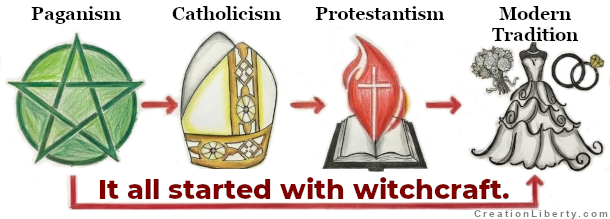
When the author says that the Catholic institution "
superstition (n): excessive exactness or rigor in religious opinions or practice; extreme and unnecessary scruples in the observance of religious rites not commanded, or of points of minor importance; excess or extravagance in religion; the doing of things not required by God, or abstaining from things not forbidden; or the belief of what is absurd, or belief without evidence
(See 'superstition', American Dictionary of the English Language, Noah Webster, 1828, retrieved Jan 20, 2026, [webstersdictionary1828.com])
Furthermore, accusations of superstition in the Bible were set against those who practiced paganism, not the other way around:
Then Paul stood in the midst of Mars' hill, and said, Ye men of Athens, I perceive that in all things ye are too superstitious.
-Acts 17:22
Although pagans do not restrict couples to participate in any single ritual like modern church buildings, they have an assortment of traditions that they pick and choose from, one of them being the exchange of rings and vows.

"Handfastings are Pagan wedding ceremonies.They do not necessarily follow a specific format, but they often incorporate many similar elements: jumping over a broom or small fire, ribbons to bind the couple's hands together, andthe exchange of vows and rings ."
-S. Zohreh Kermani, Pagan Family Values: Childhood and the Religious Imagination in Contemporary American Paganism, NYU Press, 2013, p. 212, ISBN: 9781479894604
If the exchanging of rings in a wedding ceremony was established by God, then pagans would not do it because that would go against their religious views. They do not worship the Chrisitian God of the Bible, so why would they do something they believe honors Him?
Churchgoers typically assert that pagans stole the idea from Christians, but where is the evidence of that? This is a common argument, but I have yet to hear to any churchgoer back this up with sound reasoning. The truth is that false teachers adopted the idea from pagans, and implemented it into their own religion, creating a pagan/church-ianity hybrid, which helped the Catholic Church draw in pagan converts.
In the general sense, pagans are not near as common today in European and the Middle East as they were 2,000 years ago. Back then, pagans made up the majority of society, and thus, if you wanted to appeal to the masses, you needed to appeal to pagan beliefs, which is why the Catholic cult adopted so many pagan rituals.
This is the reason pagans have no problem with modern wedding traditions. They were invented by pagan culture:
"The traditional ring ceremoney can then take place.The custom is to place the ring of the partner on his or her finger as another vow is taken. The minister usually speaks about the significance of the symbolism of the rings before the ceremony. After the ring ceremony, the [pagan] minister announces to the guests that the couple is now wedded. "
-Shanddaramon, The Five Rings: A Guide to Pagan Ministry, Astor Press, 2009, p. 220, ISBN: 9780578026671
According to pagan lore, titans—the mythological creators of mankind—invented the first wedding ring:
"The wedding ring also has its origin in pagan times. According to the ancient Greeks, Prometheus made the first wedding band out of smelted metal for strength and endurance. The unbroken circle was believed to signify the harmony of marriage...Modern-day adaptations of the many pagan rites have become big business! Photographers, jewelers, musicians, and florists have all prospered from ancient customs."
-Abigail Kirsch, The Bride and Groom's First Cookbook, Doubleday, 1996, p. 4, ISBN: 9780385476355
Please note what this author said at the end, that jewelers have prospered from these ancient pagan customs. If you want to know why such vain traditions are promoted over wisdom and understanding, that would be one of the primary reasons.
For the love of money is the root of all evil: which while some coveted after, they have erred from the faith, and pierced themselves through with many sorrows.
-1 Timothy 6:10
For a certain man named Demetrius, a silversmith, which made silver shrines for Diana, brought no small gain unto the craftsmen; Whom he called together with the workmen of like occupation, and said, Sirs, ye know that by this craft we have our wealth. Moreover ye see and hear, that not alone at Ephesus, but almost throughout all Asia, this Paul hath persuaded and turned away much people, saying that they be no gods, which are made with hands: So that not only this our craft is in danger to be set at nought; but also that the temple of the great goddess Diana should be despised, and her magnificence should be destroyed, whom all Asia and the world worshippeth. And when they heard these sayings, they were full of wrath, and cried out, saying, Great is Diana of the Ephesians.
-Acts 19:24-28
The following author was a Catholic school teacher for 18 years, and she now makes a living practicing witchcraft as a medium. Mediums and psychics practice divination, necromancy, and sorcery, all of which are abominations in the sight of God. She explained more details of the pagan superstition:
"Our world is filled with pagan symbols—take, for example, the wedding band. It was believed that if bad luck came to a married couple, it would get trapped in a circle (the ring), and it would just stay there, running in a circle for eternity. "
-Sylvia Browne, Secrets and Mysteries of the Word, Hay House Inc, 2006, p. 4, ISBN: 9781401922504
Although vain and superstitious, I believe this witch is being honest about pagan beliefs because there is historical and lore-based precedent for these things. Of course, Catholics claim the same thing, but the difference is that Catholics claim to be "Christian," which leaves them with the pesky problem that their traditions are not found in the Holy Scriptures—the foundation of all faith and practice—so they have to make up an excuse to follow tradition alone like the pagans do.
This is why Catholics foolishly condemn what they call "sola scriptura"—a Latin phrase that essentially means "by the Scriptures alone"—and claim that the Scriptures must be interpreted only within the bounds of Catholic tradition. They will argue that Scripture and tradition must be taken on equal footing, but the problem is that many of their traditions conflict with the Scriptures, so ultimately, they believe tradition holds precedent over the Bible.
This places Catholics under the same ideology as pagans because both believe in following man-made traditions as the foundation of their faith. Ultimately, Catholicism is a sect of paganism, and unknown to the public at large, they have spread pagan philosophy around the world.
In Catholic ideology, wedding rings are what they call a "sacrament," which they publicly claim is simply a "sign of inner grace." However, behind closed doors they actually believe sacraments are works that must be done to attain righteousness and salvation, which totally antithetical to the doctrines of Scripture:
For by grace are ye saved through faith; and that not of yourselves: it is the gift of God: Not of works, lest any man should boast.
-Ephesians 2:8-9
And therefore it was imputed to him [i.e. Abraham] for righteousness. Now it was not written for his sake alone, that it was imputed to him; But for us also, to whom it [i.e. righteousness] shall be imputed, if we believe on him that raised up Jesus our Lord from the dead; Who was delivered for our offences, and was raised again for our justification.
-Romans 4:22-25
This means Catholics actually believe spiritual blessings come from performance of rituals, but they typically will not profess that publicly since there are Christians who will call them out on their contradictions. Just as pagans believe that performing a ceremony with wedding rings will give them spiritual power, so Catholics believe the same, and all of it is a form of witchcraft.
Wedding rings are highly esteemed above other jewelry in witch covens for spell casting:
"In most cases, watches and random jewelry should be removed before practicing magick...Wedding rings are worn during the practice of magick, as they are considered sacred and blessed. "
-Aislin, Ashling Wicca: Book 1, Lulu.com, 2012, p. 111, ISBN: 9781105350108
They believe rings are enchanted, and God hates enchantments.
Then Pharaoh also called the wise men and the sorcerers: now the magicians of Egypt, they also did in like manner with their enchantments.
-Exodus 7:11
to be placed on the "ring finger?"
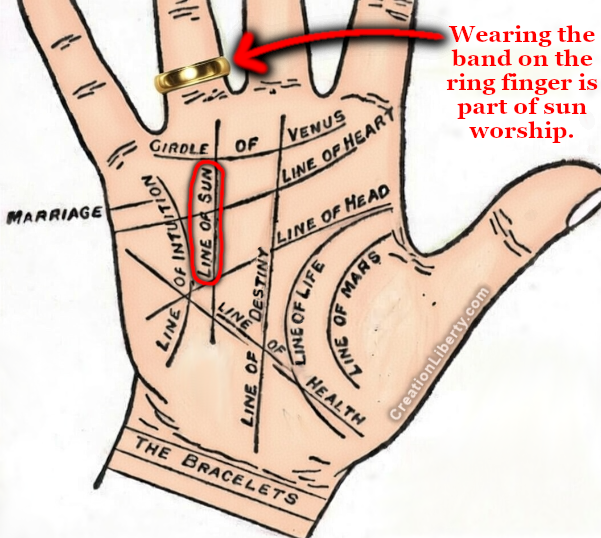
The author of The Complete Idiot's Guide to Palmistry explains more:
"Your ring finger is called your Apollo finger, after the Greek god of the sun , and it's here you'll find your creative pursuits and idealism. Your apollo will show whether you're a performer before the spotlights or behind the scenes,how well you're liked, and the level of your intensity (like the sun). Apollo, in other words, is about your relationship to expression."
-Lisa Lenard & Robin Gile, The Complete Idiot's Guide to Palmistry, 2nd Edition, DK Publishing
Another witch affirms this line of the sun:
"There are four mounts at the base of the fingers. Mount of Jupiter under the Index finger, Mount of Saturn under the middle finger,Mount of Apollo or Sun under the ring finger , Mount of Mercury under the little finger."
-Dayanand Ambawade, All the Secrets of Palmistry: For Profession and Popularity, Diamond Pocket Books, 2015, ISBN: 9788128822735
In the Wiccan religion, they claim that because the heart is on the left side of the body, the wedding ring belongs on the left hand ring finger. They believe a channel of mystic energy flows from the heart into the line of the sun finger, then transfers into the ring.
At this point, the obvious question should be: Why are churchgoers participating in this? There is no Biblical reason for it, so why continue? The only reason they continue in this witchcraft nonsense is to fit in and be accepted by the world and by religious institutions, but that is not the duty of Christians.
Love not the world, neither the things that are in the world. If any man love the world, the love of the Father is not in him.
-1 John 2:15
If ye were of the world, the world would love his own: but because ye are not of the world, but I have chosen you out of the world, therefore the world hateth you.
-John 15:19
Servants, be obedient to them that are your masters according to the flesh, with fear and trembling, in singleness of your heart, as unto Christ; Not with eyeservice, as menpleasers; but as the servants of Christ, doing the will of God from the heart;
-Ephesians 6:5-6
Wherefore, my dearly beloved, flee from idolatry.
-1 Corinthians 10:14
flee (v): to run with rapidity, as from danger; to attempt to escape; to hasten from danger or expected evil
(See 'flee', American Dictionary of the English Language, Noah Webster, 1828, retrieved Jan 21, 2026, [webstersdictionary1828.com])
My job is to teach the truth of Christ and expose the corrupt philosophies of men. Your job is to take that understanding, think on it, and make a decision that is best for you and your household according to the convictions given to you by the Holy Ghost.
I will simply leave you with the words of Jesus and some consideration:
Again, ye have heard that it hath been said by them of old time, Thou shalt not forswear thyself, but shalt perform unto the Lord thine oaths: But I say unto you, Swear not at all; neither by heaven; for it is God's throne: Nor by the earth; for it is his footstool: neither by Jerusalem; for it is the city of the great King. Neither shalt thou swear by thy head, because thou canst not make one hair white or black. But let your communication be, Yea, yea; Nay, nay: for whatsoever is more than these cometh of evil.
-Matthew 5:33-37
Examine yourselves, whether ye be in the faith; prove your own selves. Know ye not your own selves, how that Jesus Christ is in you, except ye be reprobates?
-2 Corinthians 13:5
And be not conformed to this world: but be ye transformed by the renewing of your mind, that ye may prove what is that good, and acceptable, and perfect, will of God.
-Romans 12:2

I know the typical churchgoer response is that "they're pretty," but that is not why the tradition was implemented. Did these women come up with the idea on their own, or were they taught it from the time they were little girls and anticipated doing it without ever questioning why? What they do not understand is that this is yet another witchcraft tradition said to hold magical properties, giving the holder "luck," and invoking spells that were alleged to ward off evil spirits.
I remember when I first started researching the history behind this, there were many authors from various church-ianity websites talking about it, but no one had a reasonable explanation. I read ridiculous things, like flowers being used to cover smell because people did not bathe, or soap or scented oils did not exist in prior eras. There is no evidence to support that, and Biblical evidence contradicts it. They offered nothing more than their opinions and guesses, but nothing that made any sense.
(Read "Does the Bible Teach Sanitation Practices?" at creationliberty.com for details.)
Yet, despite the lack of questions and willful ignorance, the bouquet is still considered sacred. We cannot find precedent for this in the Scriptures, so where did it come from? Pagans have a proper reason for this, albeit silly and superstitious, yet logical from the perspective of their religion:
"The origin of the bridal bouquet goes all the way back to the ancient belief thatstrong-smelling spices and herbs would prevent evil spirits from ruining things . Her bridesmaids often follow suit, and even the flower girls have a specific role to shower all of the guests with petals from the chosen variety of flower. As Pagans, we are not limited to thecolors, smells, and magickal uses of flowers . We can also incorporate the colors, smells and magickal uses of herbs. You are free to use traditional flowers, magickal herbs, or a combination of the two for a spectacular display of fragrance, color, and magick."
-Kendra V. Hovey, Passages Handfasting: A Pagan Guide to Commitment Rituals, Adams Media, 2007, p. 153, ISBN: 9781440516368
The bridal bouquet is part of spell-casting in witchcraft. The flower arrangement was originally selected for its fertility properties, or in other words, it is a charm supposedly used to grant blessings from their false gods and goddesses:
"The ancients carried bouquets of herbs for several reasons...bridal bouquets were also part of pagan fertility rituals . In addition,many bouquets were designed to keep evil spirits at bay . Chives and garlic, being thought most advantageous for this purpose, were commonly found in bridal bouquets."
-Kristina Seleshanko, Carry Me Over the Threshold, Zondervan, 2009, p. 29, ISBN: 9780310861256

Flower girls are often recruited to spread flower petals (most commonly rose petals) down the aisle of a wedding ceremony, and that was also adopted from pagan culture. This is part of their incantation ritual for marriage spells:
"Starting at the eastern-most point of where the circle will be cast,the Flower Girls (Maidens) each stand with a basket of rose petals... The rose petals are a symbol of our Lady and the Flower Maidens a symbol of youth ... When all is ready, the groom rings a bell, opens the book containing the wedding vows, and lights a candle to announce the beginning of the rite."
-A.J. Drew, Wicca for Couples: Making Magick Together, Career Press, 2002, p. 126, ISBN: 9781564146205; Drew has authored many books on Wicca and hosts the annual Real Witches Ball for PaganNation.com.
Pagans also believe the flowers are a symbol of fertility:
"The couple would either be carried by their [witch] coven members or would ride in a small cart, pulled by the coveners, a pony, or even a goat.Flowers, a sign of fertility, would be plentiful both on the cart, carried by the processioners, and strewn along the way. The procession will end up at the site of the Wiccan Circle. "
-Raymond Buckland, Wicca for Life: The Way of the Craft -- From Birth to Summerland, Citadel Press, 2003, p. 159, ISBN: 9780806524559; Buckland has authored many books on witchcraft, and speaks internationally on the subject.
Sadly, while most churchgoers refuse to hear the truth because it upsets their pleasant feelings, Universal Life Church—a wildly corrupt ecumenical organization that attempts to fuse together pagan religions from all over the world—are more honest about this subject than the average evangelical churchgoer:
"Colors have great symbolism in paganism, with slightly different meanings from one faith to another ... Dress should be elegant, but comfortable, made of natural fibers. It is perfectly acceptable to dress in the romantic styles of former times, to create a fairytale atmosphere...Choose colors to match the season, or that traditionally mean new beginnings, such as white or green. Careful research is necessary here. For example, it is bad luck to wear green at an Irish wedding, particularly for the bride. You may need incense and anointing oils in appropriate scents, candles in appropriate colors, and some kind of beautiful cord, ribbon or tie if you are planning on a handfasting ritual."
-Universal Life Church, "Wedding Officiant Training: How to Perform a Pagan Wedding," retrieved Jan 22, 2026, [https://www.ulcweddingofficiants.com/officiant-training/how-to-perform-a-pagan-wedding/]
Even the petals from flowers correspond to astrological signs—another reason flower bouquets are significant in paganism:
"Consider usingpetals from flowers that correspond to the bride's and groom's astrological signs ... Those flowers mingling and falling to the ground together as a symbol of the union being marked."
-A.J. Drew, A Wiccan Bible: Exploring the Mysteries of the Craft from Birth to Summerland, Career Press, 2003, p. 128, ISBN: 9781564146663
It should be a great embarrassment for churchgoers that they cannot explain the reasoning behind what they do and why; while pagans, who are supposed to be more ignorant of the truth, can readily articulate their reasoning. No one has done evil for simply holding flowers, but the point is that the flower arrangement originally served a witchcraft function, which Catholics adopted to lure pagans into their cult, and leavened evangelical pastors then mimicked in order to seem spiritually relevant, caring nothing for the sanctity of Christ's church. If churchgoers want to argue with me about the flower bouquet, they will also have to argue why the bride traditionally throws it behind her into a crowd of female guests. There are reasons for this, but they all are based on pagan superstition and witchcraft.

"The origins of the bouquet toss can be traced back to ancient Rome, wherebrides would carry or wear flowers as a symbol of new beginnings, fertility, and fidelity. These flowers were often a combination of herbs, like rosemary and dill, which were believed to have magical properties that would ward off evil spirits and ensure a happy marriage. In addition, the bride would also carry a wreath of flowers on her head, which symbolized her virginity and purity. "
-Hockwold Hall, "The History of Throwing a Boquet [sic] at Your Wedding," Mar 29, 2023, retrieved Jan 23, 2026, [https://hockwoldhallnorfolk.com/blog/this-history-of-the-bouquet-toss/]
Irony abounds when we consider that most brides in modern America are neither pure nor virgins, yet will wear things intended to symbolize those virtues. It is fitting, however, since wedding ceremonies have done nothing to prevent mass divorce, demonstrating that all of these things are a hypocritical show to create an appearance of "holiness" in the dulled eyes of society.
"The modern tradition of throwing the bridal bouquet to determine who will be the next to marryhas its roots in pagan ritual from antiquity . [i.e. ancient past] The Roman bride wore a sort of woolen belt or cummerbund called a girdle... that was removed by her new husband at the conclusion of the wedding ceremony. By the 17th century, brides festooned their wedding dresses with ribbons, lace, silk belts around the waist and all sorts of pen cases, knives and purses.Wedding guests scrambled to strip the hapless bride of these trophies, sometimes tearing her garters off her legs in front of the altar. The groom fared little better, since he, too, wore stockings and garters.It was to reduce this trophy hunting that the bride began to throw her bridal bouquet and the groom tossed a garter to the guests ."
-Orange Coast Magazine, Vol. 13, No. 6, June 1987, p. 160, ISSN 0279-0483
Tearing clothing and trinkets off of a bride is not anything close to being in accord with the teachings of Christ, but Rome created these traditions based on pagan culture, and the Catholic cult—being the child of the Roman Empire—has always sought to preserve its own. To avoid being viewed as hypocrites while upholding pagan tradition, Catholics slightly toned down the traditions of witches and then declared their pagan rituals to be "Christian."
Throwing the bouquet over the shoulder to pass it to another sounds more harmless to the public; however, the tossing of things over the shoulder is a common witchcraft practice. For example, the tossing of salt over one's shoulder is a superstitious practice common to witches, as they believe it is an act to honor their "spirits" (which are actually devils, 1Co 10:20) and bring them good fortune.
(See Raven Grimassi, The Wiccan Mysteries: Ancient Origins & Teachings, Llewellyn Publications, 1997, p. 207, ISBN: 9781567182545)
Tradition teaches that the woman who catches the bride's bouquet is destined to be married next. This is not only ridiculous and verifiably false, but there is nothing in the Scriptures that indicates we Christians should participate in such absurd superstitions.
Some readers might argue that it is simply done for "fun." I have no doubts that people do it for fun, but there are people who will tie a rope to their leg and jump off a bridge for "fun," and thus, what is "fun" is not necessarily synonymous with what is good, reasonable, or sensible.
But if someone wants to argue "fun" as a justification for wedding traditions, then how do they justify having the bride stripped of intimate garments in front of a crowd of family and friends? This is what is done when the groom strips the bride of her garter.
"In the fourteenth century, when bedding the bride was a popular custom, the unmarried men taking part in the tradition tried tosnatch the bride's garter for good luck . It's believed that brides, not enjoying this manhandling, began removing their garters and flinging them at the crowd, resulting in the tradition of the garter toss. Some historians also believe that during these bedding ceremonies, unmarried women started stealing the bride's stockings in hopes of having some of the bride'sgood luck rub off on them . Once again, it's believed the bride preferred to remove her own clothing and started throwing her stockings at the crowd.Later, when bedding became socially unacceptable, brides tossed their bouquets to the crowd instead ."
-Kristina Selshanko, Carry Me Over the Threshold, Zondervan, 2009, p. 54, ISBN: 9780310861256
A full female garter is much more intricate and difficult to remove, so they now sell "wedding garters" which are essentially a band that rests high on a woman's thigh where the stocking of a garter would normally sit, and is made for easy removal. Not only does he do this in front of a crowd, but then tosses the garter over his shoulder to men who try to grab his new wife's intimate garments, all under the ridiculous superstition that her supposed "virtue" would be passed to another man.
Ask yourself: Would this be appropriate in ANY other setting? What other place or time would it be considered acceptable for a man to remove his wife's undergarments and toss them to his brothers and friends?
If any of the men in that crowd were in the husband's home, and he was caught grabbing such a garment out of his wife's dresser drawer, the husband would likely be beat the guy within an inch of his life. However, if her husband strips her of it and throws it during a wedding ceremony, it suddenly becomes acceptable for no logical reason whatsoever—I have yet to find any logical or Biblical justification for this. Churchgoers tend to believe that church bells are the reason wedding bells are sounded after a ceremony, but that is not the case. The chiming of bells has long been a tradition of witches to signify the completion of a ritual:
"A consecrated brass or crystal bell is often used by Witches to signal the beginning and/or close of a ritual or Sabbat, to summon a particular spirit or deity, and to awaken meditating coven members. Bells are also rung at many Wiccan funeral rites to bless the soul of the Witch who has crossed over to the realm of the dead."
-Gerina Dunwich, Wicca Craft: The Modern Witches Book of Herbs, Magick and Dreams, Citadel Press, 1991, p. 39, ISBN: 9780806512389
Again, I am not arguing that ringing a bell is evil, but churchgoers commonly and foolishly believe these things were established by God in Scripture. How did bells become a staple of weddings? Witches have traditionally used bells not only to end a ceremony, but to begin one as well, as this pagan author provides details on how their heathen wedding ceremonies are conducted:
"Cast a circle in a clockwise direction using an athame or ceremonial sword, and after each guest has been blessed with greetings and incense,ring the altar bell to signal the start of the ceremony ."
-Gerina Dunwich, Wicca Craft: The Modern Witches Book of Herbs, Magick and Dreams, Citadel Press, 1991, p. 39, ISBN: 9780806512389
Bells are a core theme of most Wiccan rituals, and the use of them are to invoke the "energy" of their goddess:
"In ritual, the bell may be used to invoke the Goddess, and/or the Elements. Some will ring it after casting the circle to seal the energy within, while others will ring it after releasing the circle to disperse any remaining energy. It can also be used to mark different sections of a longer ritual, such as the end of invocations and the beginning of the main body of the ritual. Bells also makes a lovely way to seal different kinds of spellwork. "
-Lisa Chamberlain, "Tools of Wiccan Ritual: The Bell," Wicca Living, retrieved Jan 27, 2026, [https://wiccaliving.com/wiccan-bell/]
There are plenty of online resources to verify this long-standing witchcraft ritual, and that is why bells are also an important aspect of many mystic Eastern religions, such as Buddhism, Hinduism, and Shinto. I want Christians to understand that these rituals, like the wedding bells, are done for no other reason than tradition, without any explanation for why, and even if a pastor or priest gives a reason, they never provide any evidence to support their claim.
Although witchcraft is evil, I think it is embarrassing that witches, at the very least, have proper reasoning for what they do. Churchgoers, however, do not seem to mind doing things in willful blindness. Although bird seed is often used today out of consideration to wildlife, rice has been traditionally used, and this tossing of things (e.g. salt, rice, garter, bouquet, etc) is a common practice of witchcraft to invoke "luck" for the target of the spellcaster:
"[H]ow often have you seen people toss spilled salt over their shoulder without a second thought?That practice comes from a superstition that tossing spilled salt over your shoulder keeps evil away, and it gives the Kitchen Witch food for thought: Why not use salt (a common table condiment) as part of her magick for protection? "
-Marian Singer & Trish MacGregor, The Only Book of Wiccan Spells You'll Ever Need, Adams Media, p. 94, ISBN: 9781440542763

Once again, I am not arguing that tossing something is evil, but the couple did not wake up one morning and say to themselves, "You know what would be great? Let's have people throw stuff at us when the ceremony is finished!" This is another pagan superstitious practice of witchcraft meant to infuse "luck" in the couple.
The problem with luck is that the term is not necessarily a bad thing, since it often refers to the basic concept of chance, as we might see in a board game with dice rolls or a deck of cards. We cannot know the will of God, nor understand His infinite knowledge and foresight, which is why the Bible tells us that, from our perspective, things seem to happen by chance.
Peradventure there be fifty righteous within the city: wilt thou also destroy and not spare the place for the fifty righteous that are therein?
-Genesis 18:24
peradventure (adv): by chance
(See 'peradventure', American Dictionary of the English Language, Noah Webster, 1828, retrieved Jan 10, 2026, [webstersdictionary1828.com])
"Luck is love from the Divine made manifest. The presence of Magna Mater—the Great Mother Goddess , Creator of all—and My Good Father is everywhere as luck.It flows through all creation, all around us, always available. You might also call this current of luck a current of blessings. "
-Francesca De Grandis, "What Is Luck? How Do You Get Good Luck?" Faerie Witch Magic, Nov 4, 2020, retrieved Jan 27, 2026, [https://outlawbunny.com/2020/11/04/what-is-luck-how-do-you-get-good-luck/]
When a pagan says "luck," you can essentially replace that word with "magical energy." When the average person says "good luck," they tend to mean that they hope whatever is left up to chance will be in their favor—a blessing of well wishes. However, we Christians tend to avoid the term "luck" because we do not want others to get the wrong idea; we prefer "God bless" so we are clear that we wish the merciful hand of God to guide them to good things.
The tossing of seeds, rice, or nuts is based on pagan luck superstition, a tradition of invoking magical energy to increase fertility:
"Throwing rice at the couple after the wedding ceremony signifies prosperity and good luck. Italians traditionally toss sugared almonds, which are a symbol of fertility. Sometimes sugared almonds appear in the net bags on the wedding table as tokens for guests in Mediterranean countries. In the United States, wedding guests may throw small bird seed, dried flower petals, or paper confetti... Confetti is linked to thepagan tradition of throwing grain over a couple as a symbol of fertility ."
-Sex and Society, Marshall Cavendish Co, Vol. 3, 2010, p. 895, ISBN: 9780761479055
I was quite surprised to find a Catholic author who agreed with me on this point. Although it is not typically wise for a Catholic to publish disagreements with his religious overlords, and though I would heavily disagree with him on his corrupt ideology and false gospel, I do commend him for his boldness to point out the facts on this specific subject:
"All too frequently, even faithful church members sit through a wedding as if they have forgotten all the responses and songs, participating as spectators at a show, rather than as members of a worshipping community. And much concern is shown for such superstitions as starting the wedding on the half-hour (for good luck) and not seeing the bride before the wedding and throwing rice on the couple (an old pagan fertility symbol) , none of which can claim a proper place in Christian [i.e. Catholic] liturgy."
-Lawrence E. Mick, Understanding the Sacraments Today, Liturgical Press, 2006, p. 110, ISBN: 9780814629253
Every detail of modern wedding ceremonies is taken from pagan superstition. The irony is that the so-called "sacraments" of the Catholic cult are almost entirely taken from pagan and witchcraft traditions—slapping a "Jesus" sticker on them and foolishly claiming they are "good."
(Read Corruptions of Christianity: Catholicism at creationliberty.com for details.)
If Catholic priests—as blind as they are to the Scriptures—can see the problems with participation in pagan superstitions, it begs the question why evangelical pastors cannot see it. Keep in mind, it is not a matter of seeing what is blatantly obvious because pastors tend to cover their eyes and ears to things which give him preeminence and line his pockets—a subject we will cover later. Allow me to state the obvious: Cake is not inherently evil. Sadly, I need to make that statement so churchgoers will not falsely accuse me of making ridiculous arguments.
Inanimate objects cannot make moral decisions, and therefore objects have no good or evil properties. The moral question boils down to this: what is being done with the object and why?

Why are wedding cakes a default purchase? What does a cake have to do with getting married?
If you want to get a huge, expensive luxury cake to enjoy, by all means you are free to do what you want, but I want readers to understand that the wedding cake tradition is based on pagan custom. Witches often use cakes as part of their spellcraft:
"Many of today's marriage customs have pagan origins. Theshared wedding cake, tossed rice, and flowers are all old bits of fertility magick ."
-Edain McCoy, Sabbats: A Witch's Approach to Living the Old Ways, Llewellyn Worldwide, 2002, p. 167, ISBN: 9781567186635
If a churchgoer wants to argue that it has nothing to do with pagan custom, then I invite them to show me where God instituted this for wedding ceremonies. If you cannot open the Bible and show me why the wedding cake is a default custom, then it came from some religious tradition that is not found in the Scriptures.
"Few people are aware that thewedding cake used in modern marriage ceremonies is a relic of the symbolic corn ears worn by the bride to ensure fertility in pagan times . These corn ears were replaced by cakes that were scattered over the newly married couple as they left the church. Thus we see howa subtle magical practice, in the form of the wedding cake, has become a central part of a religious or secular ceremony that allegedly has absolutely nothing to do with magic. [i.e. Churchgoers deny its pagan roots.] The pleasant custom ofsending pieces of the wedding cake to friends and relatives is also a modern expression of the traditional need to share with one's friends the magic of the corn spirit ."
-Migene Gonzalez-Wippler, The Complete Book of Spells: Ceremonies and Magic, Llewellyn Worldwide, 1978, p. 262, ISBN: 9780875422862
Over time, customs transform from one thing to another, but the purpose of the tradition remains the same. The function does not change, and therefore the paganism is still being followed, even if the participants are unaware of it.
"The history of wedding cakes is quite long. These nuptial goodies have their origins in the ancient custom of couples ritually eating sacred foods during the marriage rite... Guests kept pieces of the cake, much as wedding guests of our own time take home slices for 'good luck.' In the Victorian era, unmarried Englishwomen placed pieces of wedding cake under their pillows for dreams of their future husbands ."
-Scott Cunningham, Cunningham's Encyclopedia of Wicca in the Kitchen, Llewellyn Worldwide, 2012, ISBN: 9780738717111
Some churchgoers will argue that such things are meaningless, and therefore, they use them to glorify God. I would like for them to show me how God is glorified through a cake.
To that, they may retort that cakes were used in the Scriptures (Lev 24:5, Num 15:20), but if they use that argument, they just proved my point. Those cakes were used in particular ways according to the commandment of God, so all churchgoers have to do is show me where God commanded cakes to be used in weddings, and I will publish retractions and corrections of this book.
The wedding cake tradition was born out of paganism, was hybridized by the Catholic cult, and is now viewed as a "sacred" tradition of willingly blind churchgoers. By their apathy towards these things, they demonstrate not only their willful ignorance, but their desire to please themselves, rather than pleasing the Lord.
Some churchgoers may argue that cakes are used for many occasions, like birthdays for example, so there should be nothing wrong with it. However, what they do not understand is that birthday cakes are also pagan in origin with similar superstitions, and I have an article called "Why I Don't Celebrate Birthdays" at creationliberty.com if you want more details on that subject.
(Please note that I call it "Why I (Personally) Don't," and not "Why Christians Shouldn't." If you want to celebrate a birthday, that is up to you; I simply want Christians to understand the pagan roots of what they doing.)
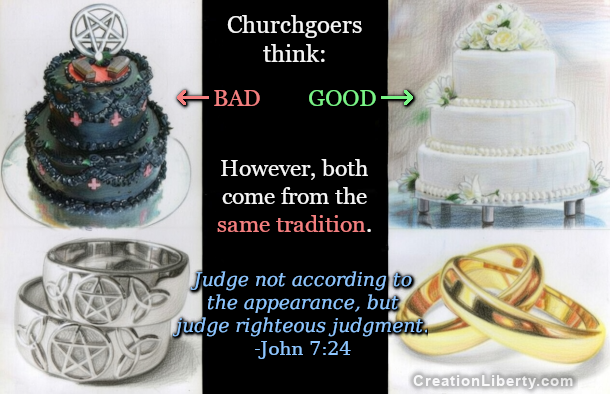
Many years ago, I published the above image of a pagan wedding cake and rings with the pentagram symbol on them, and compared it to standard church-ianity wedding cake and rings. A man wrote a letter to me expressing his great offense that I would show wedding ornaments with witchcraft symbolism on them, but little did he realize he proved my point—he refused to read the information, and judged by the appearance only, showing his favoritism to tradition rather than truth.
Judge not according to the appearance,
but judge righteous judgment.
-John 7:24
Beware of false prophets, which come to you in sheep's clothing, but inwardly they are ravening wolves.
-Matthew 7:15
For such are false apostles, deceitful workers, transforming themselves into the apostles of Christ. And no marvel; for Satan himself is transformed into an angel of light. Therefore it is no great thing if his ministers also be transformed as the ministers of righteousness; whose end shall be according to their works.
-2 Corinthians 11:13-15
What few churchgoers understand is that this is cult mentality:
cult (n): a group having a sacred ideology and a set of rites centering around their sacred symbols; a religion or sect considered to be false, unorthodox, or extremist, with members often living outside of conventional society under the direction of a charismatic leader
(See 'cult', Random House Dictionary, 2026, [dictionary.com]; See also Collins English Dictionary, 10th Edition, William Collins Sons & Co, 2012)
Thus, we Christians are commanded to guard ourselves against corrupt philosophies of the world. We should study to understand the different between the philosophy of Christ, versus the rudimentary philosophy we are first taught by the world, and then use our God-given understanding to discern (or judge) between good and evil.
Beware lest any man spoil you through philosophy and vain deceit, after the tradition of men, after the rudiments of the world, and not after Christ.
-Colossians 2:8
But strong meat belongeth to them that are of full age, even those who by reason of use have their senses exercised to discern both good and evil.
-Hebrews 5:14
Woe unto them that call evil good, and good evil; that put darkness for light, and light for darkness; that put bitter for sweet, and sweet for bitter! Woe unto them that are wise in their own eyes, and prudent in their own sight!
-Isaiah 5:20-21
Rings, flowers, bouquets, garters, cakes—these are just SOME of many wedding traditions most Americans are familiar with, or have at least heard about. Customs vary depending on family and location, but almost all have their origins in pagan superstition and witchcraft:
"As well as propagating asuperstition against marrying in May , many other wedding traditions and superstitions practiced throughout Britain today originated during the Victorian era. Most of these superstitions developed from the belief that a wedding wasa time when a couple was susceptible to bad luck and evil spirits . For instance, manybrides conform to the common belief that they should wear 'something old, something new, something borrowed, something blue' and that the groom should not see his bride wearing her wedding gown before the ceremony. While blue is considered a lucky color for brides, conversely green is thought of as extremely unlucky for brides and some wedding guests have been asked to abstain from wearing green to weddings for fear of bringing newlyweds bad luck. "
-Victoria Williams, Celebrating Life Customs around the World: From Baby Showers to Funerals, ABC-CLIO, 2016, p. 33, ISBN: 9781440836596
Why would someone not want to marry in May? In America, late May is one of the most beautiful months for weather and spring plants, so why would it be taboo for May specifically?
One of the most highly revered holidays in witchcraft is Beltane, which is celebrated in May. Beltane honors the god of death, and because death is associated with the celebration, it is "bad luck"—or rather, a risk of compiling "negative magical energy"—to marry in May.
What on earth would possess someone to require a bride to wear something blue? That makes no sense whatsoever, unless you analyze it from a witch's perspective.
Witches will tell you that—in the context of love, fidelity, harmony, and devotion—the color blue is associated with "good luck," or "positive magical energy." Although the world most often sees green as the color of luck (mostly due to celebrations like St. Patrick's Day), green in witchcraft is more associated with materialism and wealth, while blue is considered "lucky" for brides. The magical energies would supposedly cause a man to love her more than money in hope of a long-lasting marriage.
(See Erin Dragonsong, "What Is The Meaning of Colors?" Wicca Spirituality: Earth-Based Enlightenment, retrieved Jan 29, 2026, [https://www.wicca-spirituality.com/meaning-colors.html]; See also The Magickal Cat, "Magickal Color Correspondences," retrieved Nov 1, 2018, [https://web.archive.org/web/20180406211334/http://www.themagickalcat.com/Articles.asp?ID=241])
None of these things are supported in the Bible. They are foolish and vain superstitions. No one in their sane mind would do these things UNLESS there was a religious reason to do so, and that religion is paganism.
Once again, Paul rebuked the pagans in Athens:
Then Paul stood in the midst of Mars' hill, and said, Ye men of Athens, I perceive that in all things ye are too superstitious.
-Acts 17:22
Most of you have probably heard of the superstition that the groom should not see the bride before the ceremony. Again, this is just a pagan superstition that the couple would gain negative magical energy (i.e. bad luck) if he sees her before the appointed time.
There are tons of these ridiculous ideas, but what I have listed in this chapter should be more than enough to prove the point. These traditions did not originate from Scripture and have nothing to do with God and Christ. They came from religious organizations that have no concern for honoring the Word of God, yet expect you to believe that by following these insane traditions you are performing "sacred" duties that will make your marriage "righteous."
Sadly, most American churchgoers only have a love for the Lord Jesus Christ with their mouths, but in their hearts they could not care less about His Word. They love their feel-good rituals more than they love Him. The world will always push ever-forward into willful ignorance and stupidity, but how long will churchgoers hypocritically join hands with them and teach their children to do the same?
This people draweth nigh unto me with their mouth, and honoureth me with their lips; but their heart is far from me. But in vain they do worship me, teaching for doctrines the commandments of men.
-Matthew 15:8-9
Love not the world, neither the things that are in the world. If any man love the world, the love of the Father is not in him.
-1 John 2:15
In letters I have received over the years, some Christians have said they did not want to participate in modern pagan wedding traditions, but did it anyway because they feared what their families would think if they refused. I did not respond with rebuke or correction because it is not my business to tell people what to do in their personal lives, but what these folks did not understand is the philosophy behind their choices.
Unknowingly, their concerns about what certain family members (or in-laws) might think of them took a much greater priority over what Jesus Christ might think of them. Jesus taught that His doctrine should take far greater priority over what our family might think of us:
For I am come to set a man at variance [i.e. a difference that produces controversy and division] against his father, and the daughter against her mother, and the daughter in law against her mother in law. And a man's foes shall be they of his own household. He that loveth father or mother more than me is not worthy of me: and he that loveth son or daughter more than me is not worthy of me.
-Matthew 10:35-37
Wherefore, my dearly beloved, flee from idolatry.
-1 Corinthians 10:14
If she was bold enough to reject his proposal after she had already agreed to marry, and he gave in to her demands, it will only create lifelong problems. Down the road she would hold divorce over his head to get her way, and it would be a heavy burden for him to carry.
Sadly, as Adam prioritized Eve over God in the Garden, so this man chose to go through with the wedding ceremony, caving to her demands, prioritizing the woman over the Lord. Imagine a woman so self-centered that she reveres a wedding ceremony in higher regard than a life-long marriage with a man. I cannot imagine the brawling fights she will start with him on a regular basis to get her way—holding threats of divorce over his head to enforce her rebellious will.
It is better to dwell in a corner of the housetop,
than with a brawling woman in a wide house.
-Proverbs 21:9
Come unto me, all ye that labour and are heavy laden, and I will give you rest. Take my yoke upon you, and learn of me; for I am meek and lowly in heart: and ye shall find rest unto your souls. For my yoke is easy, and my burden is light.
-Matthew 11:28-30
After all my research, I am sure readers are curious to read the list of things I found. You may be disappointed to learn that there is no list, because I only found one thing—no traditional hoops, no religious tightropes.
Before I share with you what that one thing was, I want to propose a thought experiment to help us better understand the philosophy God teaches us in Scripture. Let us suppose a man and woman were stranded on a deserted island, without access to church buildings, preachers, governments, or any other entity: Could they be married?
If your answer was "No," it begs the question: why not? If the couple could not be married on their own, then how could anyone have been married throughout history?
How could the peer pressures of modernity be required of those in antiquity? Did Adam and Eve have a ceremony? Did they have to be wed in a church building? Did they have government-issued licenses? All we have to do is think for a moment that Eve did not even have a wedding dress because she got married naked!
Adam and Eve were married because God declared it to be so, and since they were the only two people in the world, they had no other choice. Today, that is called an "arranged marriage." There was no engagement period, no pomp and circumstance—they were simply married in agreement.
Thus, since marriage is a household institution established by God, the only requirement is a man and woman making a declaration to one another in agreement.
Perhaps you thought it was going to be more complicated than that, but it is indeed that simple. I have challenged others to go into the Scriptures and prove me wrong on this account, and I have never had someone present a Biblical argument to show how I am wrong—they either refuse to respond, get angry, or concede my point.
The problem with mankind is sin, and because of that, people tend not to consider how seriously God takes the words we speak. Even most churchgoers do not take much caution with the things that come out of their mouths, despite the fact that Jesus warned us that every word we speak would have to be accounted for on the Day of Judgment.
But I say unto you, That every idle word that men shall speak, they shall give account thereof in the day of judgment. For by thy words thou shalt be justified, and by thy words thou shalt be condemned.
-Matthew 12:36-37
These six things doth the LORD hate: yea, seven are an abomination unto him: A proud look, a lying tongue, and hands that shed innocent blood, An heart that deviseth wicked imaginations, feet that be swift in running to mischief, A false witness that speaketh lies, and he that soweth discord among brethren.
-Proverbs 6:16-19
A righteous man hateth lying: but a wicked man
is loathsome, and cometh to shame.
-Proverbs 13:5
(Read "God Does Not Justify Lies" at creationliberty.com for details.)
However, whether swearing an oath unto the Lord or not, mankind should be very cautious about giving their word and not keeping it, even in small matters, let alone serious lifelong decisions like marriage. Let us take a look at a passage of Scripture that gets little attention in most church buildings, but should be carefully considered:
Again, ye have heard that it hath been said by them of old time, Thou shalt not forswear thyself, but shalt perform unto the Lord thine oaths: But I say unto you, Swear not at all; neither by heaven; for it is God's throne: Nor by the earth; for it is his footstool: neither by Jerusalem; for it is the city of the great King. Neither shalt thou swear by thy head, becafuse thou canst not make one hair white or black. But let your communication be, Yea, yea; Nay, nay: for whatsoever is more than these cometh of evil.
-Matthew 5:33-37
The scribes and Pharisees (who were the pastors and elders of their day) would commonly give their word to do something (or not do something) and would not take it seriously. They would claim immunity from wrongdoing because they did not swear it unto the Lord Himself.
They began to create what they thought were legal loopholes in God's Word. They would swear by "heaven" or "God's throne" or "the earth" (i.e. things created by God) to avoid swearing unto the Lord specifically, and they would do it for trivial, day-to-day matters to give a fake appearance of "holiness."
To solve this problem, Jesus said that we ought to take our word seriously. We ought to simply say "Yes, I will do this" or "No, I will not do that," and then do as we said we would do. In this regard, vows are unnecessary and only provide a fake appearance of "righteousness" in the eyes of men.
Anything else added to our word, such as vows or written contracts, are made solely for dishonest men, as a way to make them accountable if they break their word. This is why everyone is required in a court of law to swear to "tell the whole truth, and nothing but the truth, so help me God"—it is a condition to which a man can be punished with perjury (i.e. lying under oath), since mankind cannot be trusted to their word.
We Christians ought to live honestly as Jesus taught us. We should be trustworthy and reliable people.
Lie not one to another, seeing that ye have
put off the old man with his deeds;
-Colossians 3:9
Wherefore they are no more twain, but one flesh. What therefore God hath joined together, let not man put asunder.
-Matthew 19:6
Be not deceived; God is not mocked: for whatsoever
a man soweth, that shall he also reap.
-Galatians 6:7
For the sin of their mouth and the words of their lips let them even be taken in their pride: and for cursing and lying which they speak.
-Psalm 59:12
A false witness shall not be unpunished,
and he that speaketh lies shall perish.
-Proverbs 19:9
Almost everyone has heard the typical repeat-after-me phrases that are spoken in a wedding ceremony. "Dearly beloved, we are gathered here today..." and "Do you, Jack, take Jill to be your lawfully wedded wife? And do you, Jill, take Jack to be your lawfully wedded husband?" These are considered sacred words that allegedly MUST be spoken, else Jack and Jill are doomed to never make it up the hill.
Upon initial investigation, I searched the Scriptures and could not find these traditional words anywhere. I started asking churchgoers, and they all responded the same way, asking, "Isn't it in the Bible somewhere?" They had never questioned it or searched for themselves. I found it quite strange that such a highly revered tradition was performed on assumption alone, but that was before I realized how many churchgoers care more about tradition than God's Word.
While investigating, I attended a social gathering, and happened upon a friendly pastor, so I asked him about this, hoping he could point me in the right direction, and he told me it came from a book called The Book of Common Prayer. If this was some grand secret, it is unlikely he would have told me about it, but with that in mind, it also does not seem to be talked about much, since I (nor many churchgoers I talked to) had ever heard of it.
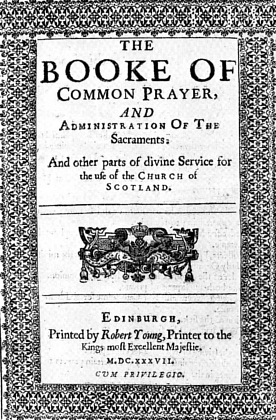
I discovered that The Book of Common Prayer was taken from the Catholic Church, filtered through the Anglicans (a denomination of Catholicism), and adopted by so-called "evangelicals." The book contains ritualistic prayers that Catholics use worldwide for morning, evening, communion, marriage, and more, and now these same prayers fill church buildings everywhere, even though Jesus commanded that we ought NOT to use such vain repetitious prayers.
And when thou prayest, thou shalt not be as the hypocrites are: for they love to pray standing in the synagogues and in the corners of the streets, that they may be seen of men. Verily I say unto you, They have their reward. But thou, when thou prayest, enter into thy closet, and when thou hast shut thy door, pray to thy Father which is in secret; and thy Father which seeth in secret shall reward thee openly. But when ye pray, use not vain repetitions, as the heathen do: for they think that they shall be heard for their much speaking. Be not ye therefore like unto them: for your Father knoweth what things ye have need of, before ye ask him.
-Matthew 6:5-8
incantation (n): the chanting or uttering of words purporting to have magical power
(See 'incantation', Random House Dictionary, 2026, [dictionary.com]; See also Collins English Dictionary, 10th Edition, William Collins Sons & Co, 2012)
There are no answers to these questions other than the logical fallacy of appeal to tradition. This is no different from a witch reciting an incantation and expecting magical results.
Notice the full title is The Book of Common Prayer AND Administration of the Sacraments. We learned earlier that Catholic "sacraments" were invented by their religious cult; they did not come from the Bible. Even for baptism and communion, which Scripture commands, the Catholic cult corrupts them with false doctrine and vile traditions that are anti-Christ in nature.
Catholicism and its cults (like Anglicanism and Orthodoxy) consider marriage a "sacrament," and therefore they impose ritualistic prayers, vows, and declarations they have attributed to their "marriage sacrament." There are different versions of The Book of Common Prayer, but most churchgoers remain blissfully unaware that their pastor deliberately skips portions of the wedding ceremony script because many listeners in evangelical church buildings would be offended if they heard the full text.
For example:
"Atthe Eucharist: The liturgy continues with the Offertory, at which the newly married couple may present the offerings of bread and wine ... it is appropriate that the newly married couple receive Communion first, after the ministers."
-Book of Common Prayer: And Administration of the Sacraments and Other Rites and Ceremonies of the Church, Church Publishing Inc, 2001, p. 432, ISBN: 9780898694390
offertory (n): the offering of the unconsecrated elements that is made to God by the celebrant in a Eucharistic service
(See 'offertory', Random House Dictionary, 2015, [www.dictionary.com]; See also Collins English Dictionary, 10th Edition, William Collins Sons & Co, 2009)
Christians ought not to have any part with such anti-Christ rituals, which blasphemously offend Christ's finished sacrifice on the cross. Pastors skip over these parts (unless the audience tolerates such heresy), deceitfully covering them up while retaining the vain repetitions that give them a "holy" appearance.
(Read Corruptions of Christianity: Catholicism & Corruptions of Christianity: Orthodoxy at creationliberty.com for details.)
The Book of Common Prayer goes on to say:
"Normally, the celebrant [i.e. one who marries the couple] is a priest or bishop. Where permitted by civil law, andwhen no priest or bishop is available , a deacon may function as celebrant, butdoes not pronounce a nuptial blessing ."
-Book of Common Prayer: And Administration of the Sacraments and Other Rites and Ceremonies of the Church, Church Publishing Inc, 2001, p. 435, ISBN: 9780898694390
So according to this corrupt Catholic document, your marriage cannot be blessed and approved by God unless an officially ordained Catholic priest performs it. This creates confusion, especially since Anglicans claim that only an Anglican priest can do it, and Orthodox priests insist that only their clergy can do it.
The fact is there is NO precedent in the Bible that any man has the authority to marry a couple. That authority does not come from men, and Scripture never gave it to men. The idea that a religious leader must marry a couple came from the vile bowels of the Catholic institution; it is nothing more than a show of so-called "holiness" to make the audience feel pure and righteous.
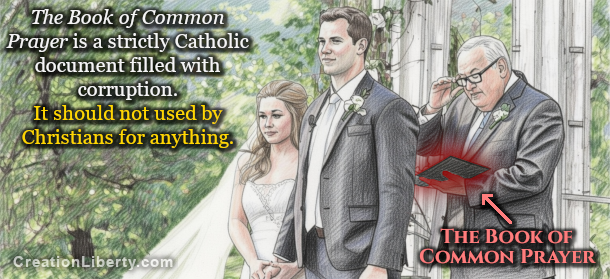
Let's read this easily-recognizable part of the wedding ceremony from The Book of Common Prayer:
"Dearly beloved:We have come together in the presence of God to witness and bless the joining together of this man and this woman in Holy Matrimony. The bond and covenant of marriage was established by God in creation, and our Lord Jesus Christ adorned this manner of life by his presence and first miracle at a wedding in Cana of Galilee. It signifies to us the mystery of the union between Christ and his Church, and Holy Scripture commends it to be honored among all people. "
-Book of Common Prayer: And Administration of the Sacraments and Other Rites and Ceremonies of the Church, Church Publishing Inc, 2001, p. 423, ISBN: 9780898694390
This is very deceitful because the wording makes it sound as if Christ approved of this script and all the pagan traditions surrounding it. The way The Book of Common Prayer presents it, one would think a great deal is documented about Christ's participation in the wedding in Cana of Galilee, but in reality, very little is said:
And the third day there was a marriage in Cana of Galilee; and the mother of Jesus was there: And both Jesus was called, and his disciples, to the marriage.
-John 2:1-2
Another red flag that most churchgoers overlook is the term "Holy Matrimony," which I warn Christians to avoid. Etymology is the study of word origins, and you may be surprised to learn that etymologists remain somewhat baffled by this phrase. Although the average person thinks 'matrimony' simply means "marriage," the pieces that make up the word do not align from a purely logical perspective.
A number of words carry the Latin suffix -mony, but the suffix itself carries no particular meaning. To clarify, consider these terms: the suffix -archy means "rule" or "govern," and patri comes from "patron," meaning "father," so patri-archy essentially means "rule of the father." Likewise, matri-archy comes from "matron," meaning "mother," so matri-archy essentially means "rule of the mother."
Though the prefix patri- (father) and matri- (mother) typically distinguish male from female, the word “matrimony” does not follow the same pattern. As I said, this has confused some etymologists, but I am about to supply the missing piece of the puzzle.
The term 'matrimony' literally means "the state of motherhood," but that remains confusing because marriage itself does not automatically make the woman a mother. If that were not perplexing enough, The Book of Common Prayer has the pastor or priest declare of the couple, "the joining together of this man and this woman in Holy Matrimony," which begs the question: how is a man supposed to enter motherhood?
Men do not enter motherhood, nor does a woman enter motherhood by a marriage covenant alone. So if there truly is such a thing as "Holy Matrimony" in that context, how exactly does the marriage ceremony bring her into motherhood?
(See 'matrimony', Online Etymology Dictionary, retrieved Nov 2, 2018, [etymonline.com/word/matrimony])
As I kept reading and studying what various researchers said about this term, I concluded their confusion stems from ignorance of Catholicism's pagan origin and lore. Most modern scholars view Catholicism as a “Christian” religion without grasping its gross error. The phrase "Holy Matrimony" refers to the couple coming into union under the Catholic moon goddess they call "Mary," officiated on her supposedly "divine" authority rather than that of the Lord God.
Some people scoff at word origins, and some readers may not find this convincing, but Catholicism has spread the religious plague of its Marian worship into other spheres of society. For example, have you ever heard a man refer to his university as his "alma mater?"
What the average person does not understand is that this is a Latin phrase made up of two words: alma meaning "virgin" and mater meaning "mother." When they call the college their "alma mater," they are actually calling it their "virgin mother"—the goddess they bow to and worship.
It is the same for those married under "Holy Matrimony." The names of God and Christ may appear for pretense, and some participants may hold God and Christ dearly in their hearts, but the dedication of the script belongs to a Catholic moon goddess.
Some of you may argue that the script specifically states the "bond and covenant of marriage was established by God in creation," yet if we keep reading, the claim is that "matrimony was ordained" by God. This signifies that the marriage is officiated under the pagan goddess worship of the Catholics.
The following is directly from a 1640 edition:
"[It] is commended of S. Paul to be honourable among all men, and therefore is not to be enterprised nor taken in hand unadvisedly, lightly, or wantonly, to satisfy mens' carnal lusts and appetites, like brute beasts that have no understanding, but reverently, discreetly, advisedly, soberly, and in the fear of God,duly considering the causes for which matrimony was ordained ."
-The Book of Common Prayer, 1640, p. 52, retrieved Feb 3, 2026, [https://archive.org/details/bim_early-english-books-1475-1640_the-book-of-common-praye_liturgies-book-of-common_1640/page/n51/mode/2up]
This is laced with the poison of Catholicism because "matrimony" was never ordained in Scripture. In the end, it does not matter how much the text talks about God and Christ or how much it claims purity and righteousness; the twisted ordainment they reference is a false authority under their demonic Marian worship.
The Book of Common Prayer's wedding script has been edited countless times by officiants and pastors over the centuries, which is why you will hear many variations of it. Each has attempted to make it more suitable to his religious views while still including the corrupt term "matrimony" in ignorance. However, despite the alterations, it begs the question: why do you need to read from a script to be married?
No one seems to ask the question; therefore no one answers the unasked questions. Worse still, churchgoers and pastors have often grown angry at me for daring to question it at all. That anger is a red flag: they hate being under God's authority and would rather silence me so they can maintain an appearance of "holiness."
Correction is grievous unto him that forsaketh the way:
and he that hateth reproof shall die.
-Proverbs 15:10
This people draweth nigh unto me with their mouth, and honoureth me with their lips; but their heart is far from me.
-Matthew 15:8
In the Bible, Jesus acknowledged the marriage of unbelievers as well:
But as the days of Noe were, so shall also the coming of the Son of man be. For as in the days that were before the flood they were eating and drinking, marrying and giving in marriage, until the day that Noe entered into the ark, And knew not until the flood came, and took them all away; so shall also the coming of the Son of man be.
-Matthew 24:37-39
(Read "The Beginner's Guide to Christian Rapture" at creationliberty.com for details.)
Some churchgoers have tried to argue that sexual intercourse is required to consummate a marriage, but where is that requirement in Scripture? If a man had been injured in war and his male member no longer functioned as normal, would that prevent him from being married?
I once helped care for a couple who were newly married in their 90s, and based on the man's back injuries, I knew it was impossible for them to engage in sexual intercourse. It would take an uncharitable and cruel ideology to insist that the couple were not permitted to live as husband and wife simply because they could not copulate.
On the other hand, I have heard some churchgoers insist that sexual intercourse automatically makes a couple married, but that also has no Biblical backing. If sex meant two people were married, then there would be no such thing as fornication, which is sex outside of marriage.
Now concerning the things whereof ye wrote unto me: It is good for a man not to touch a woman. Nevertheless, to avoid fornication, let every man have his own wife, and let every woman have her own husband.
-1 Corinthians 7:1-2
No commandment was ever given in Scripture that required a man to give a woman away for her to be married. Some churchgoers may argue that Rachel's father gave her away to Jacob, but that was not the case because Rachel was the wages owed for labor.
And it came to pass, when Laban heard the tidings of Jacob his sister's son [i.e. his nephew], that he ran to meet him, and embraced him, and kissed him, and brought him to his house. And he told Laban all these things. And Laban said to him, Surely thou art my bone and my flesh. And he abode with him the space of a month. And Laban said unto Jacob, Because thou art my brother [i.e. a nephew is flesh of his sibling in Biblical classification, and therefore considered a brother], shouldest thou therefore serve me for nought? tell me, what shall thy wages be?... And Jacob loved Rachel; and said, I will serve thee seven years for Rachel thy younger daughter.
-Genesis 29:13-18
I am only arguing that there is no law or other instruction in the Bible to do things this way, but there is reason for women to be given away by permission. Females are cared for by men in one way or another—through provision, protection, and wisdom—and therefore it is wise for women to seek a trustworthy man to advise her concerning her marriage to another man.
Furthermore, if a woman is living under the household of a man—whether it be her father, brother, uncle, etc—she should seek his permission to marry. If he cares for her needs, then she is under his authority, but if she works and lives on her own, she ought to seek the counsel of wise men about a potential suitor.
Despite all the objections I have heard from churchgoers, it does not take away the fact that the Bible only gives one requirement: the couple give their word to be husband and wife. Note that when Jacob had fulfilled his end of the agreement, he did not say "give me your daughter," but rather he called her his wife.
And Jacob said unto Laban, Give me my wife, for my days are fulfilled, that I may go in unto her. And Laban gathered together all the men of the place, and made a feast. And it came to pass in the evening, that he took Leah his daughter, and brought her to him; and he went in unto her. And Laban gave unto his daughter Leah Zilpah his maid for an handmaid. And it came to pass, that in the morning, behold, it was Leah: and he said to Laban, What is this thou hast done unto me? did not I serve with thee for Rachel? wherefore then hast thou beguiled me?
-Genesis 29:21-25
As the Scriptures tell us, Jacob was tricked into giving his word to Leah, Rachel's older sister, in marriage. Notice that Jacob did not say the marriage was invalid, although he would have had every right to do so; rather, he acknowledged he had given his word to Leah in marriage as well (despite being tricked), and thus both sisters were his wives. He agreed to another dowry payment before taking Rachel into his bed.
Jacob was favored by God and blessed because he held true to his word. His 'Yes' was yes, and his 'No' was no. Jacob had no need for contracts or swearing of oaths—he was faithful to his word, just as God is faithful to His Word, and as we all should be.
But above all things, my brethren, swear not, neither by heaven, neither by the earth, neither by any other oath: but let your yea be yea; and your nay, nay; lest ye fall into condemnation.
-James 5:12
When I think of this, I am reminded of John Rogers, who was a servant of William Tyndale for a time. After growing in understanding of God's Word, Rogers sanctified himself from the Catholic Pope, but once Mary Tudor (a.k.a. Bloody Mary) took the throne of England, she hunted Christians for the Pope of Rome—Rogers being one of her victims.
Rogers preached in a building where many Catholic bishops awaited him. After teaching that they should abstain from all things having to do with the Roman Pontiff, the bishops debated him publicly. Rogers answered them thoroughly, leaving them embarrassed, so he was promptly arrested and thrown into a prison reserved for thieves and murderers.
Rogers was sentenced to execution, and the following conversation took place during his interrogation:
"ROGERS: Well, my lord, here I stand before God and you, and all this honourable audience, I take him to witness, that I never wittingly [i.e. with full knowledge; deliberately] or willingly taught any false doctrine; and therefore have I a good conscience before God and all good men. I am sure that you and I shall come before a judge that is righteous, before whom I shall be as good a man as you: and I nothing doubt but I shall be found there a true member of the true catholic church of Christ [i.e. the lower case 'c' catholic church means "whole" or "universal," which is separate from the capital 'C' Catholic Church, a corporate entity of Rome], and everlastingly saved. And as for your false church, you need not to excommunicate me from it. I have not been in it these twenty years, the Lord be thanked therefore. But now you have done what you can, my lord,I pray you yet grant me one thing .
BISHOP:What is that?
ROGERS:That my poor wife, being a stranger [i.e. foreign to the area], may come and speak with me so long as I live. For she hath ten children that are hers and mine, and I would somewhat counsel her, what were best for her to do.
BISHOP:No, she is not thy wife. "
ROGERS:Yes, my lord, and has been these eighteen years.
BISHOP:Should I grant her to be thy wife?
ROGERS:Choose you whether you will or not, she shall be so nevertheless.
BISHOP: She shall not come at thee.
ROGERS: Then I have tried out all your charity.You make yourself highly displeased with the matrimony of priests [i.e. the Catholic Church prevents priests from marrying], but you maintain open concubinage [i.e. effectively whores; mistress living with a man in fornication]: as in Wales, where every priest has his concubine openly dwelling with him, even as your holy father [i.e. the Pope] suffers all the priests in Holland and in France to do the like. "
(See The Great Apostacy; Or, the Church of Rome Proved to be Not the Church of Christ, Hamilton, Adams & Company, 1839, p. 467, [The British Library])
The woman was indeed Rogers' wife, but why did this bishop of Rome declare that she was not? Because they were not wed in an official Catholic ceremony under the "matrimony" of their cult.
This is the true malicious nature of the Catholic institution, as well as their various denominations, and the hypocrisy is quite familiar to me. I can recall one of my family members who denies the marriage to my wife, and that family member has been divorced, with numerous occasions of fornication and adultery that have resulted in children out of wedlock.
Certainly, I am no better a person than the family member I am speaking about. I am a wicked sinner given grace by Christ—nothing more. However, it is extraordinary hypocrisy to throw a fit about the details of how I married my wife when the family member in question has made so many terrible and sinful choices.
The point I am making is that those who faithfully keep their word without ceremony are condemned by those obsessed with ceremony. I am not condemning the couple, but rather, the vain and pagan ceremony. The existence of those who have faithful and happy marriages without the need for ceremony are a living reproach to those who use ceremony as a pretense for righteousness.
My wife and I have had our struggles, but without a doubt, the biggest hurdles I have had in my marriage to my wife have been pastors and churchgoers—specifically those to whom I made the mistake of telling that we did not do any traditional wedding ceremonies. I have had more than one immediately tell me that we had to do a ceremony, but I have had none of them give me a Biblical reason for it, and I will talk more about that later in the final chapter of this book.
What I want readers to understand is that pastors are leaders in religious institutions, and one thing that has always persisted among leaders of religious institutions—no matter the location or era—is greed for power and money. If you tell a pastor that you have not gone through a traditional wedding ceremony to be married, please remember, they believe their official blessing or recognition is what truly validates the union. By choosing to proceed with your marriage independently, without first going through the religious ceremonial hoops, you somehow render their position less essential and their influence less necessary.
In their minds, they lose power because believers exercise autonomy granted to them by the Lord outside their oversight. Many pastors have spent so long in a position where they are worshiped as much (if not more than) the Living God, and they fall into the prideful trap of believing they deserve all preeminence.
preeminence (n): superiority in excellence; precedence; priority of place; superiority in rank or dignity
(See 'pre-eminence', American Dictionary of the English Language, Noah Webster, 1828, retrieved Feb 3, 2026, [webstersdictionary1828.com])
And he [i.e. Christ] is the head of the body, the church: who is the beginning, the firstborn from the dead; that in all things he might have the preeminence.
-Colossians 1:18
I wrote unto the church: but Diotrephes, who loveth to have the preeminence among them, receiveth us not. Wherefore, if I come, I will remember his deeds which he doeth, prating against us with malicious words: and not content therewith, neither doth he himself receive the brethren, and forbiddeth them that would, and casteth them out of the church. Beloved, follow not that which is evil, but that which is good. He that doeth good is of God: but he that doeth evil hath not seen God.
-3 John 1:9-11
strife (n): exertion or contention for superiority; contention in anger or enmity; contest; struggle for victory
vainglory (n): exclusive vanity excited by one's own performances; empty pride; undue elation of mind
(See 'strife', American Dictionary of the English Language, Noah Webster, 1828, retrieved Jan 23, 2020, [webstersdictionary1828.com])
Let nothing be done through strife or vainglory; but in lowliness of mind let each esteem other better than themselves.
-Philippians 2:3
But if ye have bitter envying and strife in your hearts, glory not, and lie not against the truth. This wisdom descendeth not from above, but is earthly, sensual, devilish. For where envying and strife is, there is confusion and every evil work.
-James 3:14-16
If ye fulfil the royal law according to the scripture, Thou shalt love thy neighbour as thyself, ye do well: But if ye have respect to persons, ye commit sin, and are convinced of the law as transgressors.
-James 2:8-9
(Read "Respecting Persons Is Sin" at creationliberty.com for details.)
(See Samantha Lacia, "A Guide to Wedding Officiant Cost, Fees and Donations," The Knot, Mar 26, 2025, retrieved Feb 3, 2026, [https://www.theknot.com/content/wedding-officiant-fees-donations-basics])
Please take a moment to consider that the average ceremony lasts about 25 minutes, which means a wedding officiant is making roughly $500 an hour to read a script out of a book and receives free fine dining afterwards. I can understand where the pastors are coming from because that sounds like a really easy, high-paying job, but the whole thing is a scam in which they pretend to be the priests of God while fleecing the flock.
For the love of money is the root of all evil: which while some coveted after, they have erred from the faith, and pierced themselves through with many sorrows.
-1 Timothy 6:10
Whose mouths must be stopped, who subvert whole houses, teaching things which they ought not, for filthy lucre's [i.e. money's] sake.
-Titus 1:11
In my time as an evangelist, I am occasionally scoffed at for how much time I spend rebuking pastors for their words and deeds, but I am spending no less time doing so than Jesus and His apostles did, as documented in the Bible. Most of the New Testament is rebuke of corrupt men, corrections to the church against sin, and warnings of vicious men who disguise themselves as "loving" pastors when they are anything but.
But there were false prophets also among the people, even as there shall be false teachers among you, who privily shall bring in damnable heresies, even denying the Lord that bought them, and bring upon themselves swift destruction. And
-2 Peter 2:1-3
Outside of having a marriage announcement party, there is not a single wedding tradition that my wife and I followed, and in our day-to-day lives, people know we are married, and no one knows or cares how it took place. They just accept us as married because we said we are.
When my wife or I tell people we are married, there has never arisen a situation where they demand to see proof. If we do not offer details, no one asks any questions—they just accept it with controversy. Ask yourself: when someone tells you they are married, do you demand proof that they went through a ceremony, or do you just accept it as a fact without question?
word in marriage is all that is required.
And the LORD plagued Pharaoh and his house with great plagues because of Sarai Abram's wife. And Pharaoh called Abram, and said, What is this that thou hast done unto me? why didst thou not tell me that she was thy wife?
-Genesis 12:17-18
Giving your word is a binding covenant before God and men, whether you give your word for something as simple as taking out the trash or giving your word for something more solemn, like working seven years to marry a woman. The Bible teaches us to take seriously the words that come out of our mouths.
Keep thy foot when thou goest to the house of God, and be more ready to hear, than to give the sacrifice of fools: for they consider not that they do evil. Be not rash with thy mouth, and let not thine heart be hasty to utter any thing before God: for God is in heaven, and thou upon earth: therefore let thy words be few. For a dream cometh through the multitude of business; and a fool's voice is known by multitude of words... Suffer not thy mouth to cause thy flesh to sin; neither say thou before the angel, that it was an error: wherefore should God be angry at thy voice, and destroy the work of thine hands?
-Ecclesiastes 5:1-6
Perhaps some readers may now be in agreement with me on the stipulations of marriage, but they want to go through with wedding ceremonies anyway. To them I say, it is none of my business what you choose to do. I am only responsible for me and my household.
Why?
I have never been given an answer that makes Biblical sense.
license (n): formal permission from a governmental or other constituted authority to do something
(See 'license', Random House Dictionary, 2026, [dictionary.com]; See also Collins English Dictionary, 10th Edition, William Collins Sons & Co, 2012)
arbiter (n): a person who has the sole or absolute power of judging or determining
(See 'arbiter', Random House Dictionary, 2026, [dictionary.com]; See also Collins English Dictionary, 10th Edition, William Collins Sons & Co, 2012)
Let every soul be subject unto the higher powers. For there is no power but of God: the powers that be are ordained of God. Whosoever therefore resisteth the power, resisteth the ordinance of God: and they that resist shall receive to themselves damnation. For rulers are not a terror to good works, but to the evil. Wilt thou then not be afraid of the power? do that which is good, and thou shalt have praise of the same: For he is the minister of God to thee for good. But if thou do that which is evil, be afraid; for he beareth not the sword in vain: for he is the minister of God, a revenger to execute wrath upon him that doeth evil.
-Romans 13:1-4
The earliest U.S. marriage licenses trace back to Massachusetts around 1639, and it was only to prevent bigamy (i.e. in which a bride was already married to someone else) or incest, which is not only against divine command, but also creates problems with deformed and/or retarded children that places a burden on communities. Until that time, and for a couple of centuries afterwards, most people got married on their own, or did things in a religious setting of their choosing, without state licenses involved.
(See Jessica Levey, "A Short History of the Marriage License & Common Law Marriages," American Marriage Ministries, Jan 17, 2023, retrieved Feb 3. 2026, [https://theamm.org/articles/1530-a-short-history-of-the-marriage-license-common-law-marriages])
The primary reason marriage licenses spread to all fifty states was racist views that people of varying ethnicities should not marry and breed. This was an attempt to use government as an enforcement arm to prevent a dark-skinned person and a light-skinned person from marrying and bearing children.
In fact, states were so restrictive on the point of marriage that the Supreme Court had to step in and overrule this garbage in 1967, putting a stop to the racist stranglehold states had on marriage licenses. Richard Loving (white) and Mildred Jeter (black/native) were childhood sweethearts from Virginia, crossed the border into Washington D.C. to get a marriage license, but were arrested on their return home, forced to flee the state, and with the help of some organizations, brought the case all the way to the Supreme Court:
"In June, 1958, two residents of Virginia, Mildred Jeter, a Negro woman, and Richard Loving, a white man, were married in the District of Columbia pursuant to its laws. Shortly after their marriage, the Lovings returned to Virginia and established their marital abode in Caroline County. At the October Term, 1958, of the Circuit Court of Caroline County, agrand jury issued an indictment charging the Lovings with violating Virginia's ban on interracial marriages. On January 6, 1959, the Lovings pleaded guilty to the charge, and were sentenced to one year in jail; however, the trial judge suspended the sentence for a period of 25 years on the condition that the Lovings leave the State and not return to Virginia together for 25 years. He stated in an opinion that:
'Almighty God created the races white, black, yellow, malay and red, and he placed them on separate continents. And, but for the interference with his arrangement, there would be no cause for such marriage.The fact that he separated the races shows that he did not intend for the races to mix. '

After their convictions, the Lovings took up residence in the District of Columbia... Appellants point out that the State's concern in these statutes, as expressed in the words of the 1924 Act's title, 'An Act to Preserve Racial Integrity ,' extends only to the integrity of the white race. While Virginiaprohibits whites from marrying any nonwhite (subject to the exception for the descendants of Pocahontas), Negroes, Orientals, and any other racial class may intermarry without statutory interference. Appellants contend that this distinction renders Virginia's miscegenation statutes [i.e. laws against interracial marriages] arbitrary and unreasonable even assuming the constitutional validity of an official purpose to preserve 'racial integrity.' We need not reach this contention, because we find the racial classifications in these statutes repugnant to the Fourteenth Amendment, even assuming an even-handed state purpose to protect the 'integrity' of all races. "
-Loving v. Virginia, 388 U.S. 1, June 12, 1967, Justia U.S. Supreme Court, retrieved Feb 4, 2026, [https://supreme.justia.com/cases/federal/us/388/1/]
To summarize, the Lovings’ attorneys argued that the law of "Preserving Racial Integrity" made no sense, even without the 14th Amendment, which contains the "equal protection" clause that prohibits states from passing laws that do not provide equal protection to all legal American citizens, no matter their color, sex, or religion. The law only protected white-skinned citizens, but even if that were permitted under the Fourteenth Amendment, how could you determine whether someone was purely white?
(See "Fourteenth Amendment," Section 1, Constitution Annotated, retrieved Feb 4, 2026, [https://constitution.congress.gov/constitution/amendment-14/])
Virginia lawmakers at that time must have known this law was moronic when authoring it because they made a "Pocahontas Clause," which was intended to give exception to anyone with one-sixteenth or less native blood, since the original founders of Virginia claimed to be descendents of Pocahontas through her marriage to John Rolfe in 1614. The fact that they were selective as to which racial mixes were acceptable, based on completely arbitrary standards, demonstrated corrupt ideology, nonsensical argumentation, and a clear violation of the U.S. Constitution.
Neither is there any Biblical justification for marriage segregation because, as I have already pointed out, governments were instituted to punish evildoers, and there is no evil or wrong action in differing cultural ethnicities marrying and bearing children. Anyone who claims there is evil or wrong in such a thing is defying the doctrines of the Holy Scriptures.
race (n): a group of persons related by common descent or heredity
(See 'race', Random House Dictionary, 2026, [dictionary.com]; See also Collins English Dictionary, 10th Edition, William Collins Sons & Co, 2012)
God that made the world and all things therein... And hath made of one blood all nations of men for to dwell on all the face of the earth, and hath determined the times before appointed, and the bounds of their habitation;
-Acts 17:24-26
Perhaps you have been taught that some sort of certificate is required, but that is not true either. There is a bill of divorce in Scripture, and we will cover that in chapter six, but the Bible never commands, sets precedent, or even implies a bill of marriage.
First, we need to consider that a requirement to get a marriage license or certificate automatically implies that a third party must verify your marriage. As I said earlier, God is the only third-party authority for marriage, and He has already given His permission in His Word, so when I say "third party," I am referring to men (e.g. priest, pastor, ship's captain, judge, etc) who are usurping God's authority and infringing on your liberty.
This third party is often a religious figure, based on the traditions set forth in the Catholic cult and replicated worldwide. The Catholic Church established the Inquisitors in the 12th century to torture and murder those whom they deemed a threat to Catholic ideology—an action they failed to recognize was antithetical to the plain teachings of Jesus Christ, demonstrating their antichrist nature—but this was not enough, so they sought to put all marriage under their authority in an effort to place legal limitations on non-Catholics and force them to kneel to Catholic rule.
Some Catholics will object to this and claim that it was only for those in the Catholic institution. However, as we read in the previous chapter from the martyrdom of John Rogers, the priests would not recognize anyone's marriage unless they first submitted to Catholic clergy.
In the 24th session of the Council of Trent (1545-1563, i.e. Catholicism's response to the Protestant Reformation), they made a decree called Tametsi, which condemned to damnation and destruction (i.e. anathema) all those who did not affirm ALL of the following tenets:
- CANON 1: You must attest that matrimony (i.e. marriage under the authority of their goddess Mary) is a law instituted by Christ.
- CANON 2: You must attest that having more than one wife is sin.
- CANON 3: You must attest that the Catholic institution can dispense with Levitical laws surrounding marriage, and can create new ones at their discretion.
- CANON 6: You must attest that Catholic oaths are to be held in higher authority and esteem than those of marriage.
- CANON 8: You must attest that "legal separation" without divorce is acceptable.
- CANON 11: You must attest that Catholicism's superstitious prohibition of marriage at certain times of the year (based on pagan ideology) is holy and good.
- CANON 12: You must attest that Catholic clergy are the judges of all marriage. (See Papal Encyclicals Online, "General Council of Trent: Twenty-Fourth Session," 1563, retrieved Feb 4, 2026, [https://www.papalencyclicals.net/councils/trent/twenty-fourth-session.htm])
This is why the Holy Ghost warned us about the vain superstition and dangerous ideology of false religion, in which they forbid people to marry based on the scruples of their foolish religious traditions. Drunk with power and blinded by the incense burned before them, they usurp God's authority to build a golden pillar of preeminence, and all who do not bow to their imagined supremacy are cast out—only because it is currently unlawful in America to torture and murder the Christians who oppose them, as they did during the 600 years of Inquisition.
Speaking lies in hypocrisy; having their conscience seared with a hot iron; Forbidding to marry, and commanding to abstain from meats, which God hath created to be received with thanksgiving of them which believe and know the truth.
-1 Timothy 4:2-3
Most people will never read this nor care, and because of their pride and stubbornness, they refuse to understand that when they put their signatures on a marriage license, they are signing a contract. This is not something they are told by any governing agency, because the agency has no obligation to tell them, nor warn them of the heresies and dangers in their legal agreement.
Before we dig into the details, it needs to be made clear:
to get a marriage license.
The following author tells readers:
"Marriage licenses are required in all states although the requirements vary. The license is a permit that confirms that both of you are free to legally marry ... After the wedding, your officiant will sign the license, along with your witnesses... and send it in to the office that handles marriage licenses."
-Lifetime Press, The Lifetime Wedding Planner, Hyperion, 2003, p. 34, ISBN: 9780786869435
This is the general public’s brainwashed view on it, and without demanding evidence, they accept it—no questions asked. In 2026, Quora was one of the internet's largest crowdsourced Q&A platforms, and when asked the question "Is it necessary to get a marriage license after getting married?" the majority of the answers were an emphatic "Yes," despite the fact that not a single respondent provided a source.
(See Quora, "Is it necessary to get a marriage license after getting married?" retrieved Feb 5, 2026, [https://www.quora.com/Is-it-necessary-to-get-a-marriage-license-after-getting-married])
If readers can shake off the ridiculous idea that "some dude on the internet said it, so it must be true," you will find that there is NO U.S. law that mandates a couple has a REQUIREMENT to sign a marriage license. (It is likely the same argument could be made for any nation, but I am American, so I stick to what I know.) If you do not have a license to drive, you can be arrested for driving on public roads—likewise practicing medicine, practicing law, contracting, and many other things—but there are NO RECORDED CASES in the U.S. where a married couple has been arrested or fined for not having a marriage license.
The only people to ever be charged and fined are wedding officiants, which are those who have been given a license to legally officiate marriages. If they officiate a marriage under some unlawful pretense, or officiate a marriage without a state license to officiate, then they can get charged with a crime, but since couples do not need a third-party person to marry them, this makes them completely useless in the first place.
All the licensable activities I listed can be studied and practiced privately, but not in a public for-profit setting. You can freely study and practice medicine, law, or contracting in your own home. You can learn to drive and operate a motor vehicle on your own property without a license. However, practicing those activities in public requires a government-issued license, so what public benefit does a marriage license actually grant?
This question is awkward because marriage is not a public benefit. It costs taxpayers nothing and requires no public infrastructure. Whether a couple marries has no effect on anyone else's day-to-day activities. Therefore the government must create benefits to entice couples to sign the contract, and as far as I know, there are only two very small benefits:
- A small write-off on income taxes.
- Faster identification for transfers of property.
To understand this, readers must overcome a difficult hurdle. When we say "marriage" and when the state says "marriage," we are not talking about the same thing.
We understand marriage to be the lifelong union of one man and one woman in wedlock, for the purpose of raising a family and preventing fornication. (1Co 7:2) The state, however, does not marry couples in that sense; instead, it tricks couples into signing a property-rights contract that gives the state authority over their assets at its own discretion.
In other words, a state marriage license is nothing more than a business contract. The following is a standard marriage license from the State of Washington's Department of Health:

As you can see, this appears simple and straightforward on the surface. Most couples think there is no harm in providing this information, since the state already possesses these details. However, once signed and approved by a clerk, a hidden binding contract is activated, which has nothing to do with marriage, and everything to do with who becomes the judicator of your relationship and the owner of your children.
In the previous chapter, we examined the wedding script read by pastors and officiants. Most readers will recognize this phrase: "By the power vested in me, I now pronounce you husband and wife." The word "power" means authority, and "vested" means assigned to; therefore, the pastor claims authority to marry two people.
This begs the question: Power from whom? In His Word, God never granted any third party authority to marry two people, so that power did not come from the authority of God.
The corrupt website Open Ministry helps people become officiants. On their site they instruct those officiants to speak the following phrase:
"By the power vested in me by the State of _____, I now pronounce you husband and wife. "
-Open Ministry, "How to Perform a Wedding Ceremony," retrieved Oct 9, 2018, [oministry.com/services/wedding-ceremony]
This is more accurate because the power to marry is not only presumptuously claimed by the pastor without any spiritual authority; he appeals to the state for that power—not to the Living God.
The term 'marriage' generally means "to bond," as in the union of a man and a woman, but as I noted earlier, that is not what the state means by "marriage." To the state, "marriage" is a legal term that refers to a corporation bound by a property-rights contract. In their eyes it has nothing to do with Biblical marriage, nor do they care about it.
Consider this: When a couple marries Biblically, must they agree to the responsibilities required of husbands and wives?
Can they alter that arrangement to exclude responsibilities in a Biblical marriage?
Can couples alter the responsibilities with a state-issued marriage license?
For example, a prenuptial (i.e. "before marriage") agreement allows parties to alter the terms of property ownership in the business contract. This alone should make it clear that state-issued marriage licenses and Biblical marriage are not the same thing.
I have had great difficulty getting churchgoers to listen and understand the meaning of contractual agreements, let alone the ramifications of signing them in spiritual matters. If you want to learn more about that subject, I highly recommend my book 501c3: The Devil's Church, where I cover the foolishness and deceit of pastors and elders who enter contracts they do not understand.
The following quote is from an Ohio law office that provides a general warning about contracts in an attempt to educate the American public:
"Contracts pervade our daily lives. When we marry, we enter into a contract. When we buy a home and have gas, electricity, and water furnished to the house, we sign separate contracts. When we buy food or clothing, or go to the doctor or dentist, we act under contracts. When we write a check, we act under a contract with our bank to honor the check, and the check itself may fulfill our obligation under another contract. We earn our livelihood under contract. The daily business of not only our households, but of the world, is conducted under a series of contracts... Because so many of our relationships with others are affected by the law of contracts,it is important to know what a contract is, the obligations created by contract, and how contracts may be enforced. "
-Fanter & Associates, "Understanding Contracts," F&A LLC, retrieved Feb 5, 2026, [https://fangerlaw.com/free-legal-information/understanding-contracts/]
Signing a business contract with the state grants it power to enforce legislation over you, your spouse, and any children that result from that union. This is almost never disclosed to newlywed couples, which is why most Americans show no concern about it.
Virgil Cooper discovered this surprising truth when he requested information about it from his local county courthouse:
"I asked her [i.e. the clerk] to explain to me the general and statutory implications of the marriage license... she deferred for most technical explanations to her assistant... He then explained some of the technicalities of the marriage license. He said, first of all,the marriage license is a secular contract between the parties and the State. The State is the principal party in that secular contract. The husband and wife are secondary or inferior parties. The secular contract is a three-way contract between the State, as Principal, and the husband and wife as the other two legs of the contract. He said, in the traditional sense a marriage is a covenant between the husband and wife and God, butin the secular contract with the state, reference to God is a dotted line, and NOT officially considered included in the secular contract at all. He said if the husband and wife wish to include God as a party in their marriage, that is a 'dotted line' they will have to add in their own minds ... He said further that what he meant by the relationship toGod being a 'dotted line' meant that the State regards any mention of God as irrelevant, even meaningless... The husband and wife are merely contractually 'joined' as business partners, not in any religious union. They may even be considered, he said, connected to each other by another 'dotted line.' "
-Virgil Cooper, "Marriage Licenses: The Real Truth," retrieved Feb 5, 2026, [http://usavsus.info/MarriageLicenses-TheRealTruth.htm]
I made the following diagram to summerize. Once you sign the contract, this is what it looks like:
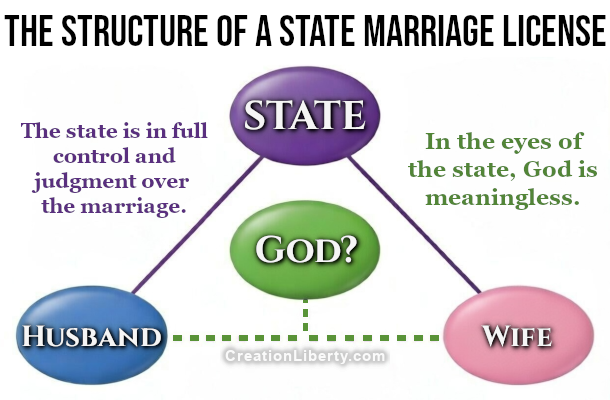
It is quite rare to find a clerk with this level of understanding, and her assessment is absolutely correct. The average American does not realize that in the eyes of the court, there is no man and woman. There are only corporate "persons" documented on paper, and because God cannot be documented in their records, He does not exist to them.
Do not misunderstand me; I am not arguing that faithful Christians cannot work in government. Individuals within government may acknowledge God and look to Him for guidance. The institution of government itself, however, is blind and uncaring toward God's Word, and therefore, the Bible is irrelevant to the marriage license.
To help clarify this, consider Black's Law Dictionary's definition of "marriage." I plead with you to read it carefully and not skim past it, because these are the definitions used in courts of law:
marriage (n): as distinguished [i.e. separate] from the agreement to marry and from the act of becoming married, is the civil status of one man and one woman united in law for life, for the discharge to each other and the community of the duties legally incumbent on those whose association is founded on the distinction of sex
(See 'marriage', Black's Law Dictionary, 2nd Edition, retrieved Feb 5, 2026, [https://thelawdictionary.org/marriage/])
to do with marriage.
In the same way, the state grants the couple a "
From here on, I will continue to use the terms "marriage contract" and "marriage license," but readers must understand that I am using those phrases only in the manner the state uses them. Whenever I write "marriage contract" or "marriage license," I am not referring to marriage itself—I am referring only to the state property-rights contract.
As Cooper continued questioning the clerk, he learned that children produced under the marriage license are considered property of the couple. As the authority over the property-rights contract, the state becomes the sovereign authority over those children:
"[The County Clerk] also said that it is very important to understand thatchildren born to the marriage are considered by law as 'the contract bearing fruit'—meaning the children primarily belong to the State , even though the law never comes out and says so in so many words... he said it is vitally important for parents to understand two doctrines that became established in the United States during the 1930s. The first is theDoctrine of Parens Patriae . The second is theDoctrine of In Loco Parentis .
Parens Patriae means literally 'the parent of the country' or to state it more bluntly - the State is the undisclosed true parent. Along this line a 1930s Arizona Supreme Court case states thatparents have no property right in their children, and have custody of their children during good behavior at the sufferance of the State. This means that parents may raise their children and maintain custody of their children as long as they don't offend the State... the parents are only conditional caretakers. [Thus the Doctrine of Loco Parentis]"
-Virgil Cooper, "Marriage Licenses: The Real Truth," retrieved Oct 10, 2018, [usavsus.info/MarriageLicenses-TheRealTruth.htm]
Although Cooper's statement is generally correct, there are a couple of errors that should be fixed, specifically his reference to a "
That being said, the doctrine of parens patriae is a legitimate concern because if you sign a marriage license, you effectively sign your children—current or future—over as wards of the state. You can claim all you want that your children belong to you and the Lord God, but your signed contract says otherwise, and the state will ultimately enforce its will as it chooses.
The phrase "
Who is the father of a child's father? In this context, it is neither God nor a grandfather. Under a marriage license, the father over the child's father is the state.
It means you are the parent of your children, but under the supervision of the nation. The state can exert authority over you and remove your children from your care—temporarily or permanently—for any reason it deems necessary.
Once your marriage contract is approved, effective immediately, your hidden "
This means the state allows you to raise its children the way you want—while you feed, shelter, clothe, and provide all their necessities out of your own pocket—so long as you raise them in accordance with state-approved guidelines. Any violation of the state's rules for raising the children it acquires through your marriage license will result in law enforcement retrieving its children from you.
Keep in mind that courts will almost never openly tell you that your children are creatures of the state; I am simply pointing out that there are many instances in which children are treated this way by the state because they quietly understand the law and contract. This is why so many cases about "parental rights" have been brought to courts across the country, but sadly, parental rights are not mentioned in the U.S. Constitution.
For example, if your child is rebellious, unruly, and defiant, you ought to discipline him with a spanking to set him straight and cause him to feel pain for his wrongdoing. This is what God instructs us to do when a child remains impenitent in wicked behavior. (Pro 13:24) However, the government may view that as "child abuse" and take away your children because you signed a contract that makes the state the sole ruling authority over your marriage and the children produced from it.
U.S. courts have ruled that parental authority is NOT absolute. (See Prince v. Massachusetts, 1944, 321 U.S. 158) They have ruled that parents do not have full discretion. (See Parham v. J.R., 1979, 442 U.S. 584) Although the standard of convincing evidence tends to be high in most cases, the state can still terminate parental rights over children. (See Santosky v. Kramer, 1982, 455 U.S. 745) With such vaguely written laws, judges in these cases wield far too much power to decide whether they think a parent is "unfit."
For example, in the 1944 case of Prince v. Massachusetts, the court said:
"It is cardinal with us that the custody, care and nurture of the child reside first in the parents, whose primary function and freedom include preparation for obligations the state can neither supply nor hinder. "
-Justice Rutledge, Prince v. Massachusetts, 321 U.S. 158, 1944, retrieved Feb 6, 2026, [https://supreme.justia.com/cases/federal/us/321/158/]
Although most Americans would find this a good and fair statement, we need to carefully consider the wording. When the judge said "
The judge expressed how he felt on the matter, but that does not mean all judges in all states must operate according to his personal preference. Certainly the "
Furthermore, the judge rightly noted that "
The controversial case involved a Jehovah's Witness mother, Sarah Prince, who allowed her 9-year-old niece to distribute Watchtower religious literature on a street under conditions that violated city ordinances based on child labor laws. Although I am firmly against the corruptions of Jehovah's Witness false doctrine, Sarah argued that this violated the First Amendment freedom of religion.
(Read "Corruptions of Christianity: Jehovah's Witness" at creationliberty.com for details.)
After reading the documents, I would side with the court in this particular case, mainly because of the extreme circumstances in violation of state law. However, the fact remains that the court's ruling in this case should be extremely concerning to parents. The court went on to say:
"But the family itself is not beyond regulation in the public interest, as against a claim of religious liberty. "
-Justice Rutledge, Prince v. Massachusetts, 321 U.S. 158, 1944, retrieved Feb 6, 2026, [https://supreme.justia.com/cases/federal/us/321/158/]
Of course, this begs the question: What is public interest? The frightening part is that "public interest," when the law is vaguely defined, is whatever the court says it is.
I cannot emphasize enough that marriage licenses mean the state ultimately holds carte blanche privilege—full discretionary power—over you and your children. There may be some legal barricades, but if the state decides it wants to act, it will enforce its will with endless resources at its disposal, potentially forcing you to spend years of your life to have a chance at gaining remedy.
Some Americans argue that the government could enforce its will whether you sign a contract with them or not. The difference is that when you sign the contract, you willingly GAVE them that power and therefore have little room to argue against them.
If you do not sign a contract with the government, then they have no lawful authority to take your children. If they do it anyway, they are the evildoers, and you are justified in the eyes of God. Being justified in God's sight should concern Christians more than anything, since whatever the government might do against us, the Lord can and will bring us justice in due time.
In the 1979 case of Parham v. J.R., the court ruled that the state has authority over the parents in terms of medical judgment:
"Notwithstanding a child's liberty interest in not being confined unnecessarily for medical treatment, and assuming that a person has a protectible interest in not being erroneously labeled as mentally ill, parents—who have traditional interests in and responsibility for the upbringing of their child—retain a substantial, if not the dominant, role in the decision, absent a finding of neglect or abuse.However, the child's rights and the nature of the commitment decision are such that parents do not always have absolute discretion to institutionalize a child; they retain plenary authority to seek such care for their children, subject to an independent medical judgment. "
-Parham v. J.R., 442 U.S. 584, 1979, retrieved Feb 6, 2026, [https://supreme.justia.com/cases/federal/us/442/584/]
Allow me to remove the legalese and translate that for you in simple terms: "Parents have discretionary power over their children until the state says they don't." This should be quite alarming to Americans, most especially after the recent Covid-19 scam-demic, in which parents were routinely overruled in various aspects—from quackery social distancing and mask rules, even to forced genetic-altering vaccination in some cases, poisoning children against their will.
For example, in Lincoln County, Maine (2021), a minor student in a public school was given Pfizer's mRNA vaccine without parental consent. The parents sued the school, but Maine's Supreme Court dismissed the case under the Public Readiness and Emergency Preparedness (PREP) Act. This demonstrated that if state officials claim their actions are an "emergency," they can do whatever they want without consequences.
The ludicrous thing about this case is that the state claims the school's actions did not constitute "forced vaccination." What else are we supposed to call it? If the parents retaliated by getting out a rifle and shooting the school nurse in the arm, would attempted murder charges be dismissed because it was not a "forced bullet?"
Earlier, I mentioned that Child Protective Services (CPS) has gained an infamous reputation for bypassing the due process clause of the 14th Amendment. They are supposed to respect and uphold due process based on "parental rights" (see Pierce vs. Society of Sisters, 1925, 268 U.S. 510), but they commonly ignore it.
Under the same "emergency" excuse, they often steal American children away from their parents. Under authority of a state marriage license, parents often have little to no legal recourse for justice and restitution, other than rolling the dice with special pleading to a judge—which often costs a lot of money in attorney fees, with varied rates of success.
I am not arguing that these kinds of things happen to most people. The more you involve yourself in contracts with the state, however, the more power you give to state officials to rule over and ruin your life.
If you sign a marriage contract, it does not mean you will be treated like a slave in every instance. Some people go their entire lives without running into any legal problems, but it still adds to the state's ruling authority over you and your family, and some families end up learning this the hard way.
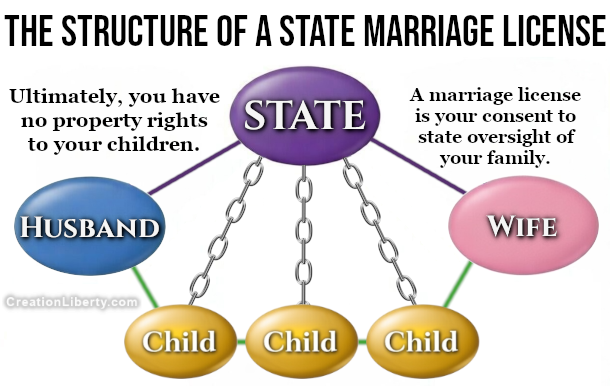
The following author correctly points out:
"When you sign anything that has to do with a state or a local government, there are times when you actually relinquish certain rights. When you sign a marriage contract, you give up your right to educate your children the way you see fit, giving the state authority to educate them and even remove them from you if necessary. "
-Trent Goodbaudy, Freedom from Government: How to Reclaim Your Power, Trent Goodbaudy, 2012, p. 49, ISBN: 9781468196344
When you sign a contract, the government does not sit back and ignore it. Most people think the county clerk simply files a piece of paper away and never thinks of it again. Officials will hold you accountable to it whenever and wherever it benefits the public or the state's establishment of power. It is foolish for people to sign contracts and then think they can do and say whatever they want without considering the boundaries of their agreement.
So much worse are churchgoers, who hypocritically claim to serve the Christian God of the Bible while simultaneously signing contracts without concern about keeping their word. If you say you will do something and then refuse to do it, you make yourself a liar. (Pro 6:16-19, Mat 12:36) As I stated earlier, God holds us accountable to our word, spoken or written, so if we sign a contract, we either need to abide by what we agreed to do, or find a way to lawfully dissolve that contract.
In Wisconsin, government officials attempted to educate ignorant parents on this subject:
"In 1993, parents were upset here in Wisconsin because a test was being administered to their children in the government schools which was very invasive of the family's privacy.When parents complained, they were shocked by the school bureaucrats who informed them that their children were required to take the test by law and that they would have to take the test because they (the government school) had jurisdiction over their children. When parents asked the bureaucrats what gave them jurisdiction, the bureaucrats answered, 'your marriage license and their birth certificates.' Judicially, and in increasing fashion, practically, your state marriage license has far-reaching implications."
-Matthew Trewhella, "5 Reasons Why Christians Should Not Obtain a State Marriage License," Mercy Seat Christian Church, 2012, retrieved Feb 6, 2026, [https://mercyseat.net/pdfs/marriagelicense.pdf]
I am not covering the subject of birth certificates, because that goes beyond the scope of this book. Marriage licenses, however, are the primary source of contractual authority, and the first mistake is getting one.
The second mistake parents make is putting their children into the public education system. This system is corrupt in nearly every county in the United States. Homeschooled students score 15-25 percentile points higher on standardized tests than public school students, and this is just one of many statistics that demonstrate private and homeschooled students substantially outperform public school students, and for good reason.
(See Elka Jacobs-Pinson, "Public School vs. Homeschool Statistics: A Comprehensive Analysis," Sept 18, 2024, retrieved Feb 6, 2026, [https://crowncounseling.com/statistics/public-school-vs-homeschool/])
Some elderly couples realized that the entire structure of the marriage license scheme is designed to keep them trapped in the oppressive system. Their spouses died and left them with pension income, but if they get remarried, they lose that income, as the following pastor testified:
"I have performed wedding ceremonies for couples without marriage licenses—they wanted to be married in the sight of God but didn't care about making it legal. I started doing this when I realized that a great many senior citizen couples in my community were living together after their respective spouses had died. Had they become legally married they would have lost the pension income of a deceased spouse, but on the other hand just 'living together' conflicted with their moral values. "
-Dave Stillie, Extreme Surrender: Breaking Free from Futile Religious Ritual to Develop a Real Relationship with God, CrossBooks, 2013, p. 71, ISBN: 9781462728626
This pastor is foolish and unlearned because he still believes couples need him to marry them. This lacks Biblical evidence and is nonsensical. Pastors commonly cling to this false ideology because they love preeminence from the public, and couples need to start asking questions to understand how much time and money they waste on religiosity.
religiosity (n): religious feeling or devotion; an intense, excessive, or fervent religiousness
(See 'religiosity', Random House Dictionary, 2026, [dictionary.com]; See also Collins English Dictionary, 10th Edition, William Collins Sons & Co, 2012)
The solution to this problem is so simple the average couple obsessed with religiosity cannot see it: Simply give your word in marriage and keep it. If you do that, you don't have to involve the government, spend unnecessary money, or special plead with religious gurus.
The government will use any excuse it can to avoid paying you what you are owed, and the marriage license is just one of those ways. Furthermore, it places unbiblical requirements on the license while also permitting things that are strictly prohibited in God's Word:
| Question About Marriage | State | Bible |
|---|---|---|
| Is a "bill of marriage" required? | Yes | No |
| Is an officiant required? | Yes | No |
| Can you get divorced for any reason? | Yes | No |
| Can same-sex couples marry? | Yes | No |
| Can you get a "legal separation?" | Yes | No |
In short, the couple thinks they are married by the state, so the state becomes the final authority in all matters of faith and practice. Therefore, if the state gives them permission to sin, they think it justifies their sin.
Know ye not that the unrighteous shall not inherit the kingdom of God? Be not deceived: neither fornicators, nor idolaters, nor adulterers, nor effeminate [i.e. trangender], nor abusers of themselves with mankind [i.e. queers], Nor thieves, nor covetous, nor drunkards, nor revilers, nor extortioners, shall inherit the kingdom of God.
-1 Corinthians 6:9-10
Your family might condemn you, but when I read the Bible, Jesus told me that if I follow my family over His Word, then I am not worthy of Him:
He that loveth father or mother more than me is not worthy of me: and he that loveth son or daughter more than me is not worthy of me. And he that taketh not his cross, and followeth after me, is not worthy of me. He that findeth his life shall lose it: and he that loseth his life for my sake shall find it.
-Matthew 10:37-39
Be ye not unequally yoked [i.e. joined, united] together with unbelievers: for what fellowship hath righteousness with unrighteousness? and what communion hath light with darkness? And what concord hath Christ with Belial? or what part hath he that believeth with an infidel? And what agreement hath the temple of God with idols? for ye are the temple of the living God; as God hath said, I will dwell in them, and walk in them; and I will be their God, and they shall be my people. Wherefore come out from among them, and be ye separate, saith the Lord, and touch not the unclean thing; and I will receive you, And will be a Father unto you, and ye shall be my sons and daughters, saith the Lord Almighty.
-2 Corinthians 6:14-18

This ministry does not offer legal advice, so please do not write to me asking details about how to create, amend or dissolve contracts. Roughly half of all law firms in America offer free consultation before retainment, so if you want legal help, contact a law office and ask.
The simple thing to do is give your word in marriage, let your family, friends, and neighbors know you are married when the subject arises, and outside of that, say nothing. When you introduce your spouse, you can introduce the man as your husband or the woman as your wife. Do not volunteer any details and you will find that people just accept it without asking for any details.
But if you offer details, be prepared for backlash. The average churchgoer upholds the marriage license as an icon of supposed "righteousness," so much so, they will defend it even when it makes no sense.
queer (n): strange or odd from a conventional viewpoint; weird; of a person, gay or lesbian
(See 'queer', Random House Dictionary, 2026, [dictionary.com]; See also Collins English Dictionary, 10th Edition, William Collins Sons & Co, 2012)
oxymoron (n): a combination of contradictory or incongruous words (such as cruel kindness)
(See 'oxymoron', Random House Dictionary, 2026, [dictionary.com]; See also Collins English Dictionary, 10th Edition, William Collins Sons & Co, 2012)
If someone wants to argue that marriage is an efficient setup to bring forth children, I agree, but only under the presupposition of the Christian God of the Bible. Outside of the Christian God of the Bible, you must first justify why human existence is morally right. Since good and evil cannot be justified to exist in an atheistic, evolutionary, and humanist worldview, there is no justification for marriage either.
(Read Atheism Unraveled: The Impossibility of Logic and Morals Without God at creationliberty.com for details.)
Since they cannot justify marriage in their own bleak and nonsensical worldview, their strategy is simply not to think about it. They plow blindly forward to find another way to be "married" without the Christian God of the Bible. Some have accomplished this through false religion, in which officiants hold a ceremony to "marry" queers, but the Bible never authorizes or requires a third party to marry two people, and such an officiant makes no sense in any other worldview.
Pagan religion has always acknowledged queers, which is why many of them turn to heathen ideology for help in this area. In America, however, paganism is not very popular compared to other belief systems, so queers do not get much attention or acknowledgment from the public—something many of them greatly desire.
Since they do not rely on the Christian God of the Bible, they turn to majority opinion (a logical fallacy) to make themselves feel better about their choices. They think that if they can get churchgoers to acknowledge them, or the government to force acknowledgment, they will somehow be "married," but in reality, it is impossible for same-sex couples to be married.
Thus, the primary way queers have sought marriage authority is through government, because it is the path of least resistance, but the problem remains that a marriage license is not real marriage. We established that in the previous chapter. Queers do not generally care so long as it is called "marriage" and so long as they can get some public authority to self-identify as being "married."
Creating a public controversy over this subject is exactly what the queers wanted, to get attention. Churchgoers were too blinded by their own hypocrisies to see the trap. So-called "Christian" communities brought forth their public outrage that the government would allow queers to get marriage licenses.
The entire reason queers wanted marriage licenses is because the public ignorantly and foolishly believes those licenses make people married. If the public at large would stop placing their self-perceived "holiness" into state-issued licenses, then queers would not have sought their own alleged "holiness" by obtaining them.
Queers want their sin justified by the public. They cannot get justification in the eyes of God, so they seek to change God into their own image and use public opinion as their justification.
Professing themselves to be wise, they became fools, And changed the glory of the uncorruptible God into an image made like to corruptible man, and to birds, and fourfooted beasts, and creeping things. Wherefore God also gave them up to uncleanness through the lusts of their own hearts, to dishonour their own bodies between themselves: [e.g. queers in fornication] Who changed the truth of God into a lie, and worshipped and served the creature more than the Creator, who is blessed for ever. Amen.
-Romans 1:22-25

There is a lot of word play in this process, so I must translate to help readers understand the nonsensical sleight-of-hand. Remember what we learned in the previous chapter: marriage licenses are not much different than two roommates signing a lease agreement with the property owner—in this case, the state.
Once you understand this point, you will see why the queers are MORE in the right on this issue. They are wicked in their morals and stupid in their philosophy, but when it comes to property rights, ask yourself this: Should all Americans have the right to distribute and will their property to whom they please?
Do American citizens have the right to form property contracts with others at their discretion? Of course they do, and that begs the question: Why should the government be partial against Americans forming state-issued property contracts on the basis of sexual preference?
If a queer wants to sign a property-rights contract with another queer, why should I care? It does not matter to me, because I know marriage licenses (i.e. state-issued property contracts) are not marriage, but willingly ignorant churchgoers think the license is real marriage, so they throw a childish tantrum in objection.
Granted, sodomites (i.e. the Biblical term for queers) do not understand this either. When they pushed for marriage licenses from the state, they did not realize they were only pushing to form a state-issued property-rights contract with their roommate.
Once you see that perspective, it becomes clear that it would be wrong to deny them such a right—just as it would be wrong to deny them the right to sign a lease agreement based on sexual preference. If they want to call that marriage, I will simply laugh at their feeble attempt to maintain delusions of grandeur and normalize their vile sins.
Let's look at some examples of how both churchgoers and the government talk past each other. They both use the term "marriage," but they mean something different by it. Churchgoers say "marriage" and mean God's binding of a man and woman in one flesh, whereas the government says "marriage" and means a corporate business contract between two citizens.
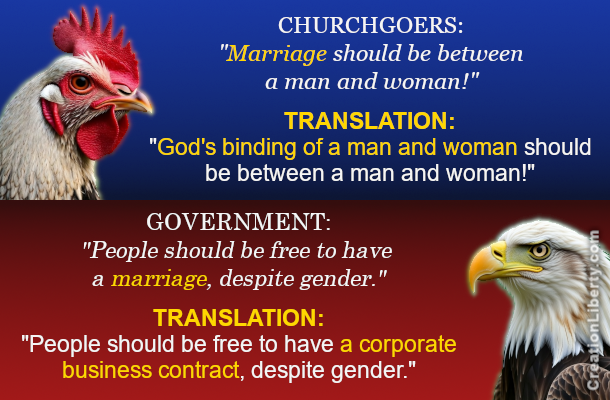
In this example, churchgoers argue that marriage should be between a man and a woman, but the government says marriage should be permitted without limitation on gender. Churchgoers actually say that God's binding of a man and a woman should be between a man and a woman, which is TRUE, and the government says that all citizens, regardless of gender, should be allowed to make a corporate business contract concerning their property rights, which is ALSO TRUE.
Thus, both parties are correct. The problem is that both parties use the term 'marriage' in two different ways without addressing the source of conflict.
Churchgoers may want the government to acknowledge the Christian God of the Bible concerning marriage, but that is not only an overreach of government's sole duty to punish evildoers; it is also impossible within the constraints of the Constitution. Let's read the First Amendment:
"Congress shall make no law respecting an establishment of religion, or prohibiting the free exercise thereof ; or abridging the freedom of speech, or of the press; or the right of the people peaceably to assemble, and to petition the Government for a redress of grievances."
-First Amendment, Constitution of the United States, retrieved Feb 11, 2026, [https://constitution.congress.gov/constitution/amendment-1/]
If Congress, federal or state, passed a law prohibiting queers from obtaining any state license on the basis of sexual preference, that would violate the First Amendment. Morality itself can only be justified by the Christian God of the Bible (as I demonstrated in my book, Atheism Unraveled), so to condemn homosexuality as a sin requires a religious worldview first, therefore making it unconstitutional to pass any law prohibiting queers from obtaining a marriage license.
The solution is for churchgoers to realize that marriage licenses are not marriage. I do not believe that will ever happen in America. Churchgoers are often willingly ignorant and pridefully desperate to justify everything they have done as "righteous." Since gaining this understanding requires humility, most will never accept what I am saying.
But he giveth more grace. Wherefore he saith, God resisteth the proud, but giveth grace unto the humble.
-James 4:6
Pride goeth before destruction, and
an haughty spirit before a fall.
-Proverbs 16:18
Wherefore let him that thinketh he
standeth take heed lest he fall.
-1 Corinthians 10:12
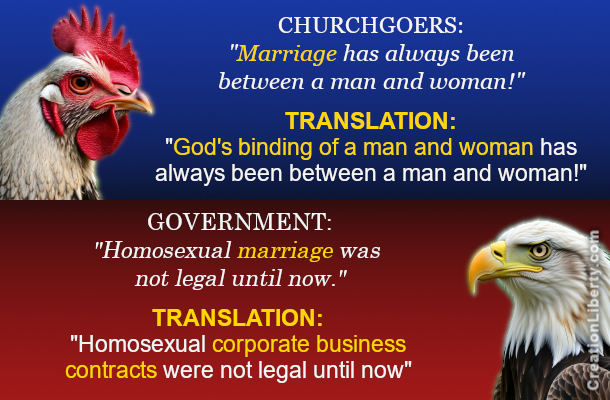
Again, both parties are correct. It is TRUE that marriage has always been between a man and a woman throughout history, and it remains that way today. It is ALSO TRUE that state-issued property rights contracts between queers were not legal in the United States until now.
Most people—both churchgoers and queers—have never considered this: queers have never been prevented from declaring themselves married to each other. They could privately declare they are married, act as if they are, and hire an attorney to set up a property-rights contract between them of their own accord, without any government involvement or public acknowledgment.
That begs the question: Why have they not done so already? As I said earlier, the wicked, godless heathen, slaves to their lust, need public acknowledgment to have any authority or claim any credibility. The fastest way to get public acknowledgment is to use media to be a squeaky wheel among greasy congressmen.
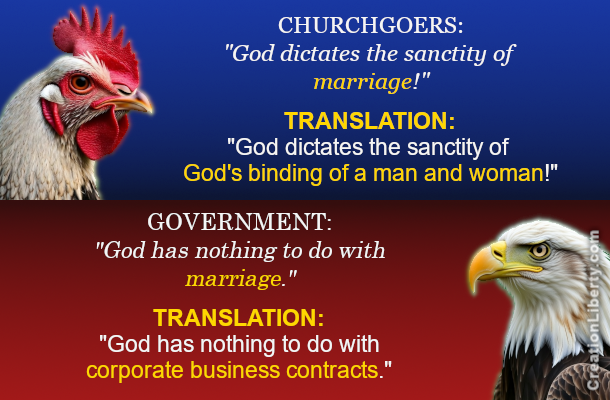
Once again, both parties are correct. It is TRUE that the Lord God established marriage for a man and a woman, and He dictates its sanctification, but it is ALSO TRUE that God is not an acknowledged party in state-issued property contracts.
Ultimately, the battle over "gay marriage" is born out of pride on both sides, confusion, and misplaced faith. Distracted by their petty squabbles, both sides failed to see that the government was the real winner. It gained more money and power in the long run by feeding the delusions of queers who demand something that does not exist, while reassuring ignorant churchgoers that they can retain their imagined "holiness" if they pay a license fee.
and both sides ended up more enslaved.
For Christians, the solution is simple:
- Reject the lie that a marriage license equals marriage.
- Stop acknowledging that queers are "married" by a license.
- Do not give the government more money and power.
- Dismiss pastors of false religion, who offer vain platitudes in pagan ceremonies.
- Live a life and marriage that is a good example for Christ.
The heart of the righteous studieth to answer:
but the mouth of the wicked poureth out evil things.
-Proverbs 15:28
Let us therefore come boldly unto the throne of grace, that we may obtain mercy, and find grace to help in time of need.
-Hebrews 4:16
Those who believe you can get divorced and remarried for any reason are wrong, and those who believe you cannot get divorced and remarried under any circumstance are also wrong. The Bible allows certain conditions under which divorce and remarriage are permitted, but outside of those conditions, there is no Biblical justification for divorce and remarriage.
Divorce was never meant to be an option, but God allowed it. It is important to understand why He allowed it in certain cases:
The Pharisees also came unto him, tempting him, and saying unto him, Is it lawful for a man to put away his wife for every cause?
-Matthew 19:3
And he answered and said unto them, Have ye not read, that he which made them at the beginning made them male and female,
-Matthew 19:4
And said, For this cause shall a man leave father and mother, and shall cleave to his wife: and they twain [i.e. two] shall be one flesh?
-Matthew 19:5
Wherefore they are no more twain, but one flesh. What therefore God hath joined together, let not man put asunder.
-Matthew 19:6
This answer subverted the spies' attempts to trap Jesus. They shifted their tactics and tried to put Him into a contradiction by bringing up the Mosaic law (Deut 24:1) which allowed divorce:
They say unto him, Why did Moses then command to give a writing of divorcement, and to put her away? He saith unto them, Moses because of the hardness of your hearts suffered you to put away your wives: but from the beginning it was not so.
-Matthew 19:7-8
(Read Feminism: Castrating America at creationliberty.com for details.)
I mention this to note that women are not exempt from Biblical rebuke on this point. Both men and women have sin (Rom 3:23), and because of that sin, they harbor hatred against those whom they should be most charitable toward.
Moses, under the guidance of the Holy Ghost, permitted the Jews to divorce their wives. Jesus turned the entrapment of the scribes and Pharisees back around on them, pointing out that the Jews were such a hateful and stubborn people—having great hardness of heart—that it was permitted to prevent further sin.
hardness (n): obduracy [i.e. persistency in sin], impenitence [i.e. absence of repentance, no grief of wrongdoing], confirmed state of wickedness
(See 'hardness', American Dictionary of the English Language, Noah Webster, 1828, retrieved Feb 12, 2026, [webstersdictionary1828.com])
This was not done out of leniency to hateful men, but in kindness and consideration to the victims of such abuse, that they might have protection and peace from the wicked. This is why Moses said:
When a man hath taken a wife, and married her, and it come to pass that she find no favour in his eyes, because he hath found some uncleanness in her: then let him write her a bill of divorcement, and give it in her hand, and send her out of his house. And when she is departed out of his house, she may go and be another man's wife.
-Deuteronomy 24:1-2
And I say unto you, Whosoever shall put away his wife, except it be for fornication, and shall marry another, committeth adultery: and whoso marrieth her which is put away doth commit adultery.
-Matthew 19:9
Whosoever putteth away his wife, and marrieth another, committeth adultery: and whosoever marrieth her that is put away from her husband committeth adultery.
-Luke 16:18
And if a woman shall put away her husband, and be married to another, she committeth adultery.
-Mark 10:12
cherry-pick (v): to choose or take the best or most profitable of (a number of things), esp for one's own benefit
(See 'cherry-pick', Random House Dictionary, 2026, [dictionary.com]; See also Collins English Dictionary, 10th Edition, William Collins Sons & Co, 2012)
Whom shall he teach knowledge? and whom shall he make to understand doctrine? them that are weaned from the milk, and drawn from the breasts. For precept must be upon precept, precept upon precept; line upon line, line upon line; here a little, and there a little:
-Isaiah 28:9-10
- "precept upon precept" — We ought not take commandments in isolation without consideration of other passages in the same context. We should take each commandment in correlation with other commandments.
- "line upon line" — Though some verses are proverbial, and intended to be considered within the scope of the verse alone, most verses do not fall into that category, and should be read in context before conclusions of interpretation are drawn.
- "here a little and there a little" — Correlating verses are rarely in the same location. Often, various verses provide small details, commandments, and considerations, which must all be combined to come to a perfect (i.e. complete) understanding of the doctrine.
But the word of the LORD was unto them precept upon precept, precept upon precept; line upon line, line upon line; here a little, and there a little; that they might go, and fall backward, and be broken, and snared, and taken.
-Isaiah 28:13
This makes it easier for us to spot counterfeit teachers because they will "fall backward, and be broken, and snared, and taken." This is why the Bible says such men are "ever learning" but never able to gain understanding of God's Word, because they have not been born again to receive the Spirit of God.
Having a form of godliness, but denying the power [i.e. authority] thereof: from such turn away. For of this sort are they which creep into houses, and lead captive silly women laden with sins, led away with divers lusts, Ever learning, and never able to come to the knowledge of the truth.
-2 Timothy 3:5-7
But the natural man receiveth not the things of the Spirit of God: for they are foolishness unto him: neither can he know them, because they are spiritually discerned.
-1 Corinthians 2:14
The follow is a list of Biblical reasons for divorce, and we will cover the details about each of these points:
- Impenitent adultery
- Physical abuse of spouse or children
- Unbelieving spouse separating from Christian spouse
Let the husband render unto the wife due benevolence [i.e. kindness, charity]: and likewise also the wife unto the husband. The wife hath not power of her own body, but the husband: and likewise also the husband hath not power of his own body, but the wife. Defraud ye not one the other, except it be with consent for a time, that ye may give yourselves to fasting and prayer; and come together again, that Satan tempt you not for your incontinency. [i.e. the inability to control the lusts of the flesh]
-1 Corinthians 7:3-5
defraud (v): to deprive of right, either by obtaining something by deception or artifice, or by taking something wrongfully without the knowledge or consent of the owner; to cheat
(See 'defraud', American Dictionary of the English Language, Noah Webster, 1828, retrieved Feb 13, 2026, [webstersdictionary1828.com])
In this passage, we are told that the wife's body is under the authority of her husband, and the husband's body is under the authority of his wife. It is benevolent (i.e. kind, loving, and charitable) to submit to the spouse's authority over our flesh, but to reject this authority is to steal from the spouse what rightfully belongs to him or her.
Nevertheless, to avoid fornication, let every man have his own wife, and let every woman have her own husband.
-1 Corinthians 7:2
Though Jesus was targeting the hypocritical and stubborn Jews with His comments about the hardness of their hearts, churchgoers mistakenly believe that the one who divorces has the hardened heart. This is not true in all cases. Each instance should be analyzed according to the facts, and the guilty party (or parties) are those who are sinning.
Certainly, reconciliation should be attempted if at all possible, and forgiveness should be granted at the first sign of repentance, as the Lord has done with us. However, there are numerous circumstances in which a Christian man or woman has wanted to fix the marriage and remain married, but the spouse continues in sinful behavior, causing a rupture in the family.
When giving your word in marriage, God takes it seriously, but remember that a marriage is a combined effort. Marriages cannot be maintained by only one person's dedication. Those who arrogantly think that the efforts of one party alone can hold the marriage together are almost always those who have never gone through the process of having an unfaithful, stubborn, and hateful spouse.
God did not create marriage as a burden to punish those who live honestly and keep their word. Divorce was allowed because of the wickedness of men, AND to give some relief to innocent victims.
Sadly, most divorce courts have turned into a feminized spectacle which do nothing more than torture men for trying to be good husbands and fathers, and rarely punish malicious and manipulative women trying to get everything for nothing. If you want to learn more on that subject, and what to watch out for, I cover that in great detail in my book, Feminism: Castrating America at creationliberty.com.
Thus, marriage is built on the concept of charity, which is the fulfillment of all the law and prophets:
And now abideth faith, hope, charity, these three; but the greatest of these is charity.
-1 Corinthians 13:13
Therefore all things whatsoever ye would that men should do to you, do ye even so to them: for this is the law and the prophets.
-Matthew 7:2
Now the end of the commandment is charity out of a pure heart, and of a good conscience, and of faith unfeigned:
-1 Timothy 1:5
With this understanding of the end of the law being charity, we can now grasp why divorce is justified when physical abuse is present in the household. If a woman is lashing out in anger at her husband and children with physical violence, or the man is doing so against his wife and children, then divorce can be justified to protect the lives of the family, or at least separate until the offender gets help.
The first thing that should always be done in these situations is to seek help from family and friends. This goes for both men and women, as both tend to cover up physical violence out of embarrassment. It is good to find strong and wise family members and friends who can help bring mediation and be eyewitnesses.
No matter the situation, the family should try to bring peace and understanding, but if that cannot be reached, divorce may be necessary to separate the offending party and stop the violence. Too many families have allowed it to go on out of fear and embarrassment, and the end of that road leads to permanent scars and/or death.
Sadly, corrupt preachers will accuse me of being wicked for teaching this doctrine, and their false accusations come from their own uncharitable hearts.
But those things which proceed out of the mouth come forth from the heart; and they defile the man.
-Matthew 15:18
Consider when Jesus healed a man on the sabbath day:
And he entered again into the synagogue; and there was a man there which had a withered hand. And they watched him, whether he would heal him on the sabbath day; that they might accuse him. And he saith unto the man which had the withered hand, Stand forth. And he saith unto them, Is it lawful to do good on the sabbath days, or to do evil? to save life, or to kill? But they held their peace. And when he had looked round about on them with anger, being grieved for the hardness of their hearts, he saith unto the man, Stretch forth thine hand. And he stretched it out: and his hand was restored whole as the other. And the Pharisees went forth, and straightway took counsel with the Herodians against him, how they might destroy him.
-Mark 3:1-6
Again, consider what Jesus said: "Is it lawful to save life or to kill?" Is it better to protect a life or let someone suffer and die? Is it better to depart from the violent spouse who could injure or kill you and your children, or is it better to risk everyone's lives for pretense?
Divorce is not always the answer, and it is uncharitable to choose that first without exploring other options. However, if all other options have been exhausted and the offending party will not change their wicked ways, then divorce is there to help protect the innocent victims and give them a chance to have a peaceful and productive home.
In case some Christians have been raised in a church building where they teach that divorce is sinful no matter what, God always makes exceptions to His rules to protect the innocent. He is extremly kind in that regard. For example, the law makes it clear that killing another man is evil:
Thou shalt not kill.
-Exodus 20:13
He saith unto him, Which? Jesus said, Thou shalt do no murder, Thou shalt not commit adultery, Thou shalt not steal, Thou shalt not bear false witness,
-Matthew 19:18
If a thief be found breaking up, and be smitten that he die, there shall no blood be shed for him.
-Exodus 22:2
The law is the knowledge of sin. (Rom 3:20) With that knowledge we can identify evil, guard ourselves against it, discipline our own hearts, and protect the innocent.
For the oppression of the poor, for the sighing of the needy, now will I arise, saith the LORD; I will set him in safety from him that puffeth at him. The words of the LORD are pure words: as silver tried in a furnace of earth, purified seven times.
-Psalm 12:5-6
In Feminism: Castrating America, I documented studies showing that sole instigators of domestic violence are more often women than men, but roughly 70% of all domestic violence cases are men and women attacking each other at the same time. We will cover this more in chapter seven. I want to encourage all readers—if you are a man, woman, or child—who see this happening: contact family or friends you trust and talk to them about it before something drastic happens.
We have covered adultery and physical abuse, and now we move on to the final justification for divorce. There are situations when an unbelieving spouse no longer wants to be married because the other spouse has been born again in Christ, and Paul explains:
But I speak this by permission, and not of commandment. For I would that all men were even as I myself. But every man hath his proper gift of God, one after this manner, and another after that. I say therefore to the unmarried and widows, It is good for them if they abide even as I. But if they cannot contain, let them marry: for it is better to marry than to burn.
-1 Corinthians 7:6-9
And unto the married I command, yet not I, but the Lord, Let not the wife depart from her husband: But and if she depart, let her remain unmarried, or be reconciled to her husband: and let not the husband put away his wife.
-1 Corinthians 7:10-11
For the unbelieving husband is sanctified by the wife, and the unbelieving wife is sanctified by the husband: else were your children unclean; but now are they holy. But if the unbelieving depart, let him depart. A brother or a sister is not under bondage in such cases: but God hath called us to peace.
-1 Corinthians 7:14-15
Know ye not, brethren, (for I speak to them that know the law,) how that the law hath dominion over a man as long as he liveth? For the woman which hath an husband is bound by the law to her husband so long as he liveth; but if the husband be dead, she is loosed from the law of her husband.
-Romans 7:1-2
If the unbeliever wills to get a divorce and there is no reconciliation, the faithful Christian ought to yield to the unbelieving spouse's desire and suffer the departure. As Paul stated, we are called to peace, not to war. Our contention should only be for faith in Christ and the rebuke of evildoers according to His moral law. (Jude 1:3) In this case, the faithful Christian is also free to remarry—only once—to another who is faithful to Christ, and then remain married for life.
All things should be done in honesty and charity. If you are not honest and charitable in these cases, God will judge you in this life or the next. We are all held accountable for the things we say and do, so do not lie against the truth of your situation to justify yourself in something you may feel like doing.
To give an example, I will briefly describe a situation I documented in my book, Wolves in Costume: Kent Hovind. False preacher Kent Hovind went through a divorce with his first wife, and over the next few years, he would proceed to marry and separate from three more women—never issuing a bill of divorce; only separating from them.
To be perfectly clear, Kent Hovind is currently married to three women at the same time, and is not caring for any of them. Wife #1 lasted from 1973-2016, wife #2 lasted from 2016-2017, wife #3 lasted from 2018-2021, and wife #4 lasted from 2021-2025.
His first wife of many years divorced him after his shenanigans landed her in prison for a year, while Kent himself was in prison for 10 years. After he got out of prison, his activities continued to pose a risk of her being arrested again, so she wisely departed since her husband refused to protect her, and as far as I know, she remains unmarried to this day in obedience to the Scriptures.
But and if she depart, let her remain unmarried, or be reconciled to her husband: and let not the husband put away his wife.
-1 Corinthians 7:11
Kent then geared up to marry his third wife, but when his followers questioned this, he "renounced" his marriage to his second wife. This is not divorce. A "renouncement" simply means he declared their marriage null and void, and therefore not legitimate, so he could move on to sleep with the next woman.
I interviewed Kent's third wife on my livestream, and she departed from him over claims of domestic violence. He also took advantage of her financially while lying to everyone about what happened. She sued him and won all three court cases against him. Kent never divorced his third wife either; instead he "renounced" his marriage to her as well, and this appears to be a contrivance he uses to go from woman to woman.
(See "CLE Interview with Cindi Lincoln (One of Kent Hovind's Wives)," CLE Rumble Channel, [https://rumble.com/vup06r-cle-interview-with-cindi-lincoln-one-kent-hovinds-wives.html])
Kent then married his fourth wife and eventually separated from her as well, although no details are publicly available to explain why. All these marriages—including the abandonment of his wives—took place over nine years. Kent Hovind clearly does not care about God's Word, which is no surprise since he preaches a false gospel on salvation, but in the end, the Lord will judge him for his deceptions and other evil deeds.
As I demonstrated in earlier chapters, there is no need for a marriage license or marriage certificate, but in the case of divorce, there is Biblical precedent for a divorce certificate. The Bible calls this a "bill of divorcement," which is written only by the man and serves as the woman's documented proof that she is no longer bound to her husband:
And if the latter husband hate her, and write her a bill of divorcement, and giveth it in her hand, and sendeth her out of his house; or if the latter husband die, which took her to be his wife;
-Deuteronomy 24:3
Suffer not thy mouth to cause thy flesh to sin; neither say thou before the angel, that it was an error: wherefore should God be angry at thy voice, and destroy the work of thine hands?
-Ecclesiastes 5:6
If any readers happen to be in that situation, there are two important passages you need to understand. In Deuteronomy 24, God is talking about the details of what a woman can or cannot do after her husband divorces her and she remarries someone else:
Her former husband, which sent her away, may not take her again to be his wife, after that she is defiled; for that is abomination before the LORD: and thou shalt not cause the land to sin, which the LORD thy God giveth thee for an inheritance.
-Deuteronomy 24:4
So when they continued asking him, he lifted up himself, and said unto them, He that is without sin among you, let him first cast a stone at her. And again he stooped down, and wrote on the ground. And they which heard it, being convicted by their own conscience, went out one by one, beginning at the eldest, even unto the last: and Jesus was left alone, and the woman standing in the midst. When Jesus had lifted up himself, and saw none but the woman, he said unto her, Woman, where are those thine accusers? hath no man condemned thee? She said, No man, Lord. And Jesus said unto her, Neither do I condemn thee: go, and sin no more.
-John 8:7-11
Ultimately, the best course of action is to be wise in your first choice of partner and marry someone once for life. As I said in the first chapter, you should always draw on the wisdom of those around you, who have your best interests at heart. Never let divorce linger in the back of your mind as an option. Live humbly for the sake of Jesus Christ, be kind and charitable to one another, and then allow God to bless and protect your family—that is my hope for you all.
Most marriages nowadays begin with an emotional high—from the wedding ceremony and the party to the honeymoon—which can last for some weeks or months, but eventually the couple comes down from that high. This is where they are truly tested, to see whether they married based on emotions and common interests or based on family and common philosophy.
As of 2023 the United States has the 6th highest divorce rate in the world, with roughly 40% of all American marriages ending in less than 12 years. Over the past two decades that percentage has slightly dropped and the average length has increased from 10 to 12 years, but as I pointed out earlier, this is only because fewer people are getting married, with many instead choosing to live together in fornication.
(See Pew Research Center, "8 facts about divorce in the United States," Oct 16, 2025, retrieved Feb 17, 2026, [https://www.pewresearch.org/short-reads/2025/10/16/8-facts-about-divorce-in-the-united-states/])
Although some readers might think 12 years is a long time, compared to the length of a lifespan it is quite short. We should also consider that if divorced people go on to remarry, 60% of second marriages end in divorce and 73% of third marriages end in divorce, so the best strategy—for both men and women—is to work on that first marriage and make it the ONLY marriage.
(Wilkinson & Finkbeiner, "Divorce Statistics: Over 115 Studies, Facts and Rates for 2024," retrieved Feb 17, 2026, [https://www.wf-lawyers.com/divorce-statistics-and-facts/])
Do not misunderstand why I share these statistics—I am not trying to scare anyone out of getting married. I am only warning you of the pitfalls if you are not careful. I want all people—most especially Christians—to take this seriously. If you approach marriage wisely, you can have a peaceful, lifelong union.
If you remember back to the first chapter, I said that marriage should be grounded in three basic principles:
- Honesty
- Humility
- Hard Work
Please try to keep these in mind as we continue. Let's begin with the most common issue couples deal with... Based on polls and research, couples struggle with communication more than anything else. I find this ironic because, in my view, it is the easiest issue to handle, but I can still understand why so many people struggle with it.
When couples have a problem, they tend to speak only from their own perspective. Due to mankind's sinful nature in the flesh, they often communicate from a place of wrath and vengeance rather than mercy and charity. This is something each of us must fix within ourselves through prayer and self-discipline.
Wherefore, my beloved brethren,
-James 1:19-20
I bring this up because when a wrathful spouse does not want to be held accountable for words or actions, they will often bring up intimate weaknesses as a distraction. This should be avoided, and the fault in legitimate disputes should be identified and handled accordingly, without being led down pointless rabbit trails that result in vain debate.
This is why the Lord's advice through James is vital. We ought to be ready and willing to hear what the other has to say, consider our words carefully before speaking (Ecc 5:2), and be willing to let go of anger and bitterness over things of little importance—requiring resilient patience, understanding, and humility.
It is difficult to assess proper fault in an argument without speaking directly to both husband and wife and analyzing the details of the situation. Every argument must be handled based on the circumstances. Emotions do not determine right or wrong. The heated party could be in the right and the calm party could be in the wrong—the devil is always in the details. Therefore, the only thing I can do for readers is give general principles to follow, which you should be able to apply to any situation.
Readers should take caution concerning marriage counseling, especially when researching online: Beware the gimmicks.
gimmick (n): an ingenious or novel device, scheme, or stratagem, especially one designed to attract attention or increase appeal
(See 'gimmick', Random House Dictionary, 2026, [dictionary.com]; See also Collins English Dictionary, 10th Edition, William Collins Sons & Co, 2012)
The Gottmans claim there are four horsemen of communication breakdown in a marriage, a direct reference to the four horsemen of Revelation. (Rev 6:1-8) They used the Bible reference to give their psychological analysis an implied "Biblical" connotation—a common trick meant to imply a "spiritual" meaning to gullible churchgoers and thereby lend feigned "Biblical" credibility to their writing.
(See Ellie Lisitsa, "The Four Horsemen: Criticism, Contempt, Defensiveness, and Stonewalling," retrieved Feb 17, 2026, [https://www.gottman.com/blog/the-four-horsemen-recognizing-criticism-contempt-defensiveness-and-stonewalling/])
The "four horsemen" they list are criticism, contempt, defensiveness, and stonewalling, but the Gottman Institute article I referenced did not bother to define those terms anywhere on the page. If we are not specific about what we mean by these terms, then we will not fully understand how and when they are right or wrong. What I am about to demonstrate is that most of them can be good or bad depending on the circumstance.
As we go through these example, you only need to look for two things: malice and strife.
malice (adj): extreme enmity of heart, or malevolence; a disposition to injure others without cause, from mere personal gratification or from a spirit of revenge; unprovoked malignity or spite
strife (n): exertion or contention for superiority; context of emulation, either by intellectual or physical efforts
(See 'malicious' & 'strife', American Dictionary of the English Language, Noah Webster, 1828, retrieved Feb 17, 2026, [webstersdictionary1828.com])
There are degrees to which malice and strife reveal themselves. Sometimes it is obvious, while other times the signs are subtle. It takes a discerning mind to identify it and know how to handle it.
But strong meat belongeth to them that are of full age, even those who by reason of use have their senses exercised to discern both good and evil.
-Hebrews 5:14
criticism (n): the act of passing judgment as to the merits of anything
(See 'criticism', Random House Dictionary, 2026, [dictionary.com]; See also Collins English Dictionary, 10th Edition, William Collins Sons & Co, 2012)
judge (v): to compare facts or ideas, and perceive their agreement or disagreement, and thus to distinguish truth from falsehood
(See 'judge', American Dictionary of the English Language, Noah Webster, 1828, retrieved Feb 17, 2026, 2026, [webstersdictionary1828.com])
Can a critic be malicious and offer an unreasonable judgment of the restaurant? Certainly that can and has happened, which would make the critic wrong in that circumstance. However, if the critic is honest and humble, then a negative response from the restaurant would put the owners in the wrong.
The Gottmans offer this example:
"Complaint: I was scared when you were running late and didn’t call me. I thought we had agreed that we would do that for each other.
Criticism" You never think about how your behavior is affecting other people. I don’t believe you are that forgetful, you’re just selfish. You never think of others! You never think of me!"
-Ellie Lisitsa, "The Four Horsemen: Criticism, Contempt, Defensiveness, and Stonewalling," retrieved Feb 17, 2026, [https://www.gottman.com/blog/the-four-horsemen-recognizing-criticism-contempt-defensiveness-and-stonewalling/]
They label one statement a "complaint" while the other is a "criticism," but in reality, both are criticisms. Both express how the speaker feels rather than expressing the facts, which is key to any argument.
In formal debates, every debater worth his salt understands that you must define your terms and present facts to end the argument. This should also be done in marriage disputes, otherwise, you will end up talking past each other. If the facts do not point in your direction, then you should be willing to concede to those facts by adhering to the principle of honesty that I mentioned at the beginning of this chapter.
The criticism in the second statement exhibits how the speaker feels with malice and strife. It demeans the spouse to gain superiority, which makes that statement evil in its intent. The criticism in the first statement expresses how the speaker feels without malice and strife, which is better but still not correct.
The first statement only expresses feelings about the situation, not the core problem. We have to ask ourselves: What is wrong with agreeing to call if you are running late and then not doing it?
If there was a prior agreement, then the guilty party gave their word and did not keep it, which, as we learned in chapter two, is called a lie. There is nothing wrong with expressing that you were hurt or scared because of it, but the core principle that should have been noted was this: "We agreed we would do that for each other, and by not doing it you did not keep your word, which hurts."
This statement is much better because it includes the facts as well as the moral principle behind the matter at hand. If the guilty party is honest and humble, he or she would have to concede the point, acknowledge the wrongdoing, express sorrow for it, and find a peaceful resolution—which would include the offended party gladly offering forgiveness.
With that in mind, circumstances can change everything. What if the reason for no call was that the phone was dead or broken? What if the reason was an emergency in which there was no opportunity to call? Depending on the situation, a failure to do what was promised does not always constitute a lie, and therefore the feelings of the offended party become meaningless.
We also cannot ignore the general understanding that women tend to have a much harder time accepting criticism than men. This is simply a fact of nature, and I covered the detailed reasons for that in my book, Feminism: Castrating America.
Because the Gottmans know they make most of their money from female purchases, their bottom line is to pander to women. For that reason it is unlikely they would make the bold statements you will find in this book. However, these concepts are necessary to keep in mind because they have a large impact on whether criticism is retaliated against with malice and strife.
Men and women must approach marriage in different ways because each has differing authority. Men have more authority in marriage than women, and women understand this instinctively, but because females' desire for their husbands is a curse from God (Gen 3:16), their entire being is wrapped up in pleasing men, and therefore, in many cases, a wife's inner reaction to criticism can be far beyond irrational.
Relationship consultant and author Alison Armstrong was on The Ellen Fisher Podcast, and described this so well that I figured it might be more impactful for female readers if I let her briefly explain it. I hope men will pay close attention to this as well, because it is good for you to know how much your wife relies on your approval:
"The thing men don't know about women is how sensitive we are to criticism... we think that we—conscious or unconscious—our job is to be pleasing and as long as I'm pleasing, you will only procreate with me, and you'll protect me, and you'll provide for me—as long as I'm pleasing. So I have to be pleasing, andif you mention something critical, I have failed utterly and I'm going to die ... It feels—it crashes the system, and you don't have to say something for it to seem critical. Like,you can state a fact, and we will take it as a criticism. The green beans are cold. *gasp* ... You're just stating a fact! There's no accusation in it at all!... And what men don't know about women is thatwomen don't know that you're affected differently by criticism . How women are affected by criticism is that we change. The green beans are cold, so they will be different next time, and we may resent you for it, but they will be different because we have to survive... Andwhat men don't know about women is that we think that you should be affected the same way by criticism. That's why I criticize you, so you'll change... It doesn't work that way. "
-Alison Armstrong, Interview on The Ellen Fisher Podcast, Jan 8, 2026, retrieved Feb 17, 2026, [https://www.instagram.com/reel/DTRNfNOASG7]
Alison suggests men change the way they approach women, but by following her advice, men would have to change all their speech habits to tiptoe around women, trying to avoid any emotional landmines. This is quite unreasonable, and one my major criticisms of Alison. Although I believe everyone should be at least somewhat considerate with what they say and even how they say it, I firmly disagree with Alison that all the responsibility should be placed on men in this regard.
Again, women were cursed with a deep desire to gain the approval of men, which was handed down from Adam and Eve. This makes her great desire to be pleasing a part of her nature, but it does not relinquish her responsibility to discipline herself and control how she feels.
The ground was cursed for Adam's sake, and he was charged by God to labor until he died. (Gen 3:17) If a man does not work, do we show him pity and adjust everything we say and do around his feelings, or do we rebuke, correct, and discipline him?
Of course we discipline men who are not disciplined because they are expected to operate according to the curses and punishments God gave them—no excuses. So why do women get a free pass? In like manner, women ought to acknowledge what their curse is, what they are like as females, and their emotional instability. Women are free to feel how they feel, but they must control their feelings, and discipline themselves to maintain a calm demeanor and rational approach to the subject matter.
Everyone needs to work through their weaknesses. It's just part of life. When it comes to the spiritual matters of faith, Paul instructed all Christians that they ought to act as adult men in their understanding, not as children:
Watch ye, stand fast in the faith, quit you like men, be strong. Let all your things be done with charity.
-1 Corinthians 16:13-14
quit (v): to carry through; to do or perform something to the end
(See 'quit', American Dictionary of the English Language, Noah Webster, 1828, retrieved Feb 18, 2026, [webstersdictionary1828.com])
That being said, I know of men who act completely unreasonable in the face of criticism, but it is more common in women. Nevertheless, we should all consider one another with charity first and foremost. Whether we are giving or receiving criticism, we should offer as much mercy and understanding to each other as possible, and the more you learn to do that, the more peace you will find in your household.
The Gottmans bring up the next example, which is contempt:
"You’re ‘tired?’ Cry me a river. I’ve been with the kids all day, running around like mad to keep this house going and all you do when you come home from work is flop down on that sofa like a child and play those idiotic video games. I don’t have time to deal with another kid. Could you be any more pathetic?"
-Ellie Lisitsa, "The Four Horsemen: Criticism, Contempt, Defensiveness, and Stonewalling," retrieved Feb 17, 2026, [https://www.gottman.com/blog/the-four-horsemen-recognizing-criticism-contempt-defensiveness-and-stonewalling/]
First, let's define the term:
contempt (n): the feeling with which a person regards anything considered mean, vile, or worthless
(See 'contempt', Random House Dictionary, 2026, [dictionary.com]; See also Collins English Dictionary, 10th Edition, William Collins Sons & Co, 2012)
redundant (adj): exceeding what is needed or useful; superfluous; characterized by unnecessary words or repetition
(See 'redundant', Random House Dictionary, 2026, [dictionary.com]; See also Collins English Dictionary, 10th Edition, William Collins Sons & Co, 2012)
Although contempt against sin is considered righteous (Pro 8:13), it is not contempt against the sinner. Righteous indignation is anger at the evildoing of another for the purpose of stopping wickedness and bringing justice to victims—not hatred of an individual, for that would likewise be sinful in nature. (1Jo 3:15)
Ultimately, the attitude from a malicious spouse is, "Why don't they do more for me?" The attitude of the faithful spouse is, "What can I do to make life easier for them?" As Jesus taught us, the end of the law and prophets is charity: to consider others and treat them the way we would want to be treated. That is why it is so important, when looking for a spouse, that you choose one who has a charitable heart.
Therefore all things whatsoever ye would that men should do to you, do ye even so to them: for this is the law and the prophets.
-Matthew 7:12
"Question: "Did you call Betty and Ralph to let them know that we’re not coming tonight as you promised this morning?"
Defensive response: "I was just too darn busy today. As a matter of fact, you know just how busy my schedule was. Why didn’t you just do it?"
-Ellie Lisitsa, "The Four Horsemen: Criticism, Contempt, Defensiveness, and Stonewalling," retrieved Feb 17, 2026, [https://www.gottman.com/blog/the-four-horsemen-recognizing-criticism-contempt-defensiveness-and-stonewalling/]
defensive (n): excessively concerned with guarding against the real or imagined threat of criticism, injury to one's ego [i.e. pride], or exposure of one's shortcomings
(See 'defensive', Random House Dictionary, 2026, [dictionary.com]; See also Collins English Dictionary, 10th Edition, William Collins Sons & Co, 2012)
Let's use the Gottmans' example to learn how to handle defensive people. As I pointed out in earlier examples, the first thing we need to do is identify the wrong, and in this case it was lying: someone who gives their word and does not keep it.
When a person with malicious intent asks a question, it is very often a strategy and very rarely a request for knowledge. Malicious people use questions as a weapon to make you feel ashamed, to trigger a false sense of guilt, thereby keeping you focused on self-analysis to distract you from pointing out their wrongdoing.
Often, malicious people strive based on pure emotion, which means they often do not consider or remember what they just said. Repeating their question back to them before answering it can be effective. When the malicious spouse asks why we did not do it, we could respond, "Why didn't I just do it? Because you gave me your word you would do it."
No matter what a malicious person says, when they are on the defensive they need to distract you from focusing on the wrongdoing in question. Therefore, focus only on the wrongdoing while being charitable in return.
If we add something like, "If you ask me, I would be happy to do it for you," this shows willingness to help without relinquishing the responsibility of the spouse who gave their word and failed to keep it. If we do not address the wrongdoing, nothing changes—it is not fun, but the root of sin must be identified and worked out.
I have seen many marriage counselors tell people that they need to let things go, which is true in some cases. However, in the case of sin, there is no letting it go until it has been discussed and resolved, otherwise, the sin will continue and repeatedly inflict grief on the marriage.
Although some readers may want strategies for dealing with resistant spouses, I have nothing specific to offer because different situations require different approaches. Men and women, for example, should approach one another differently according to their distinct roles and authority, and without a particular instance to examine, no single rule always works.
Men hold the authority in marriage, and the advice I always give them when confronting their wives is "firm, but gentle." A good leader knows how to be gentle and to exercise his authority charitably, with discipline, reason, and confidence, which requires much study and practice.
Because women do not hold the authority in marriage, they often think it is harder to address these matters, but the difficulty usually stems only from the fact that they were never taught how to approach men. More often than not, men are benevolent toward their wives, so women simply need to learn how to be feminine in their approach to conflict.
The advice I give to women is "honorable and gentle submission." Bring your strong conviction to your husband in this manner, and you may be surprised at the result.
Likewise, ye wives, be in subjection to your own husbands; that, if any obey not the word, they also may without the word be won by the conversation of the wives; While they behold your chaste conversation coupled with fear.
-1 Peter 3:1-2
If you are a female who is not used to this approach, try it sometime. You can use this with your father, brother, or husband. Sometimes you will need to wait hours or days before seeing a result, but the man's reaction may surprise you.
On the other hand, defensiveness is generally protective and resistant to attack, which is not necessarily a bad thing. The definition I provided earlier hinges on whether the defensive person has malicious intent.
If the attack comes from dishonest accusation, then defensiveness is not wrong. However, as I pointed out earlier, it is far better to gently, wisely, and charitably go on the attack against the sin rather than let someone force you to constantly hide behind a shield.
The last "horseman" is stonewalling:
"Stonewalling occurs when the listener withdraws from the interaction, shuts down, and simply stops responding to their partner. Rather than confronting the issues with their partner, people who stonewall can make evasive maneuvers such as tuning out, turning away, acting busy, or engaging in obsessive or distracting behaviors."
-Ellie Lisitsa, "The Four Horsemen: Criticism, Contempt, Defensiveness, and Stonewalling," retrieved Feb 17, 2026, [https://www.gottman.com/blog/the-four-horsemen-recognizing-criticism-contempt-defensiveness-and-stonewalling/]
stonewalling (n): the act of stalling, evading, or filibustering, especially to avoid revealing politically embarrassing information
(See 'defensive', Random House Dictionary, 2026, [dictionary.com]; See also Collins English Dictionary, 10th Edition, William Collins Sons & Co, 2012)
I have watched women rail and nag at a man for the sole purpose of rage bait—a vicious attempt to provoke him into physical violence so she can use it against him. Although this behavior is far more common with women, I have seen both men and women act this way. In such situations, the solution is to silently record everything that is happening and then withdraw from the malicious encounter until the bad actor has calmed down—only then can a reasonable conversation lead to resolution and reconciliation.
That being said, if the refusal to engage is based on maliciousness—in that the withdrawn spouse has no intention of reconciliation—then it becomes a sinful act. There is no charity in that attitude. They do it only to hurt their spouse, nothing more.
To speak evil of no man, to be no brawlers, but gentle, shewing all meekness unto all men. For we ourselves also were sometimes foolish, disobedient, deceived, serving divers lusts and pleasures, living in malice and envy, hateful, and hating one another.
-Titus 3:2-3
At times you need to be silent and pull back from the situation to think. If that is the case, then silence alone is insufficient because it leaves your spouse confused, hurt, and insulted.
The section of this chapter is called "Communication," and one of the interesting things about this term is that most people do not know what it means. They think it means "talking," but actually it generally means giving:
communication (n): the act of imparting, conferring, or delivering, from one to another
(See 'communication', American Dictionary of the English Language, Noah Webster, 1828, retrieved Feb 17, 2026, [webstersdictionary1828.com])
In the end, you do not need gimmicks to be good communicators. I only addressed what the Gottmans are teaching because they are so frequently searched for on the internet, and I find them to be redundant, senseless, and useless in many regards. Allow me to simplify this because, ultimately, there are three things you need to train yourself to look for and understand:
- Malice and strife—identify the sin, and address it.
- Avoidance and deflection—bring the topic back to the sin.
- Charity and forgiveness—show kindness and understanding, with a willingness to forgive at the first sign of penitence.
penitence (n): repentance; pain; sorrow or grief of heart for sins or offenses; contrition that springs from a conviction of guilt
(See 'penitence', American Dictionary of the English Language, Noah Webster, 1828, retrieved Feb 19, 2026, [webstersdictionary1828.com])
Take heed to yourselves: If thy brother trespass against thee, rebuke him; and if he repent, forgive him. And if he trespass against thee seven times in a day, and seven times in a day turn again to thee, saying, I repent; thou shalt forgive him.
-Luke 17:3-4
(Read There is No Saving Grace Without Repentance at creationliberty.com for details.)
In chapter eight I will give you some examples of communication issues I have gone through in my own marriage and how they were resolved. But you should always remember that communication is one of the largest pillars of a stable marriage. Without proper communication, nothing else I discuss in this chapter will have any resolution. As I said earlier, there is no flawless marriage, and each one has its conflicts. This is normal, but a surprising number of couples fight endlessly—moving from one argument to the next with only brief pauses and no resolution.
resolution (n): a solution, accommodation, or settling of a problem or controversy
(See 'resolution', American Dictionary of the English Language, Noah Webster, 1828, retrieved Feb 20, 2026, [webstersdictionary1828.com])
bitterness (n): in a figurative sense, extreme enmity, grudge, hatred; or rather an excessive degree or implacableness of passions and emotions
(See 'bitterness', American Dictionary of the English Language, Noah Webster, 1828, retrieved Feb 20, 2026, [webstersdictionary1828.com])
Wherefore putting away lying, speak every man truth with his neighbour: for we are members one of another. Be ye angry, and sin not: let not the sun go down upon your wrath: Neither give place to the devil.
-Ephesians 4:25-27
In the general sense, anger is not a sin, because if it were, God would be a sinner, and God cannot sin. Anger does not become sin until it springs from pride, selfishness, and covetousness; only then does a person develop deep-seated hatred of another rather than hating the sin itself.
Therefore, we should not allow "the sun go down upon" our anger, meaning that we deal with the issue quickly, resolve the matter, and let go of our anger. Many things in this world require us to release anger without resolution, because they happen in passing with people we do not know, but we are talking about marriage. As opposed to a stranger, the person with whom we share an intimate relationship may have wronged us in our own home, so we must address anger by targeting the wrongdoing while remembering that we are speaking with an intimate companion.
Fights are generally viewed negatively, and they are to a degree, but if you avoid conflict you miss the opportunity to grow closer and strengthen your relationship. Arguments can become deeper connections, but we have to see past the surface level of the argument to find the core of the dispute.
Some arguments arise over simple things with clear solutions, like taking out the trash, budgets, or child discipline. These can be settled through compromise, research, and planning.
Perpetual problems are typically over fundamental values, personality traits, or lifestyle choices. These are quite common because the old saying "opposites attract" is true and works well in marriage.
If you married someone exactly like yourself, then your spouse shares your weaknesses and makes you both vulnerable, but if your spouse has strengths, interests, and skills different from yours, then with your powers combined, the two of you gain a wider range of capabilities. Your differences make you a strong team to take on challenges life throws your way.
In some instances, these differences can be changed to a degree through dialogue and discipline, but other things will not change as readily. Therefore we often have to accept certain outcomes, compromise based on preferences, and remember that a little humor goes a long way in overcoming challenges.
If you need to raise a conflict with your spouse, do not barge in with guns blazing. That puts your spouse on guard, stresses them out, and immediately closes them off to hearing and understanding. For men, a woman bursting in with nagging creates annoyance and frustration, and for women, a man bursting in yelling creates fear and anxiety—both suffer grief.
Remember the communication lessons: Approach potentially intense conversations with charity, considering the other first before yourself. Think about how you would like your spouse to approach you if they have a concern. Begin gently, calmly, and peacefully. If the topic permits, add some humor and laughter to remind them that you are both in this marriage together for the long haul.
Monitor yourself, and if you find you are getting heated with anger boiling up and increasing your heart rate, tell your spouse that you want to take twenty minutes to calm down. Try to identify this early, before your anger overloads. Take a walk with slow deep breaths, and pray that the Lord would calm your heart and mind.
Be reasonable in your approach, and remember that this is supposed to be the person who loves and cares for you more than anyone else in the world. Quick de-escalation is key. A simple apology like "I apologize for raising my voice," a touch on the hand, some witty humor (if that is your personality), or an affirmation like "Even though we fight, you're still my favorite person" can be extremely effective in softening a stony heart.
If you disagree with your spouse, try offering to understand. Ask questions like, "Can you help me understand why this matters so much to you?" Acknowledging statements like "I see why that frustrates you" can help to validate the way they feel about an issue, even if you disagree, but you should only say these things in honesty with a genuine heart—never lie to assuage anger or frustration, as a spouse can typically see through it, and it will only increase wrath.
Always keep in mind that if sin lies at the core of the matter, you must address it. De-escalating conversations should not become a pretense to avoid confronting wrongdoing; rather, it is a charitable method and useful tool to keep the discussion cool and reasonable.
I have found that a sincere compliment in the middle of an argument goes a long way. No matter the subject, if you calm your mind and heart you can find something the other has done well. Show appreciation for their good deeds and hard work. This opens them to the understanding that even though you are fighting, you are not their enemy.
Remember what I taught in earlier chapters: if you want a spouse who is humble and kind in demeanor, you must first humble yourself and become a kind role model for them to follow. Be the change you want to see in your spouse. If you are unwilling to become the kind of person you want your spouse to be, then you are asking too much of them.
You should also note that if you see any positive changes in your spouse, use those communication skills and point out their hard work, dedication, and thoughtfulness. Do not overlook small things your spouse does. Take notice, praise the little things, and celebrate larger accomplishments. Do this consistently, and you will find that making requests becomes easier over time. I put these points in this order for a particular reason. Some couples will find that if they work on their communication skills and conflict resolution, intimacy will automatically increase slowly over time.
However, other couples will still experience this occasionally after having children or going through high-stress situations. Do not consider it weird—that is perfectly normal. Marriage is work, which is why I called this section BUILDING intimacy, and if you want something good with longevity, you have to put in the time and effort.
![How to Build Intimacy in a Marriage [creationliberty.com]](../images/marriage30.png "How to Build Intimacy in a Marriage [creationliberty.com]")
intimacy (n): a close, familiar, and usually affectionate or loving personal relationship with another person or group
(See 'intimacy', Random House Dictionary, 2026, [dictionary.com]; See also Collins English Dictionary, 10th Edition, William Collins Sons & Co, 2012)
When the husband comes home from work, the wife may speak to him and he may listen, but his body language shows he is focused on taking off his shoes, grabbing a snack, or turning on the television. The husband may have something to tell the wife, but she stands at the stove with her back turned or does not look up from her book or phone.
Think about your daily life and how you approach people. If you interact with customers, co-workers at your job, or clerks at a shop, do you make eye contact with them? Do you turn your body away from them or toward them when you interact? Do you pay them no attention when they speak to you?
I am not arguing that we should build intimate relationships with customers, co-workers, or clerks; although that is not a bad idea if you operate a business. My point is that it is paradoxical for couples to devote significantly more time and detailed effort to ordinary, non-intimate interactions than to the intimate partner they claim to prioritize.
Imagine for a moment you are at a restaurant where a waitress approaches you, introduces herself, asks for your order, writes it down, brings it out, and serves all your plates and drinks. Now imagine that during that entire process you never once look at the waitress—do you think that would seem rude?
The vast majority of people would not treat others this way in public, but some will treat their spouse this way. If you are having intimacy problems, simple body language is positive step in the right direction. The next time your spouse wants to speak with you, try pausing or putting down whatever you are looking at, turn your body toward your spouse, and make eye contact.
For some, this seems like an overly simple gesture that will make no difference, but I assure you it will make a great difference in a short time. Imagine how hurtful it would be to have your spouse turn away from you when you start speaking. How would you react if a waiter or waitress turned away from you the moment you began to speak? Would you return to that restaurant? Likely not. If you would not use that body language with strangers, why would you do it in your most intimate relationship? Hopefully this helps couples understand why divorce looms over marriages where both parties refuse to respect simple body language that communicates basic value to their partner.
your body language will reflect it.
Thou blind Pharisee, cleanse first that which is within the cup and platter, that the outside of them may be clean also.
-Matthew 23:26
O generation of vipers, how can ye, being evil, speak good things? for out of the abundance of the heart the mouth speaketh.
-Matthew 12:34
For men: Take the initiative to ask her about something she has been working on for your sake or the sake of the family. This gives her the reward of your attention for productive effort and encourages her to continue being productive to earn your attention in the future.
If she has been doing workouts to keep her figure, ask how those have been going or whether she has tried any new exercises lately. If she mentions that a certain part of her body is sore, take twenty seconds to massage it so she feels better. The entire exchange may take only a minute or two, but it can build a great deal of intimacy in the long run.
If she has made effort to keep something clean or to cook something new, speak up about it. Although criticism has its time and place and should be offered with reason and charity in proportion to the seriousness of the error, it is far more important to offer members of your household encouragement for good things when they occur, and reward them with attention.
Do not dismiss what she tells you. Try not compare her to yourself, and do not belittle her in any way. Listen to understand, not to fix any problems she may mention—only try to solve problems after you have heard her out.
Remember that women are the weaker vessel. (1Pe 3:7) What might not seem like a big accomplishment to you might be a big accomplishment to her, so if she overcame, conquered, or achieved anything productive—even if it was small—let her know she did a good job.
Consider once again that the curse of women after the fall in the Garden of Eden is that a woman's desire would revolve around her husband. This means her goal is to be pleasing to a man, whether she admits it or not.
If she has done something that has pleased you, let her know. You may not be used to doing that, but as the king of the household you need to make effort to let your subjects know when they have done well.
If there is something she can improve, simply say, "There is one thing you could do a bit different that could make this even better for me," then tell her what that is. Do not scoff and scold, because negativity only breeds more negativity. There are times and places for anger and putting your foot down, but in most cases that is unnecessary and unproductive. If you make these small changes, you may be surprised by her openness to changing things to better please you, and her overall intimacy toward you will increase.
For women: Remember this man is the king of your household and should be treated as such. He highly values honor, submission, obedience, and loyalty. Ignoring him with your body language communicates the opposite of these characteristics. Thus, when he expresses or shares a criticism, frustration, or general thought about anything in or out of the home, stop what you are doing, turn toward him, make eye contact, and engage.
The Bible instructs wives to treat husbands with reverence:
Nevertheless let every one of you in particular so love his wife even as himself; and the wife see that she reverence her husband.
-Ephesians 5:33
reverence (v): to regard with fear mingled with respect and affection; we reverence superiors for their age, their authority and their virtues; we ought to reverence parents and upright judges and magistrates; we ought to reverence the Supreme Being, his word and his ordinances
(See 'reverence', American Dictionary of the English Language, Noah Webster, 1828, retrieved Feb 24, 2026, [webstersdictionary1828.com])
Do not fall into despair, cry, whine, or complain. These responses will only make your husband feel uncomfortable and irritated, and they will close him off to intimacy and open communication with you in the future.
Instead of snapping back with a negative attitude, as I have often seen women do, respond by asking him how you could do this thing better for him. Compliment him for being so observant, and thank him for the suggestion. Point out how grateful you are that he cares enough about the household to offer his advice.
If your husband comes to you with something deep and personal, do not ignore him, and under no circumstances should you berate or make fun of him. Women often see men as so battle-hardened that they believe they cannot hurt them by their words and actions, but that is far from the truth.
A vital note for women: If your husband shares anything secret, deep and intimate with you, NEVER share that with anyone else, no matter what. Unless he gives you his express permission, that must stay between you and him at all times. For you to share his intimate problems or secret thoughts with anyone else is a disloyal betrayal of trust—he will never forget it, and whether you know it or not, it causes a rift in your marriage that can last a lifetime.
It is not my intent to offer crude visuals, but it is necessary for women to understand this point: Imagine that your husband brought you into a room with all his friends and stripped you naked for all of them to see. For women, your body is a vulnerability. Would you soon forget that, or would you carry it with you for a lifetime as a betrayal of trust? This is exactly what it is like for men when you share his deep, personal, intimate thoughts, worries, and experiences with your friends and family.
What women do not know about men is that when you are not loyal to him, when you do not take heed of what he tells you to do, when you do not follow his instructions, and when you do not take care with the vulnerable things he shares with you, you are pouring bitterness into him. It festers and grows. There is a secret bottle of emotions deep within men which they have safeguarded and kept hidden in order to become strong, and every time you do one of these things, add drops of bitterness into that bottle, even though you may not witness the immediate results of your wrongdoing.
This is why the Bible specifically instructs men on this point:
Husbands, love your wives, and
be not bitter against them.
-Colossians 3:19
No matter the circumstance, if your husband seems withdrawn and unresponsive, he is likely thinking about things on his own. One of the most important pieces of advice I can give to women on this point is this: Do not nag your husband.
nag (v): to annoy by persistent faultfinding, complaints, or demands
(See 'nag', Random House Dictionary, 2026, [dictionary.com]; See also Collins English Dictionary, 10th Edition, William Collins Sons & Co, 2012)
Men do not respond well to nagging. Though he ultimately might do what you want, I guarantee he only did it to shut you up, and it always results in unseen internal consequences.
Nagging will slowly chip away at your husband's patience. If intimacy is your goal—to motivate your husband to do things for you out of love and concern rather than to stop the source of annoyance and frustration—then you must approach him lovingly and patiently. Offer helpful reminders, but never be pushy, loud, or demanding—always consider his wants and needs above your own.
My advice for both men and women is to consider the wisdom of God:
A soft answer turneth away wrath:
but grievous words stir up anger.
-Proverbs 15:1
- MEN: Be Encouraging
- WOMEN: Be Impressed
Patience and persistency is key for intimacy. You cannot force open that door. You have to gently knock, and wait for it to be opened. Therefore, take your time, be consistent, and eventually, you will see progress, perhaps sooner than you think. On some polls, this subject receives more inquiries than others, but it is complex to address directly because a healthy sex life in marriage is the end result and reward of an intimate relationship—not a separate entity apart from the other building blocks. The major problem is that couples often compare their sexual interactions to sinful, heat-of-lust encounters,which is a huge mistake because the best sexual encounters come with the one you have held hands with through the struggles of life.
Sexual intimacy can feel quite easy at first due to new experiences, but that initial thrill fades over time. It then requires deliberate effort and planning to maintain.

God created a desire for sexual intimacy in most people for the purpose of bearing children, and He blessed us by making the experience pleasurable. However, He laid down rules that it should occur only within the bounds of marriage, which mean sex an important part of marriage to help us avoid sin and raise healthy families.
Now concerning the things whereof ye wrote unto me: It is good for a man not to touch a woman. Nevertheless, to avoid fornication, let every man have his own wife, and let every woman have her own husband. Let the husband render unto the wife due benevolence: and likewise also the wife unto the husband. The wife hath not power of her own body, but the husband: and likewise also the husband hath not power of his own body, but the wife. Defraud ye not one the other, except it be with consent for a time, that ye may give yourselves to fasting and prayer; and come together again, that Satan tempt you not for your incontinency.
-1 Corinthians 7:1-5
defraud (v): to deprive of right, either by obtaining something by deception or artifice, or by taking something wrongfully without the knowledge or consent of the owner; to cheat
incontinent (adj): not restraining the passions or appetites, particularly the sexual appetite; indulging lust without restraint or in violation of law; unchaste; lewd
(See 'incontinent', American Dictionary of the English Language, Noah Webster, 1828, retrieved Feb 25, 2026, [webstersdictionary1828.com])
Certainly there are situations with only one bad actor. I have seen marriages in which one person tries while the other does not. More often, however, both parties share guilt for sexual separation because they failed to lay the proper foundation of good communication, conflict resolution, and building intimacy—topics we have already covered in this chapter.
I want readers to understand that if you face sexual problems, you are not alone. Surveys show that about a third of all couples have sexual interaction as little as one to three times per month, with many feeling neglected and wanting more. More recent studies suggest that as many as 25 percent of American couples have sex less than once per month.
(See Peter Ueda & Catherine H. Mercer, "Trends in Frequency of Sexual Activity and Number of Sexual Partners Among Adults Aged 18 to 44 Years in the US, 2000-2018," JAMA, 2020;3;(6):e203833, doi:10.1001/jamanetworkopen.2020.3833, retrieved Feb 25, 2026, [https://jamanetwork.com/journals/jamanetworkopen/fullarticle/2767066])
It is a common problem for couples to avoid talking about sexual issues, often out of fear or embarrassment, but we must remember that sex was created by the Lord God for the enjoyment of married couples. Therefore, if we apply everything we have learned so far in this chapter to conversations about sex, it becomes easier to overcome fear and embarrassment, knowing we have a partner we can trust.
Marriage is honourable in all, and the bed undefiled:
but whoremongers and adulterers God will judge.
-Hebrews 13:4
Mismatched desire ranks among the most common issues in a sexless marriage. It often stems from a lack of communication, avoidance of conflict resolution, and missing intimacy. In many cases, working on the first three sections of this chapter creates a domino effect that solves this problem.
However, other factors can create problems, such as one spouse feeling rejected or pressured. These instances must be solved through proper communication. You have to talk it out and discuss what you want and need from your partner, because it is unreasonable to expect your partner to read your mind.
Other times, high stress and fatigue cause a drop in sexual appetite, along with hormone changes such as menopause or postpartum recovery. This requires patience, thoughtfulness, and charity in times of need, as you consider your spouse's body as you would your own flesh.
If you know your spouse has undergone heavy stress and fatigue, try creating a relaxing environment on a special evening. Muscle massages, a favorite drink, some comfort food, and peaceful quiet—perhaps by sending the children to stay with relatives for a night—can work wonders to calm your partner and encourage sexual engagement.
Always remember charity in these difficult times. Think about your spouse before yourself. If you want sexual interaction, then be what your partner needs—this creates intimacy and encourages sexual stimulation.
Sadly, one or both parties might have experienced sexual abuse as children, which can cause awkward and long-term conflicts. I wish I could say this never happens, but it occurs more frequently than some of us may choose to believe. This requires sensitive conversation, and can be a difficult hurdle, but not an impossible one.
The victimized spouse will need to open up about some of the deep and dark things that were done, why they recoil at specific words, actions, or touching, and—with your help—train themselves to accept certain things with love instead of fear. You can be a vital aid in your spouse's rehabilitation. In these conversations, always listen intently with understanding, never belittling or criticizing how they feel, and offer your complete support, which will help create a strong sexual bond.
One of the killers of sexual intimacy is robotic or mechanical routines. Although sexual intercourse is a duty—much more for women than for men—it should be treated as an enjoyable privilege rather than a boring chore.
To help in this regard, think back to when you first met. Did you say hello, exchange names, and immediately jump into bed together? I would hope not. You talked, laughed, hugged, kissed, and did many other things that increase sexual desire gradually. Although couples get very busy in their day-to-day activities, you need to create low-pressure time for sexual engagement that builds up slowly.
Chore-based mechanical sex makes everything stale, and orgasms become far less enjoyable, leaving both partners unfulfilled. Robotic, apathetic sex is like eating a rice cake for dinner: quick and easy, but unsatisfying, whereas a juicy steak is far more satisfying and memorable, yet it takes longer to prepare.
God created men and women with complementary ways of experiencing arousal and desire that serve one another while remaining unique. Couples also develop specific preferences based on experience and interests. You should therefore stay attuned to those preferences and learn how to best use them to initiate sexual intimacy with your partner.
For men: You need to learn that women build sexual desire gradually through emotional safety, affection, and feeling cherished. This can often be accomplished with soft words, light touching, hugs, kisses, and cuddling. A few minutes of effort can often bring her out of a "not in the mood" state of mind.
Women are often heavily self-conscious, moreso on some days than others, and words that build her confidence in her body and personality are helpful. Do not rush the process. Watch for her small body language cues and advance slowly as she opens up, picking up the pace as the temperature rises.
If she is working on something, approach slowly from behind, begin with the suggested soft introduction, and wait for her to turn toward you when she is ready. If you find her getting irritated or distracted, do not give up. Be persistent, but if necessary help her with whatever is distracting her—whether a household chore, children, or animals. Remove the obstacles and distractions first so she experiences less stress.
For women: You need to learn that men build sexual desire from visual appeal, admiration, and your submission. The first thing you should always do is present yourself to him in a way that highlights your beauty and feminine features.
Take your time and never be pushy, especially if he is tired. Remember that intercourse primarily requires exertion from the man. Women often do not consider that, in most cases, females do not have to put in much physical effort and therefore do not always consider a man's exhaustion to be a hurdle. Sex is physically taxing exercise, so you must wait for him to decide he wants to pursue you.
Do not engage men like you are hunting deer; rather, engage as if you are fishing. Get the right lure for correlating interest, dangle it in front of the fish, and wait for a bite—you may not get what you want, but your chances are higher than trying to force a catch with your bare hands.
Words need to be chosen carefully, and most often, you should not communicate with a man in the same way he communicates with you. Men are not women. Many 21st century American women grow up without a proper female role model to teach them this principle. Keep in mind that, in general, men are designed to be the authority who gives to women, and women are designed to submit to him in reception of that power.
Your words should therefore describe yourself—specifically your own body’s reaction to his masculine presence—while admiring his strength in obedience and surrendering to his will. Most women avoid this out of embarrassment, but when a woman sets aside her embarrassment and openly shares how her body reacts for him, it demonstrates strong submission and vulnerability, which is extremely enticing to men.
As a woman, you most likely enjoy hearing a man tell you what he is going to do to you in bed, but remember that your roles are not the same. Although not all men are identical, and there are exceptions to the rule, in most cases, men do not want to hear the same thing from you. Because you are not in authority, he wants to hear what you want him to do to you.
Opening up about your body's desire for him and the pleasure you receive from his actions—especially when presenting yourself in a special state of dress or undress—forms an extreme act of surrender and yield to his authority and strength. Women are sexually enticed when made to feel beautiful and desired, while men are sexually enticed when made to feel powerful and desired.
Men do not become aroused if a woman picks him up and tosses him on the bed—assuming she even could. Women do not become aroused if a man kneels before her wearing nothing but an apron. His power and strength, combined with gentleness, make her feel safe enough to open up. That safety creates an environment where she can present her softness and beauty together with her submission, perfecting God's created marital union.
Although there are occasions when both parties feel aroused and want quick, passionate intercourse, in the vast majority of cases this will not happen. Newlywed couples often grow disillusioned because things start out hot and heavy but cool down after a time, leaving them without proper knowledge and understanding of what to do because their parents never taught them what to expect.
Most sexual interaction in your marriage will be planned ahead of time. You will have to schedule around duties and responsibilities, especially with children. Although I criticized modern dating for its delusional and whimsical façade, the concept fits perfectly for married couples: If you struggle to reconnect, plan a date and get out of the house for a while.
Not every effort you make will turn out the way you want. Handle rejection gracefully, and women should give double consideration to that. Sometimes you simply need to accept that today was not your spouse's day. Remember that if you want the freedom to say no, you must give your spouse the same freedom. It might hurt, but you need to create a no-pressure environment, otherwise, you will never achieve the success you desire. Be understanding, and if you feel up to it, try again tomorrow.
These are general principles to follow, but it is extremely important to TALK and open up to each other about your likes and dislikes. Adjust to your partner by honoring their preferences and desires. This shows that you care.
Work on daily communication, conflict resolution, and intimacy building to maintain a healthy relationship. That foundation makes it much easier to initiate sexual interaction. Mention positive changes to each other, which encourages growth.
There is one more aspect I need to cover, which has become a major problem in early 21st-century America: obesity. It was necessary to address the relationship foundation first, but obesity kills marital relations for many reasons.
Statistics from 2021-2023 showed that over 40% of adult Americans were obese. Nearly half of our country is fat, and other nations rightly mock us for it. Statistically, it is most likely that at least one spouse in a marriage is obese. These staggering numbers should serve as a major red flag, and Americans need to take note of what we are putting in our bodies.
(See Samuel D. Emmerich & Cheryl D. Fryar, "Obesity and Severe Obesity Prevalence in Adults: United States, August 2021–August 2023," NCHS Data Brief No. 508, September 2024, retrieved Feb 26, 2026, [https://www.cdc.gov/nchs/products/databriefs/db508.htm])
Quite a number of studies have shown that increased BMI has a proportional relation to decreased sex drive, lower arousal, and lack of sexual satisfaction for both men and women. In other words, the fatter you are, the harder it will be to have pleasurable sexual intercourse with your spouse.
(See Malgorzata Biernikiewicz & Agnieszka Rusiecka, "Obesity and sexual desire: a systematic review and meta-analysis," 2025, PMID: 40163679, DOI: 10.1093/jsxmed/qdaf057, retrieved Feb 26, 2026, [https://pubmed.ncbi.nlm.nih.gov/40163679/])
These will be hard truths for some to hear, but we are instructed to speak the truth in love to one another:
But speaking the truth in love, may grow up into him in all things, which is the head, even Christ:
-Ephesians 4:15
If you are overweight and doing nothing serious about it, you are not being loving to your spouse in multiple ways. Judge yourself properly, and look at the signs of your own shortcomings.
Fatness is not physically attractive to most people. We don't need a PhD in biology to figure that out. Sadly, some married people adopt an apathetic attitude that lacks discipline, and they selfishly assume their spouse has no choice but to tolerate them.
If you do not care how your spouse views your appearance, you are not being charitable. You are not considering their wants, needs, or desires. This alone sends the message that you do not care how they feel or think. Though you may tell them you love and care for them, your lack of effort communicates that you dislike them, and have no interest in working on an intimate relationship with them.
Many books on marriage try to soften this, but that is only because they want to avoid offending anyone to sell more of products and services. Like Jesus, I care enough about you to tell you the truth, even if you hate me for it.
In America, we have access to more products and programs than anyone else in the world, yet we are more unhealthy than almost any other nation. When are we going to wake up and realize that we (as individuals) are the cause of our own problems?
It is neither good nor fair nor charitable to expect your spouse to bear the emotional, physical, and financial strain of a health crisis. How is it loving to die of a heart attack early and leave your spouse alone? How is it loving to burden them with medical bills? How is it loving to rob them of rest and relaxation by requiring endless hospital visits? A loving spouse has no problem caring for a mate whose medical issues stem from accidents or unavoidable conditions, but when those issues result from irresponsible and negligent choices, the burden becomes heavy in more ways than one.
As noted earlier, if your husband or wife is obese, you need to talk with them about it and express how it hurts you. These are issues they must understand and acknowledge. If you avoid speaking up out of fear, then it is time to recognize the gap in your marriage where you feel unable to voice concerns, return to the first section of this chapter, and learn proper communication.
Also consider this: if you refuse to talk to your spouse about their obesity because of fear, you are not being charitable to them. Is your fear more important than their life? Obesity is no small matter—it is a serious medical issue. If you would rather your spouse die a slow, early, painful death than have an honest conversation, then you need to examine the moral condition of your own heart.
A healthy diet, fitness, and weight loss is a journey filled with hardships. Never let your spouse take that journey alone. Whatever you ask your spouse to do, you should be willing to do yourself. Take the journey together, working side by side to grow stronger and healthier.
If you want practical tips on how to do that, I have another book called The Simple Solution to Cancer at creationliberty.com. In that book I help readers understand which foods to avoid and offer suggestions for exercise that builds a strong metabolism, which will not only help you burn fat, reduce chronic pain, and gain strength, but also heal your organs so they remain functional for longevity.
Sexual intimacy flourishes when both husband and wife commit to a charitable philosophy—not merely in words, but in actions—through honest and clear communication, patience, graciousness, spiritual dedication in prayer, and diligent stewardship of the body. If health has become a barrier, face it together in truth and love. Join hands, put in the work, remove the obstacles, and insert small intimacy gestures daily. If you have lost things in your marriage due to negligence, the same God who designed a pleasurable sexual experience for procreation will give you all you need to rebuild it.
Let the husband render unto the wife due benevolence: and likewise also the wife unto the husband.
-1 Corinthians 7:3

steward (n): a man employed in great families to manage the domestic concerns, superintend the other servants, collect the rents or income, keep the accounts, etc.
(See 'steward', American Dictionary of the English Language, Noah Webster, 1828, retrieved Feb 27, 2026, [webstersdictionary1828.com])
The Bible never tells us that money itself is evil because that would be a nonsensical statement. Money has no conscience. If you took a marker and wrote all over someone's face while they were sleeping, we would not say, "Bad marker! What an evil marker that is!" because markers have no conscience and therefore cannot be indicted for good or evil actions.
Only people have consciences; therefore, money in the wrong hands can lead to evil actions, while money in the right hands can lead to good actions. Men and women become wicked when they love money more than God, family, friends, and neighbors:
For the love of money is the root of all evil: which while some coveted after, they have erred from the faith, and pierced themselves through with many sorrows. But thou, O man of God, flee these things; and follow after righteousness, godliness, faith, love, patience, meekness.
-1 Timothy 6:10-11
The most common problem stems from differing values concerning money, where one spouse is a big spender while the other is a big saver. This can cause serious friction if not handled with care, because the need to spend or save can be both right and wrong for the family depending on the context.
First, I want to address women because they need to understand what the word 'husband' means:
husband (n): a man contracted or joined to a woman by marriage; an economist; a good manager; a man who knows and practices the methods of frugality and profit; a farmer; a cultivator; a tiller of the ground; to direct and manage with frugality in expending any thing; to use or employ in the manner best suited to produce the greatest effect
(See 'husband', American Dictionary of the English Language, Noah Webster, 1828, retrieved Feb 20, 2026, [webstersdictionary1828.com])
Although I know of men who need to step up and be better leaders of their households with more self-discipline and responsibility, I will need to spend more time warning and correcting women on this matter. According to global statistics from Capital One, females make roughly 85% of consumer buying decisions. Thus, since women make most of the buying decisions—especially in a marriage where the man is busy working most of the time—they bear greater responsibility to be wise, disciplined, and frugal.
(See Capital One, "Male vs. Female Shopping Statistics," Aug 6, 2025, retrieved Mar 3, 2026, [https://capitaloneshopping.com/research/male-vs-female-shopping-statistics])
consumer buying decisions.
Women are typically entrusted by the husband to make everyday, mundane financial decisions, such as shopping for food, toiletries, and other household items. These decisions must align with his philosophy of frugality.
frugal (adj): economical in use or expenditure; prudently saving or sparing; not wasteful
(See 'frugal', Random House Dictionary, 2026, [dictionary.com]; See also Collins English Dictionary, 10th Edition, William Collins Sons & Co, 2012)
Who can find a virtuous woman? for her price is far above rubies. The heart of her husband doth safely trust in her, so that he shall have no need of spoil. She will do him good and not evil all the days of her life.
-Proverbs 31:10-12
This is not limited to households where the man is the sole source of income. As a wife, even if you are also working to bring in extra income for the household, the man remains the ruling authority over where that money is spent.
Countless times, I have seen females adopt a corrupt philosophy that says, "What he earns is our money, and what I earn is my money." This is childish. If you boil away all the excuses, it comes from the mouths of women who hate and reject the loving and protective authority of their husbands.
The "what I earn is my money" attitude is selfish and dishonorable to the husband and family. If the man is out earning to pay for the maintenance and upkeep of all things needed for the family, then the only reason you have the ability to spend "your money" on what you want is because he is working in the background, quietly sacrificing his life to provide for everyone.
All household income is for the family, and the family is under the husbandry of the man. If a woman works a separate job, it is to bolster the income of the household, not to maintain a separate account from which she can spend whatever and whenever she wants apart from his ruling authority.
Creating hidden accounts behind your husband's back is not always wise. There are exceptions I have seen in very specific cases, typically when a woman knows her husband spends wildly without thought and she puts aside a secret savings account for family emergencies. Such a situation should be resolved humbly through proper communication and conflict resolution. Outside of vitally important matters of charitable provision for the household, hidden accounts will only cause turmoil if the husband discovers them, and they will crack open a chasm in your relationship.
Men, you are the leader of your house, and everyone who lives there depends on you. You are the provider. You are the manager. If the household flourishes or falls, it rests on your decision-making, and you will reap the rewards (good or bad) of whatever happens. Therefore, take this responsibility seriously. Just as the women, do not make sporadic buying decisions without first considering whether they benefit the family.
Since the rest of the household must submit to your decisions, do not forget their wants and desires. It is the joy of a father to give to his wife and children. Consider the things they want, and if they are obedient and submissive to your will, make sacrifices to give them things that will bring them joy so they may know the reward of their loyalty and dedication.
If you have a responsible and trustworthy wife who spends frugally, remember that she puts her faith in you. Do not betray her trust by spending selfishly. If you have a big-spender wife who does not make wise decisions with money, you may need to put your foot down, limit her access to funds, or take control of all purchases yourself to ensure financial stability.
That last piece of advice is something I know many men do not like because of the time involvement and hassle, but it can be necessary—a sacrifice you might need to make for the household. At the very least, it may need to be something you must do temporarily, as a punishment and discipline for her, but only to get her on the right track.
Women have a responsibility to be frugal spenders, and you may need to train your wife to do the right thing. Go grocery shopping with her and oversee the process to show her exactly what you expect. There are many videos online that teach how to be frugal—study those together. When she does a good job, communicate clearly and let her know, while also finding small ways to reward her for following your instruction.
Once she understands her role, give her a limited amount of money for grocery shopping and tell her to make it work. Let her practice responsible spending. As she demonstrates responsibility, you can gradually grant her more freedom with accounts as you see fit.
Some men may have to face the reality that this kind of discipline could cause a malicious wife to leave and file for divorce, which might give her access to your bank accounts through court order. This is one of the many reasons I advice against signing marriage licenses, because this becomes a much easier process for a malicious spouse in divorce court. If you fear this may happen, I advise you to secretly move your assets into a self-custody Bitcoin wallet for sovereignty and anonymity, and if there is anyone you can fully trust with your life, give it to them temporarily so you do not have to lie in court about your assets.
I know of men who fear taking these disciplinary actions with their women, knowing she is ready and willing to hit the divorce button, but sometimes, you need to take a risk, put your foot down, and be prepared for the backlash. As a man, you should not be living as a slave in your house. A man is called by God to have authority in his home, and a woman is called by God to submit to that authority. If your wife has no concern about your authority, then the words "husband" and "wife" are just platitudes, having no meaning other than a pretense to avoid attorneys and court battles.
Other men object because they are not very good with finances or balancing accounts, but that is only an excuse. If your wife is reliable, then by all means, utilize her accounting and deskwork skills—most women are happy to do so when called upon. However, you are the leader, so learn financial management, gain a good understanding of it, and work closely with your wife on financial planning.
Both men and women should maintain a charitable mindset in their spending. Selfish spending is a betrayal of trust and respect, and it reveals deeper signs of malice and strife. Address this through productive communication, conflict resolution, and intimacy building, so a relationship is developed in which each party does not want to disappoint the other.
I advised readers to marry based on common philosophy in chapter one for this very reason. You should look for these signs of financial responsibility and frugality in a potential husband or wife before marrying. However, if you are already in the situation, you will have to work it out together, with the man setting wise, disciplined spending boundaries for himself and everyone else in the house, while the wife remains submissive and respectful to those boundaries.
Ladies, if you have a husband who does not make wise and disciplined financial decisions, remember that nagging will not solve the underlying problem, nor will it bring you closer together. Approach your husband submissively. Remind him how much you care for him, how thankful you are for all he has done, and that you—and your children—rely on him to make these important decisions for the household.
The point you want to communicate is that you look to him and trust him. If he spends foolishly in an area, tell him how that hurt you or made you feel insignificant, but always with respect for his authority. He may need some time to think on the matter, so give him space if he needs it, but communicate clearly how his decisions affect you, so he may consider that first and foremost the next time he chooses to spend money.
Sadly, American society has turned into a debt-based culture, where many people haphazardly put purchases on a "credit" card for instant gratification rather than working, slowly saving, and enjoying the rewards of their labor in freedom, without the slavery chains of debt following them everywhere. Debt is a killer of marriages, and I cannot emphasize enough that if you have debt, you need to do everything in your power to get rid of it as quickly as possible.
The rich ruleth over the poor, and
the borrower is servant to the lender.
-Proverbs 22:7
Next, you need to STOP ALL NEW DEBT IMMEDIATELY, and that means halting any extra spending on instant gratification items. Set a ZERO-tolerance policy in your household. If an actual emergency arises, like a car accident or medical issue, it is understandable to borrow, but outside of the most extreme emergencies, the cycle of borrowing must end now.
At that point, you need to track every dollar with an established, written budget that lists essentials first—housing, food, utilities, transportation, and so on. Cut out all non-essential items and services—subscriptions, hobbies, restaurants, and the like. This takes strict discipline, but it is necessary if you want to be free, to live Biblically, and to save your marriage.
Pay minimums on all debts to avoid incurring penalty fees, then put every spare bit of money into an emergency fund. I will avoid naming dollar amounts, as I am writing this book at a time in 2026 when inflation and prices are fluctuating (and Bitcoin is still in its early stages) so you need to make wise judgment calls. That emergency fund should never be touched unless there is a real emergency, like a car repair for example, and the amount should be enough that it would cover the cost of buying a low-end used car (in the case of an accident), which can also be useful in the case of medical emergencies.
Once you build that emergency fund to a healthy level, the goal is to eliminate interest. Put every bit of money you have into whatever quickly removes interest. If you have any debts that can be paid off in three or four payments, get rid of those first to cross them off the list, and gain encouragement from eliminated bills. For all others, target the highest-interest payments first, paying minimums on everything else in the meantime.
Husbands are the driving force of household discipline, so you need to man up, put your foot down, make responsible decisions, and lead by example, doing what is right over what is convenient, no matter how much it hurts. Wives are the support behind the discipline, ensuring that the husband's ruling authority is respected and maintained at all times, doing everything you can to help—such as part-time jobs, gardening, frugal spending, and making meals at home, which is far cheaper and healthier than frozen foods or eating out.
One or both spouses can become weak to materialism during this battle. You must rely on the Lord God in prayer, as well as on one another, to get through it. Do not fall to covetousness—be content with the things you have, and in due time, you will be free.
Let your conversation be without covetousness; and be content with such things as ye have: for he hath said, I will never leave thee, nor forsake thee.
-Hebrews 13:5
Not that I speak in respect of want: for I have learned, in whatsoever state I am, therewith to be content.
-Philippians 4:11

With proper communication, conflict resolution, and intimacy building, facing these challenges together will actually strengthen your relationship. Overcoming obstacles and walking the hard road together—under the husband's strong leadership and the wife's faithful support—builds trust and reliance on one another. Not only will you experience how wonderful it is to be debt-free, you will also gain the assurance of knowing your partner is there with you for the long haul. Physical violence in a marriage is no joke and must be taken seriously, whether you are male or female. In most cases of domestic violence, both parties are guilty of attacking each other. When only one is the clear instigator of violence, statistics show the woman is more likely to be the violent party, but regardless, a physically violent spouse creates a dangerous situation.
(Read Feminism: Castrating America at creationliberty.com for more detailed statistics.)
Therefore, I advise both men and women on what they ought to do if their spouse is physically violent. I have witnessed both men and women suffer in silence, and this is not good. It must be taken with the utmost seriousness because it can lead to permanent injury or death.

First and foremost, if your spouse is physically abusive to your children, get them out of the house immediately. Take the children to a safe place, preferably a trusted family member or friend who is not well known to the abusive spouse, and do NOT tell your spouse where you have taken them until the situation has been thoroughly handled.
If you do not have children, then get yourself out of the house. This applies to both men and women. There must be a break in the violence before any peaceful resolution can occur, and that first requires temporary separation to a safe space.
Remember, the goal is not to separate the family out of vengeance or wrath, but to stop the violence as quickly as possible. Many mainstream church-ianity sources will tell you to contact law enforcement immediately, but I would not advise this. Instead, contact those who personally know both you and your spouse, and ask them as a group to help resolve the matter.
Too often, people immediately involve the government in matters that should be first handled by family and community. Counseling among family and friends should take the form of a group intervention: speak with each spouse individually and fairly, gather information with witnesses, then oversee conversation between both spouses together. Document every injury with photos, and record every discussion so that others can see, listen, and judge for themselves. Only if no resolution can be reached, or the physical abuse continues, should you contact the authorities and provide evidence, because involving the courts will upend everyone's lives.
Men, you are NOT required to endure physical violence from your wife. Leadership as the head of the household does not mean you absorb beatings at her will. If you cannot stop the violence, then leave your home.
I am sad to inform men that, in these situations, men are often mocked or disbelieved when they report physical violence from women. Therefore, you must gather evidence—primarily video evidence. If necessary, send your abusive wife to a spa day, set up hidden cameras in the house while she is gone, and record everything that happens.
Bring the evidence to family, friends, or church members you trust—specifically those who hold a sound philosophy and are not infected with feminist ideology. Do not allow your abusive wife to spin a sob story and paint herself as the victim. Instead, demand strict counseling and intervention. After that, she must exhibit genuine shame and sorrow for her sins, along with a firm agreement to ongoing counseling and regular accountability with others.
If the abusive wife offers excuses or gives a performative show to fool others while the abuse continues, you will need to involve the authorities. At that point, divorce will likely follow. As much as I hate to see any couple divorce, we must accept that sin is so deeply ingrained in some people that nothing helps them except the consequences of punishment and loss.
Women, you are not called by God to be a man's punching bag. You should temporarily separate from him to seek counseling and intervention. If possible, bring evidence with you, especially video evidence.
Women in these situations often cover for their husbands out of fear and embarrassment, but this is foolish and dangerous. You cannot help him, your children, or save your marriage by covering up a clear violation of the marriage covenant. As with the advice given to men, seek out family and friends who know you and can be trusted to intervene and work toward a peaceful resolution.
Your intervening group should look for genuine broken-heartedness over his wrongdoing, and you should not rely on empty promises. A peaceful resolution requires that he agree to counseling and regular accountability with others. You should have people check in with you daily at first, then lessen the frequency over time if things progress well.
If the physical violence persists in any form, return to your counseling group and go together to the authorities. As long as you made your best effort to fix the problem and remain together, your conscience can remain clear that you did the right thing, even if it ends in divorce.
I doubt this needs to be said, but just in case: prayer should be consistent in these situations. A person's heart will never fully be transformed without the saving power of Jesus Christ, so make sure your fervent prayers for your spouse are made daily.
The Lord God hates unjust violence, and takes note of the poor and needy:
For the oppression of the poor, for the sighing of the needy, now will I arise, saith the LORD; I will set him in safety from him that puffeth at him. The words of the LORD are pure words: as silver tried in a furnace of earth, purified seven times. Thou shalt keep them, O LORD, thou shalt preserve them from this generation for ever.
-Psalm 12:5-7
For both men and women: charity does not mean you have to silently endure violent attacks from your spouse. Some churchgoers and pastors twist the words of Jesus to claim that you should let people be physically violent to you without defense, and to help Christians, I will briefly address their false doctrine.
But I say unto you, That ye resist not evil: but whosoever shall smite thee on thy right cheek, turn to him the other also. -Matthew 5:39
Those who teach that you cannot defend yourself or seek help are cherry-picking this verse out of its context. Governments were established by God for the purpose of bringing justice to the oppressed. (Rom 13:1-4) The purpose of this verse was to explain that we should not seek personal revenge for a wrongdoing (Rom 12:19)—to return evil in the same way it was inflicted on us—and that charity requires us to ignore MINOR offenses.In Israel at that time, if a man slapped a Pharisee across the face, according to Talmudic tradition, the Pharisee would try to get personal revenge via monetary compensation. In this passage of the Sermon on the Mount, Jesus was instructing us not to do such things, but instead to exercise longsuffering and patience, not to repay evil for evil or railing for railing. (1Pe 3:9)
(See Sefaria, Bava Kamma 90a, Mishna v13, retrieved Mar 25, 2025, [https://www.sefaria.org/Bava_Kamma.90a.13?lang=bi])
As I pointed out in chapter six, the protection of life and safety is good. There is no evil in protecting your life, or the lives of other innocent people—especially children.
violent situations is non-negotiable.
Everything we have covered in this chapter—communication, resolution, intimacy, sexuality, and finances—is designed to build a marriage strong enough to withstand temptations, stress, and the natural drift that comes with time. When you learn to speak with full honesty in love, resolve disagreements Biblically, nurture intimacy daily, and work on sexual connection and financial stewardship in the God-created nuclear family—with the man as the head and the woman as the helper—you are poised to construct the strongest possible wall against infidelity, bitterness, and division.
Even with this proven structure, some couples still worry about specific threats to the marriage. Let us address those briefly and see how the foundations laid can protect you.
One of the greatest fears in marriage is betrayal of an intimate or sexual nature through secret sins of fornication and adultery, which include things like pornography. The best defense is not a list of rules—of do's and don'ts to follow—rather, a slow and steady building of oneness over time.
Part of that oneness includes courageous transparency, even about secret sinful thoughts and temptations. When the relationship is strong and flourishing, built with proper time and effort, it creates automatic safeguards in which temptation has far less power. As I have already said, prayer and turning to the Lord in times of need is most effective, but other guards can be set in place through complete transparency in communication.
Based on what I have seen in my own marriage, in other marriages, and in those I have counseled, poor communication is a huge breach. I have set a standard in my marriage that my wife and I talk about everything—not only our past experiences, but our current desires, including sinful tendencies.
Most people are embarrassed by their secret sinful thoughts and desires, which is a good thing—we ought to be ashamed of our wickedness—but sharing these with our spouse helps us understand one another. Consider this: How does your spouse know how to safeguard you from temptations if you do not share those temptations with him or her?
When your spouse comes to you with these things, try to be as understanding as possible, since it often takes a lot of courage and trust to bring them to light. We are all sinners in the eyes of God, so with your spouse you should offer as much understanding and support as possible. This encourages open dialogue and allows you to come up with ways to help in their struggles.
If there has been a breach of trust and infidelity has occurred, it can be difficult to overcome, but not impossible. If the cheating spouse shows no repentance—no genuine grief over the wrongdoing—I will be frank and say there may be no way to resolve that conflict, but if there is sorrow for the wrongdoing, there is hope.
For those who cheat, you need to come in repentance with full confession of your wrongdoing to your spouse, whom you have hurt deeply by defrauding them of their right. (1Co 7:4-5) For the offended, you need to offer forgiveness in response to true repentance (Luke 17:3), put off anger and bitterness, and be kind and merciful, as God and Christ have been kind, merciful, and forgiving toward us. (Eph 4:31-32)
I understand it is not always as simple as that, but it is not always as complicated as we make it out to be either. Indeed, adultery is a major violation of the marriage covenant—one of the worst there is—and it can quickly destroy a lifelong relationship. However, both parties must work together: one with repentance, and the other with forgiveness, otherwise, how can we expect forgiveness and reconciliation with Christ?
But if ye forgive not men their trespasses,
neither will your Father forgive your trespasses.
-Matthew 6:15
Life will bring a whirlwind of problems, often dumping everything on you all at once. You will face job loss, changes of residence, health crises, conflicts with children, harassment and conflict from in-laws, and other major life-altering complications.
Strong communication, resolution, and intimacy will help you face each stressful trial and overcome it. You will learn to take the hits in stride, and knowing you have each other to rely on, you can do it with a bit of joyful and playful humor along the way.

As I said earlier in this chapter, there is no such thing as a flawless marriage. No couple escapes hardship. The honeymoon phase will end, and unrealistic expectations only breed disappointment. One of the ways to counter this is to remain humble before the Lord God, remembering that everything we have is a gift, being appreciative of what we have, and expressing that gratitude when we notice good in our spouse.
In summary, a faithful, long-lasting marriage is not built on fanciful romanticism, as it is often erroneously and deceptively displayed in fictional media. Rather, it is built on daily obedience to the Christian God of the Bible, putting into daily practice the principles of charity—honesty, humility, and hard work—which is why those characteristics make for a good spouse.
Love your spouse as your own flesh. While keeping the differences between men and women in mind, and considering how to approach each in the proper way, treat one another in the general way you would want to be treated, with kindness, compassion, and understanding.
And as ye would that men should do to
you, do ye also to them likewise.
-Luke 6:31
Wherefore they are no more twain, but one flesh. What therefore God hath joined together, let not man put asunder.
-Matthew 19:6
Today, I use very little of what I learned in all those books because most of them were marketing gimmicks, as I mentioned in chapter seven. To put a finer point on it, they take a small piece of uncommon wisdom, chop it into a fraction of the overarching principles I have taught in this book, and create tons of materials surrounding it to get you to pay for more stuff.
Some of these books contain helpful nuggets but are infested with poor overall philosophy, and rarely present the full biblical picture. Instead, they promise quick fixes and endless niche products. Here are just a few examples of how one core idea gets repackaged into dozens of books:
|
The Five Love Languages (TFLL) by Gary Chapman | |
| TFLL: The Secret to Love that Lasts | The Five Love Languages of Children |
| TFLL: Tools for Making a Good Relationship Great | The Five Love Languages for Singles |
| The Heart of the 5 Love Languages | TFLL Military Edition: The Secret to Love That Lasts |
| A Teen's Guide to the 5 Love Languages | The Five Love Languages Gift Edition |
| Love as a Way of Life | The Five Love Languages Men's Edition |
| What Are the 5 Love Languages? | The 5 Love Languages of Teenagers |
| The Five Love Languages Journal | Keeping Love Alive as Memories Fade |
|
Men Are from Mars, Women Are from Venus (MAfMWAfV) by John Gray | |
| Mars and Venus Book of Days: 365 Inspirations to Enrich Your Relationships | Beyond Mars and Venus: Relationship Skills for Today's Complex World |
| Truly Mars and Venus: The Illustrated Essential MAfMWAfV | Why Mars and Venus Collide: Improving Relationships by Understanding How Men and Women Cope Differently |
| Mars and Venus in The Bedroom: A Guide to Lasting Romance and Passion | Mars and Venus in the Workplace: A Practical Guide for Improving Communication and Getting Results at Work |
| Venus on Fire, Mars on Ice: Hormonal Balance—The Key to Life, Love and Energy | Mars and Venus in Love: Inspiring and Heartfelt Stories of Relationships That Work |
| The Mars and Venus Diet and Exercise Solution: Create the Brain Chemistry of Health, Happiness, and Lasting Romance | Men Are From Mars, Women Are From Venus And Children Are From Heaven |
| Men, Women and Relationships: Making Peace with the Opposite Sex | Mars and Venus Together Forever: Relationship Skills for Lasting Love |
| Men are from Mars: Understanding the Man in Your Life | What You Feel You Can Heal: A Guide for Enriching Relationships |
| Focus on the Family Marriage Series | |
| The Masterpiece Marriage | The Model Marriage |
| The Passionate Marriage | The Communicating Marriage |
| The Blended Marriage | The Covenant Marriage |
| The Surprising Marriage | The Giving Marriage |
| The Fighting Marriage | The Abundant Marriage |
| Higher Love: Discovering God's Design for Your Marriage | Who Did You Really Marry? Participant's Guide: Love Languages, Personality Types, Communication |
| Signed, Sealed & Committed | The Power of Love: Building Relationships That Work |
Marital gimmicks are a way to make money by selling easy-to-remember ideas that are highly marketable. If you combine that with church-ianity tropes plagued with feminist ideology, you will learn things that you will later need to unlearn to save your marriage.
Beware lest any man spoil you through philosophy [i.e. a way of thinking] and vain deceit [i.e. useless lies] , after the tradition of men, after the rudiments [i.e. first things you learn] of the world, and not after Christ.
-Colossians 2:8
For I determined not to know any thing among you, save Jesus Christ, and him crucified. And I was with you in weakness, and in fear, and in much trembling. And my speech and my preaching was not with enticing words of man's wisdom, but in demonstration of the Spirit and of power: That your faith should not stand in the wisdom of men, but in the power of God.
-1 Corinthians 2:2-5
In contrast, the principles in this book are timeless—rooted in Scripture—not sales pitches. The wisdom of the Bible can be adapted to any situation. However, without specific examples, it is sometimes hard to visualize how these principles can be applied.
This is why I dedicated this chapter to sharing some examples from nearly two decades of my own marriage, so you can see how these principles can be applied. I talked it over with my wife—with open communication, as mentioned in the previous chapter—because my duty as a husband is to protect her, and I want to make sure we are both on board to share intimate and private moments, which I would not otherwise share. These conflicts and resolutions have increased our understanding, and it is our hope that the Lord God would bless your marriage in the same way He has graciously done with ours.
But be ye doers of the word, and not hearers
only, deceiving your own selves.
-James 1:22
Let all your things be done with charity.
-1 Corinthians 16:14
It is important to reason out every matter and do more than just acknowledge how someone feels. As opposed to other books on marriage and relationships, I firmly believe and teach that simply acknowledging feelings is not adequate—you need to understand WHY someone feels the way they do.
A hurt or frustrated feeling can be right or wrong depending on the situation. It can be caused by another person or by one's own actions and misguided perceptions, which can result in undue friction. Therefore, we must determine the root cause of the feeling, not just acknowledge it by offering lovey-dovey words of affirmation, which can do more to mask the problem than resolve it.
Many years ago, my wife wanted to start a small farm—growing vegetables, fruits, and chickens—and I knew she would need my help to some degree. To this day, I still help her occasionally with things she needs, but I warned her not to take on more than she could handle. I carefully explained that I was not going to be a "helicopter husband," hovering over her every action to micro-manage and pulling myself away from my ministry work to help her full-time on the farm every day.
In short, I am there for a helping hand when needed and for emergencies, but not as a farm hand. I have plenty of work to do in my ministry: studying, researching, writing, editing, coding, artwork, publishing, livestreams, and AV production. She understood this, but as she got started, instead of working on a few simple things one step at a time (as I had advised), she jumped in head first and took on far more than she could handle.
I remember nights where she was up until 3AM cleaning vegetables for market, which left her with only two hours to sleep before leaving for market at 5AM. This was not because I was not there for her—on the contrary, that included me helping her with some things that night. She bit off more than she could chew, often mismanaging her time (which is a lifelong flaw of hers), and by ignoring my many warnings and counsel, she got herself into a high-stress situation.
My wife loves to sleep in, and this new career path did not permit her to do so. This was no surprise because she knew what the job required, and she chose to do it anyway.
One morning, while I was working in my office, she came in frustrated about her problems. At one point she yelled out, "I have to get up at the crack of dawn to work while you get to lay around in bed all day!" My wife knows that I am very reasonable, calm, and collected, but that comment was the straw that broke the camel's back.
I work hard at what I do, and though I wake up reasonably early—typically between 6-7AM—her duties at that time required her to get up at 4-5AM on many days. However, that does not mean I "lay around in bed all day," nor does it mean I am not working seven days per week, which I typically do.
I immediately stopped her rant and called her out on that statement. She had been so enraged and frustrated at her own situation that she was just saying things without paying attention to her words. She claimed she did not remember saying it. Even though it was many years ago, I still remember what she said very clearly. I repeated back to her, word-for-word, the sentence she told me, and instead of owning up to it, she denied that she said it and got even more angry at me.
For male readers, understand that your job in the household is to lead reasonable conversation and calmly ensure things get worked out together. If you are leaving that duty to your wife, then you are not performing your duties as intended. Husbands are the disciplinarians of the house, and it is up to us to make sure we have a good understanding of what is happening and how to handle it. In almost every situation, I make us sit down and talk about it as soon as possible, never letting the matter linger for too long unless one of us needs a little time to cool down.
It is easy to mishear things when you are upset—sometimes we "hear" what matches our feelings rather than what was actually said. Accusing someone based on feelings rather than facts can do enormous damage to your relationship. Never accuse someone of saying something they did not say. Stay calm, keep your anger in check, confirm what you really heard before responding, and approach the conversation with understanding, not rage—which goes for both men and women.
However, in this situation I was absolutely certain what she said—word for word—and in response, my wife grew even angrier, denying what came out of her mouth. I already knew she was jealous that I did not have to wake up as early as she did, and her frustration poured out all at once. Nonetheless, she still spoke the words. I can understand anger and frustration, and at first I calmly listened, but a line was crossed when she began lying—the key point I mentioned in earlier chapters.
We must always identify underlying sin. Her frustration and jealousy were not sinful in themselves—on the contrary, they were understandable—but when she told a lie and then denied saying it, reconciliation became impossible until she acknowledged the truth.
That comment was far more than a moment of anger. It showed disrespect for the work I do—especially since it is ministry for the Lord Jesus Christ, which thankfully provides for our home through the charitable donations of Christians. It revealed insolence and contempt against her husband, his work, his provision, and a complete denial of her husband's counsel, in which he had repeatedly advised her not to take on so much work for this very reason.
At that point, I did something I had not done before, which only works if men do it: stonewalling. Yes, the very thing the Gottmans and their "Four Horsemen" gimmick said not to do. However, in this case it was the right call. I could only do this because I am the leader of communication in our household, and it proved extremely effective.
Some readers may think this is an uncharitable thing to do, but where is the charity in lies? Lies do not come from the Lord. They do not help anyone, and they set a horrible example for the family.
These six things doth the LORD hate: yea, seven are an abomination unto him: A proud look, a lying tongue, and hands that shed innocent blood, An heart that deviseth wicked imaginations, feet that be swift in running to mischief, A false witness that speaketh lies, and he that soweth discord among brethren.
-Proverbs 6:16-19
Ye are of your father the devil, and the lusts of your father ye will do. He was a murderer from the beginning, and abode not in the truth, because there is no truth in him. When he speaketh a lie, he speaketh of his own: for he is a liar, and the father of it.
-John 8:44
If I did not cut off and correct this behavior, she would use it as leverage to get what she wanted in the future. I had to make her understand that her attitude and lies were unacceptable in my household.
As a man, you must establish a reasonable, disciplined order to your marriage and household. Having a good understanding with wisdom is a vital component to leading a marriage. There are men who fail to do this—some who will not make even a little effort—and they should be ashamed of themselves in their willful weakness.
Women desperately desire approval and attention from men. Although some crave it more than others, every woman needs it. Therefore, in this instance, until she was willing to humble herself enough to admit her attitude was completely out of line, and confess the disrespect she showed toward me, I gave her nothing—no conversation, no responses, no eye contact.
Ladies, under no circumstance should you try stonewalling with your husbands. This is a strategy that only comes from a position of authority, under rare circumstances with a lot of prior groundwork laid. This is a method of reestablishing authority, and men do not react to it the same way you do. Stonewalling is a masculine disciplinary response—women should never try it, as it will only hurt your marriage if you do.
For women, please consider this: Can the king ignore his subjects? Sure he can. However, if the subjects came into the throne room of the king and ignored him, there would be dire consequences due to the disrespect of the authority over them. Therefore, you should consider your husband in a similar manner.
But I would have you know, that the head of every man is Christ; and the head of the woman is the man; and the head of Christ is God.
-1 Corinthians 11:3
Men, if you ever have to use this stonewalling discipline, it should be a last resort. It should only be done under very specific circumstances in which you identify a particular sin while she refuses to own up to it, and you need to have a clear condition set upon which it should end.
Do not make war for the sake of war. You make war to achieve peace through strength. When a war is declared without a condition of victory, the war lasts forever, but if you declare specific circumstances under which it will end, the two sides can eventually negotiate peace.
It pained me daily to do this, but once it started, it could only finish when she decided she wanted to talk it out peacefully. I had to be an unmovable wall. I pointed out that she was lying to my face, told her to get out of my office, and I did not speak to or look at her for three very long, grueling weeks.
In some cases, you may have to tell your wife the conditions upon which reconciliation will occur, but in this instance, I did not have to. My wife already knew what she needed to do because I had already set a standard of clear and reasonable communication in the years prior to this point.
If you have not established open communication in your household, you need to make it clear to her what will end the stonewalling. If you do not do this, then you are in the wrong because it is uncharitable to expect a woman to read your mind and meet a goal she does not understand.
One day, my wife finally knocked on my office door, and with a careful and calm demeanor, she asked if we could talk. Since my wife knows that she can always enter my office freely, the knocking itself was already a sign of submission. Her attitude also showed signs of peace and reconciliation, so I welcomed her in.
She insisted that she did not remember saying it because she was so angry she could not remember anything she said that day. She therefore submitted to my testimony of the events and was sorrowful for her rage, which had led her to disrespect me and my work.
At that point, I gladly welcomed her to come sit with me and held her while she cried sorrowful tears over her wrongdoing. This is exactly what I had been waiting for her to do, but she was so prideful and angry that it took three weeks to accomplish what could have been done in ten minutes if she had made better choices.
Although she was responsible for her words and attitude, I do not place full blame on her; rather, I place part of the blame on her mother. My mother-in-law is a vicious and pretentious woman as I have experience a number of times, and according to my wife's testimony, she raised her daughter to be vindictive and selfish. It has taken many years of conversation and effort to get my wife to the point where she can reject the bad, worldly philosophy she learned from her mother.
Hopefully, readers can see that this process requires learning communication, exhibiting patience, and resolving conflict—all of which builds intimacy. I never had to do that again for that length of time. From that point forward, the rare instances when I had to initiate stonewalling, we resolved the conflict the same day, usually within a few hours. I had to put my foot down firmly, set proper boundaries in the roles and relationship between us, and then make sure I was ready and willing to accept her with open arms at the first genuine sign of repentance, just as the Lord Jesus Christ has forgiven us at the first sign of our repentance.
repentance (n): sorrow for any thing done or said; the pain or grief which a person experiences in consequence of the injury or inconvenience produced by his own conduct
(See 'repentance', American Dictionary of the English Language, Noah Webster, 1828, retrieved Feb 20, 2026, [webstersdictionary1828.com])
Charity suffereth long, and is kind; charity envieth not; charity vaunteth not itself, is not puffed up, Doth not behave itself unseemly, seeketh not her own, is not easily provoked, thinketh no evil; Rejoiceth not in iniquity, but rejoiceth in the truth; Beareth all things, believeth all things, hopeth all things, endureth all things.
-1 Corinthians 13:4-7
Now, ladies, I advise you on how to handle a husband who is being sinful, perhaps in his own lies and malice. Remember, when you entered this marriage, you submitted to his authority over you, so remind yourself of this, and make him the authority over you.
Women, if you take nothing else away from this book, I want you to remember one piece of advice:
The previous generation of women gave up and lost knowledge about men—how they think and operate—so this generation has fallen even further. Once more, I advise against gimmicky, church-ianity marriage counseling books and seminars, because many of them are infested with an egalitarian worldview that preaches more feminist ideology than you might think.
egalitarian (adj): asserting, resulting from, or characterized by belief in the equality of all people, especially in political, economic, or social life
(See 'egalitarian', Random House Dictionary, 2026, [dictionary.com]; See also Collins English Dictionary, 10th Edition, William Collins Sons & Co, 2012)
Ask yourself this: What do men want from women? Women need to try understanding men more to grasp what they have to endure.
As boys, they do not receive the help that girls do, and more is expected of them. As they grow into teenagers, they quickly realize that society cares only about women, and that men are valued only for what they can produce.
Thus, males quickly learn they must work in sweat and blood—without tears—until they die. That's it. Most women do not understand this. Females need to take time to think about the grueling, thankless work men do daily, and consider what wonderful privileges women enjoy because men make so many sacrifices.
(Read Feminism: Castrating America at creationliberty.com for details.)
Only then will women realize that what men want from women is honor with gratitude, graceful obedience, gentle submission, and cheerful care. From the moment of his birth, the world wars against him from every angle, and in this world, the only hope of respite from that heavy burden is you. So ask yourself: Will you make his life more miserable, or will you give him comfort, even in times of disagreement?
We covered this in the previous chapter, but it is worth a reminder:
Nevertheless let every one of you in particular so love his wife even as himself; and the wife see that she reverence her husband.
-Ephesians 5:33
reverence (v): to regard with fear mingled with respect and affection
(See 'reverence', American Dictionary of the English Language, Noah Webster, 1828, retrieved Mar 10, 2026, [webstersdictionary1828.com])
As a subject in your king's household, be reliant upon him. Express your reliance on his intellect, his wisdom, his provision, his protection, and his guidance. This is what it means to be inwardly humble, and it should reflect in your voice and body language.
Your husband may demand to speak with you, and you should stop what you are doing (if you can) and listen. However, you should never demand to speak with him because submission requires permission from the authority over you.
But let it be the hidden man of the heart, in that which is not corruptible, even the ornament of a meek and quiet spirit, which is in the sight of God of great price. For after this manner in the old time the holy women also, who trusted in God, adorned themselves, being in subjection unto their own husbands: Even as Sara obeyed Abraham, calling him lord: whose daughters ye are, as long as ye do well, and are not afraid with any amazement.
-1 Peter 3:4-6
With this approach of honor in mind, first inquire if you may have a conversation about something concerning. If possible, wait to ask him when he is not fully engaged or in the middle of working on something else. If he turns you away, do not throw a fit or get angry—accept his 'No' answer, and try again later.
You might find it surprisingly effective to lower yourself beneath him during the conversation. If he is standing, sit with good posture and attentiveness while he talks to you. If you go into the bedroom for privacy and he sits on the bed, sit on the floor at his feet unless he invites you to sit with him.
Soft and gentle words are the best recipe for success, as men are often benevolent and protective of women who come to them in this way. Start by reminding him that "I need your guidance," or "I trust you to lead us," or "I'm grateful for how hard you work." These establish honor for him, which becomes the platform upon which to build the conversation.
Always use your own words in a manner that is natural to you. Never repeat something you read in a script from a book, as it can easily come off as fake and disingenuous, hindering the conversation.
Focus on addressing the facts, and listen without interrupting when he speaks. If you need to let him know how you feel, do not do it in an accusatory way, because that is manipulative. Starting sentences with "Why don't you" or "You always" is not productive. Men are repulsed by this kind of language because it is strife—a way of fighting for power to get your way—rather than focusing solely on finding a solution that benefits everyone.
Make pleas, humble requests, and gentle suggestions—which are more often safely done by asking questions—but never give orders or make demands. You chose to be a wife, and that means you are under the lifelong authority and care of your husband. If there is something you do not understand, ask him if he would explain it so you can understand his reasoning. Do not expect your requests or suggestions to be fulfilled immediately, because men commonly need time to think, to calculate your desires in the context of many factors, such as finances, discipline, maintenance, and balance of his desires with those of the rest of the household.
If you have never done this before, expect odd reactions from your husband, perhaps even sarcasm or disbelief. Do not be discouraged—he is not used to it yet, and those reactions are typically his safeguards to protect his heart. As you continue to come to him with this humble, cheerful, and submissive attitude, you may be pleasantly surprised to notice some positive results in due time.
Sometimes arguments come down to perspective, and in these cases there is no right or wrong. Certainly there are many situations in which only one party is correct, but there are some situations where both are right, or both are wrong.
One day I was driving my wife home and got frustrated with the car in front of me. It braked hard, causing me to do the same, but there were no brake lights to warn me. I expressed my frustration, but my wife objected and said there were brake lights.
I knew for certain that I did not see any brake lights, but she insisted that there were, and a heated argument began. We argued as we followed this vehicle for some miles down the road. As the car slowed to turn, we discovered that his driver's side brake light was out, but his passenger side brake light was still working.
In this situation, we were both right, but we only saw our own perspective straight ahead of us. She saw the brake light on the passenger side, while I saw the lack of a brake light on the driver's side.
For such a simple matter, a heated debate is unnecessary. But we need to consider the reason the argument took place. Both of us were fighting to prove our testimony was true and that we were not lying, but the problem was mostly coming from my wife's end.
Women may not like this, but in these instances you need to pick your battles. It is good to fight for what is right when it concerns something very important in the moment that would affect the safety and well-being of the family, but for something as frivolous as whether or not you saw a brake light, the matter is meaningless.
What if we had never seen the full picture of what happened? Would the argument have continued? What my wife should have done is simply told me what she saw, and then calmly submitted to whatever I said about it. She could have said, "That's strange, I'm pretty sure I saw tail lights, but if they were out, that is frustrating to deal with."
Persisting in a pointless argument, especially while distracting the man who is driving a car, is certainly not wise. There is a proper time and place for everything, and sometimes the matter is completely unnecessary. If I was shown to be wrong at a later time, it is my responsibility to correct myself and then communicate my error and correction to her so she maintains confidence that, with patience, I will correct myself in due time.
We always want to address the sin, but in this situation there was no sin. Neither of us was lying, and later we both laughed about it. When conflicting testimonies cannot be resolved, the man's word should be regarded as the highest authority—even if he is wrong—and he in turn should be considerate of the perspectives of those under his care.
These matters are not about being "right." That is pointless strife. This is about order and peace in the household under God's design, which creates more intimacy in the marriage and sets a great example for children.
It is a long-standing meme that men are afraid to tell their wives the truth. Though I can understand the comedy side of it, in reality, it is no joke, and I find that far too many people laugh it off instead of dealing with the root of the problem. This is something that should be taken with the utmost seriousness because it involves dishonesty, pride, malice, and strife, all of which are destructive to marriages.
If my wife prepares a meal that does not taste good, I tell her so. In the early years she would throw a fit, huff in irritation, and give me the attitude that said, “Why won't you just like what I prepare?”
Cooking is a skill cultivated over many years of trial and error, and men often serve as the guinea pigs of that experimentation. Though we may feel disappointed by a poorly made meal, we must remember that her efforts to broaden her skills benefit the household, and therefore we ought to offer encouragement alongside critique.
However, if she remains unaware of a problem, she will continue doing things wrong. Children and guests will then suffer badly prepared food, and she will face embarrassment in the long run. Is it better to endure short-term disappointment or long-term embarrassment? It is neither charitable nor honest for a man to say nothing, and it is certainly not becoming of a masculine leader to remain silent out of fear of his wife's reaction.
I have a more acute sense of smell than my wife, and sometimes, I can tell the dish is vile by the smell alone before I take a bite. Other times I must eat a few bites to confirm I was not imagining things. While smelling or tasting, I try to identify in my mind where the problem lies or how best to describe what seems off.
My wife and I have studied cooking together to some degree, but she is far more learned than I am now. However, we both acknowledge that my senses are overall more attuned than hers. Therefore, our teamwork consists of her skills and knowledge paired with my sensitive palate for assessment.
Use those differences to your advantage.

Typically, when I need to mention something, I approach her positively with constructive critique. In turn, she makes the effort to keep a positive attitude and remain open to my analysis for the betterment of her skills, and together we make a strong team.
My wife attempted to make fruit tarts a few months before I wrote this book, and they looked beautiful, but when I tasted them, something was missing. The flavor I expected was not there.
She knows I do not like things overly sweet, and neither does she, but this seemed underwhelming. It did not taste the way it looked. Simply adding sugar to the custard would ruin the balance of the natural fruit sugars. While we ate them, we brainstormed together. Eventually I suggested a thin lining of white chocolate on the crust underneath the custard, her face immediately lit up, and she said, "That's it! That would be perfect!"
She made them again a few weeks later with the white chocolate. I am happy to report that I have never had a fruit tart that tasted so good.
Almost every man dreams of this ideal scenario where his wife works things out together reasonably, but you will rarely (if ever) find a woman who is like this by nature. This is the result of nearly two decades of my effort—of patience, understanding, wisdom, rebuke, and correction—and even then, she still throws a fit sometimes. My focus is to tell her the truth, not merely because I want to eat delicious things, but because I want our house guests to be excited to visit for the delicious food, so she can be pleased when others are pleased.
As long as I can keep her from trying wacky experiments with our guests, she has received nothing but lavish praise. I have strictly instructed her to stick with tried and proven dishes for visitors.
We are thankful the Lord God has given us His wisdom in that regard, so we might present something pleasing for others. Whatever your specialty, according to your unique skills, I hope all married couples would take this same charitable approach with each other and those around you.
The disposition of women in regard to criticism should be better understood by both men and women, but feminine emotional nature often gets in the way of deeper understanding. For example, men enjoy resting by nature, but they have to overcome their desire with discipline, and get to work. Women should not have an excuse simply for being female—everyone has responsibility to put aside their feelings and do what is right. Women should view their emotional nature as an obstacle to overcome, to be more helpful and efficient.
As we briefly learned in chapter seven, a woman's world crumbles at the first sign of her husband's criticism. She enters an unreasonable emotional process: because the green beans are cold, she concludes the absurdity that her husband will no longer provide, protect, or procreate with her.
While men learn to be a bit more sensitive for their wives, women need to learn to be a bit tougher for their husbands. We cannot reasonably expect a husband and wife to reach a unified understanding without acknowledging basic truths. If the husband is hindered from stating simple facts out of sensitivity to his wife's feelings, a chasm will always remain in the relationship.
Women respond to criticism with angered emotions because, instinctively, they are trying to get men to react as women do. They use tears, anger, and other upset emotions to change the world around them—a tactic they learn as little girls.
In the world of women—where everyone must get along at all times—if one woman cries in frustration, the others typically change their position to align with her feelings. Thus, women assume men will react the same way to upset emotions, but men are smarter, stronger, and more resilient against emotional outbursts, so they cannot be led away from facts by whimsical sentiments.
Both the husband and wife must make effort to be more charitable toward the other and work as a team. Men should not treat women like males, nor should women treat men like females.
Men should not harshly bark orders in non-emergency situations, and attempt to be gentler in their approach to their wives. Women need to build thicker skin, stop taking facts so personally, and remain open and receptive to their husbands suggests and instructions.
Before we were married, my wife did not know the first thing about cooking, but she secretly liked me and wanted to try cooking. Women almost instinctively know that the way to a man's heart is through his stomach, but without the skills, it can be a rocky road.
In her mind, she thought it would be a great idea to make pumpkin soup for her very first attempt. God only knows the logic, or lack thereof, that led her to this decision.
Personally, I do not like pumpkin anything, with the exception of pumpkin pie prepared carefully—I do not like most pumpkin pies. Therefore this was not going to end well. She has a terrible habit of not asking me what I like and instead assuming I will like it. After all, it was her amazing idea, so in her mind, there is no possible way I will not enjoy whatever monstrosity was born of that idea.
I could only describe the end result as something similar to what you might find in a baby's diaper. I never tasted it. I refused to put something that looked and smelled that awful in my mouth.
Most women would have erred on the side of caution and tried something simple like spaghetti or an omelette, but my wife is the adventurous type, often too much for her own good. That is why we make a good team: I tend to be more reserved and safety-minded to contrast her risk-taking character, and we balance each other out.
Remember, this was my wife's first attempt at cooking, before she learned to taste test her own creations. I told her to taste it herself. As she put a spoonful in her mouth, it is difficult to describe her expression in words, but I will give it my best shot.
The look on her face was a contortion of conflicting muscles. Half of her face pridefully exhibited the thought, "This is fine, I'll prove him wrong," while the other half registered her brain's emergency warning not to allow this foreign substance to enter her digestive system.
After her taste test there was a bit of silence, and the next words out of her mouth need context, because I do not want you to think my wife is a horrible person. She is frugal and does not like things to go to waste, so it would pain her to see all that food discarded.
She said, "Maybe I can give it to my friend?" My first thought was, "Are you punishing her? Has she done something wrong? Why do you hate your friend?" Her logic was that her friend raised rabbits, which surprised me because I did not take her to be someone who liked torturing animals. In the end, after I addressed how wrong and insulting it would be to give something so awful to a friend, she made the difficult decision to throw out the abominable soup.
She tried other things and failed quite miserably—sometimes hilariously—and she would often throw fits, as if I should simply accept poorly prepared or burnt food without complaint. Sometimes I did accept and eat it simply because we did not have enough money to choose otherwise, but over time, through patience with her and years of study with trial and error, she has become the best chef I have ever encountered.
I have generally lost interest in restaurants because I eat five-star meals at home nearly every day. What I want readers to note is that this is note due only to her work, but both of us together.
Without my leadership—demanding honesty in the household, identifying problems, while encouraging her and advising where I could—she never would have gotten this far. Her determination and hard work deserve most of the credit for her accomplishments, but I say this so men understand that you cannot run a successful household by hiding in fear and lying to avoid controversy.
A wise leader acknowledges the talents of those under his authority. He does not try to do everything himself, but guides and instructs others to make the best use of their skills. However, he cannot do this unless he is honest with those under his charge and communicates with reason and discipline, and therefore, men must harness the truth lovingly with discipline—even if they are hated for a time—for the betterment of the household.
Ladies, you will not be a successful wife while trying to manipulatively usurp authority over a man through outbursts you foolishly think will change him. Take personal responsibility and do not blame everything on external factors. You need to become an adult woman—master of your emotions.
Take your husband's criticism thoughtfully, understanding that his concern is to make the household run more efficiently. Humbly come to him for encouragement if you feel disheartened.
Men, make sure you speak the truth in love. I can understand frustration if she is repeatedly doing something you have instructed her not to do, but anger over honest mistakes or unknown issues helps no one. Be patient with understanding, and in due time, your household will flourish.
That we henceforth be no more children, tossed to and fro, and carried about with every wind of doctrine, by the sleight of men, and cunning craftiness, whereby they lie in wait to deceive; But speaking the truth in love, may grow up into him in all things, which is the head, even Christ:
-Ephesians 4:14-15
My mother-in-law raised my wife in strife and anger, and due to that wicked ideology, my wife was physically abusive toward me in the early years of our marriage. She did not begin to show this until after we were married, so like many other men have experienced, it came as a surprise. She has been reluctant to talk about it due to embarrassment, but she agreed that my speaking of it publicly in this book could help others.
There would be striking on occasion, and though it never reached my face, it was usually aimed at my arms and torso. For example, I sat with her calmly and gently on the couch to talk about her behavior, and after I related a fact, she burst into outrageous anger, grabbed my arm, and dug her fingernails into my skin as hard as she could.
Part of the reason I was able to take this patiently was because I was used to it. I had sisters who abused me when I was a child, and I had female bullies at school do the same, knowing that I could not defend myself, else adults and simps would retaliate.
For some men, striking back may be the first inclination, and to a degree, I understand where you are coming from. As we learned earlier, in domestic abuse cases, the vast majority involve both parties attacking each other, which is done out of strife, to gain control over the situation. Physical violence should never be initiated in the first place, however, whether you are a man or a woman, attempting revenge with violent retaliation against your spouse is NEVER the answer.
If the striking becomes dangerous to the point that you must defend your life—perhaps if your spouse pulls a weapon on you (e.g. knife, gun, cast iron skillet, etc)—then by all means do whatever you have to do to defend yourself. If you must physically attack your spouse to ensure your safety, do it. There is no Biblical condemnation for defending yourself from someone with murderous intent, but physically attacking your spouse out of personal revenge is neither love nor charity.
Dearly beloved, avenge not yourselves, but rather give place unto wrath: for it is written, Vengeance is mine; I will repay, saith the Lord.
-Romans 12:19
Where were the women in my wife's life telling her it was wrong to strike a man, no matter the circumstance? Her family was not doing it. My family was not doing it. There was a lack of that guiding presence. Therefore I could only rely on the authority of the Scriptures and my authority as a husband to help set her straight.
I patiently tolerated her physical attacks for the first two to three years, and I tried to calmly speak with her and provide as much understanding as possible. The hope was that she would look at herself, and understand the sin in her attitude and actions. However, I eventually realized that long-term tolerance was not helping either of us, and I had to draw a line.
Two years into our marriage, I asked my family to come help with a group intervention involving myself and my wife. I am sorry to say it did not help much, and without revealing too many details, the reason was that all those present held bad philosophies.
Do not misunderstand: I still encourage interventions with family and friends if you need the help. At the time, however, I did not have anyone else I could turn to.
During that intervention, some participants infected with feminist philosophy tried to comfort my wife. They coddled the abuser, not the victim, and sought to be understanding toward her domestic violence. Others were so angry with her that there was either dead silence or yelling, but none of their reactions were helpful.
Then my wife betrayed my trust by lashing out at me and exposing some of my deep personal secrets to my family. She meant it to be embarrassing—to gain some sort of perceived revenge on me—but worse still, not a single person rebuked her for it.
To say the least, it was a train wreck of a meeting. Afterward I heard from some of them that my wife was considering divorce. At that point I had taken enough. I confronted her on her secret divorce thoughts and told her that if she wanted to leave, she should pack her stuff and get out, because I refused to live in a house of hatred.
Please note that I could only do this because my family retained full control over the property where we lived. Men, you need to understand that if you adopt the feminist, egalitarian mindset, you will have little to no power in situations like these, and without power, you cannot effectively discipline others.
We did not have any children, but for those of you who might, this is why I encourage men to live near family you can trust. If we had children at the time, my parents would have been there to help me with them. At this point, I could have escorted my wife out the door, changed the locks, and law enforcement would do nothing about domestic disputes—she would either have to reason with me to see the children or go through the courts.
For any of you going through this type of difficult time in your marriage, document EVERYTHING. Record every conversation. Save every receipt. Log every trip. It is difficult, but if you get into a court situation, your attorney will thank you, and you will have a much higher chance of victory.
I am focusing on advising men in this instance because women have tons of resources and aid from every corner of government and society. Men do not readily get help for anything. Therefore, I advise men to maintain property ownership, do not let your wife take the children away from the home, and remember that law enforcement can do nothing for non-violent domestic disputes unless they have court orders.
If your wife's violence is getting worse and she is tries to break up the household, you need to document the injuries (preferably on video) and file a police report. This will allow you to get a protective order, which gives you a firm legal foothold which an attorney can use to leverage things in your favor so that you, as the father, can rightfully keep primary custody of your children.
When people descend this far into physical violence against the person they are supposed to love more than anyone else in the world, there is often nothing you can do but protect yourself and your children. At that point all you can do is pray that God would convert and heal all those involved. I have found that God is kind and merciful to the faithful, therefore, do your best to select an honest, humble, and hard-working spouse, then let the Lord guide everything else.
As I warned earlier, having a marriage license can be a huge mistake. It can heavily limit your options to protect yourself and your property, so be cautious what choices you make early on, as they can have dire consequences later.
Since we did not have a marriage license and I could retain full control over my assets, I told her where the door was if she wanted to leave. That may have been what she thought she wanted in the moment, but she would have had no choice but to return to her parents' house with nothing.
I knew this was a risky move, but sometimes fixing a marriage requires risk. Nothing in this world is guaranteed, and doing what is right is not always convenient. As a man, it was my job to fix the issue, but if it could not be fixed, then she needed to go. Again, I told her that if she wanted to quit, she should leave and take her hatred with her, but by the grace of God, that helped open her eyes so she could see herself in a new light.
She decided to stay, and slowly over the next few years she began to realize that somewhere along the way she had turned into what her mother trained her to be, instead of what she needed to be from a Biblical perspective. She never wanted to be like her mother, but it came naturally, and she had to fight against it. A few years later, when I began to write my exposé on feminism, my wife had a hard time accepting the reality of how frequently women abuse men in a gynocentric society, but the more I revealed, the more she saw the hatefulness her mother had instilled in her.
Only in recent years has my wife come to realize and appreciate how much patience, understanding, and longsuffering I had with her, but I had to combine that with one thing: tough love. I had to become more masculine and disciplined than before, and do so in a strategic way—patient, waiting years for proper results.
I have commonly heard irritating churchgoers—infected by feminism—say that Christians always have to be nice like Jesus, but Jesus was not always nice. Jesus was mostly patient, calm, and understanding, but there were some instances where He called men vipers (Mat 12:34), told them they were hypocrites full of corruption (Mat 23:27), and flipped tables in righteous anger. (John 2:15) Whatever we do, we need to handle situations with wisdom, and respond appropriately to situation at hand, whether it be gentle or tough love.
Not everything in marriage is going to be resolved in "four easy steps" or "five basic rules" like you see in gimmicky church-ianity books and seminars. Philosophy—a person's way of thinking—is not changed overnight. Real change takes study, experience, conversation, patience, and reasoning to alter.
Today, my wife fervently hates feminism. She openly admits she still discovers reflections of it in her words and actions, but she continues to work on them every day.
I was a bit too soft on her in the beginning, and I had to increase in toughness and leadership. She was too harsh, and she had to learn humility and submission.
These results are all thanks to the Lord Jesus Christ and His Word, which taught me honesty, humility, hard work, communication, reconciliation, and discipline. By demanding those things in my household, my wife adopted those qualities, but it took time because she was not properly taught them in her father's household.
So often, you see the typical church-ianity wedding, after which the couple flies off on a whimsical, passionate honeymoon. My wife and I were far too poor to afford anything like that. We did not have a traditional wedding, so we did not receive all the lavish gifts many couples get. We had a wedding party, but few people showed up. The monetary gifts we received were only enough to cover our food for a month. We had none of the fanfare of weddings or honeymoons, and we almost ended up divorcing after just two years, and yet, through hard work and dedication, we now have the kind of marriage many others wish they had: peaceful, strong, content, and united.
The sad reality is that people typically do not change their way of thinking until they suffer first. As much as I wish for you all to enjoy the grand and lavish blessings of prosperity—to have far more than my wife and I had when we started—the truth is that a strong and happy marriage is not built on those things. A long-lasting marriage is built by working through times of hardship.
Charitable honesty with disciplined perseverance is the key to success. If we are to do well according to the Word of God, we should not tolerate sin, and remain consistent in our pursuit of good works.
And let us not be weary in well doing: for
in due season we shall reap, if we faint not.
-Galatians 6:9
The best outcome for everyone, which brings the highest level of happiness and contentment, is for the husband and wife to stay together and work things out peacefully. This requires men to take up firm but gentle leadership, and women to cheerfully submit to his authority in love.
So ditch the gimmicks and walk the walk of faith, charity, and duty. Men, take the responsibilities of your role willingly, bringing tough love with wisdom and patience. Women, put yourself in your place and take on your helper role beneath the man. Plant your roots firmly in the principles of God’s Word, and good things will eventually blossom.
How does your view of male headship and female submission differ from what most pastors teach today (e.g. John Piper, Tim Keller, Focus on the Family, etc)?
They use terms like "servant leadership" because they push "mutual submission" between husband and wife, but that is not how God established the hierarchy of marriage. (Eph 5:23) Ladies, if you do not want to be under the authority of a husband, then do not get married, but if you have a great desire to be married, remember that you are already under the authority of other men in your life, so utilize the wise among them to help you judge whether the man you are interested in would be a good husband because you will have to submit to that man for a lifetime.
Pathetic pastoral attempts to amalgamate God’s Word with modernity by making everything “equal” in roles, ability, and authority will only complicate your marriage and make everyone unhappy. Men already sacrifice everything for the family, and the only reward he gets for it is his authority, so to attempt to strip him of that is a very bad idea that has consequences.
This blending of ideologies is nothing more than cultural capitulation—bending the knee to political winds. It demonstrates that teachers like John Piper, Tim Keller, James Dobson, and many others are marketers, not ministers. The Bible never teaches mutual submission of authority between husband and wife, any more than it teaches mutual submission between Christ and the church. The church is to be submissive to Christ, just as the wife is to be submissive to the husband.
I teach functional, practical, authoritative headship of the husband over the wife—even if he is wrong in minor matters that do not offend the laws of God. Women can object when it comes to sin by appealing to a higher power, because the headship of God is over the husband, but the submission and reverence of the wife to the husband is Biblically non-negotiable.
so the wife kneels to the husband.
For rebellion is as the sin of witchcraft, and stubbornness is as iniquity and idolatry. Because thou hast rejected the word of the LORD, he hath also rejected thee from being king.
-1 Samuel 15:23
Therefore, I encourage couples to stop listening to these feminized, egalitarian so-called "Christian" preachers. Throw out their seminars and books—they are making things worse. You may get a generic, temporal "peace" for a time by following their gimmicks, but in the end they are helping you build a bridge made of paper that easily collapses at the first sign of turbulence.
Why don't you teach the Five Love Languages or other popular marriage tools?
The reason his method is talked about worldwide is because it has surface-level effectiveness that works short-term. Chapman's method is a lot like pharmaceutical drugs: they provide short-term relief, with unforeseen long-term consequences. Essentially Chapman found an effective way to tell people how to act and speak charitably without having to become inwardly charitable.
Love is a selfless sacrifice mixed with intimate affection. Humility considers others better than ourselves. Thus, love with humility is charity, that we think of what others need and want before ourselves.
Let nothing be done through strife or vainglory; but in lowliness of mind let each esteem other better than themselves.
-Philippians 2:3
Therefore all things whatsoever ye would that men should do to you, do ye even so to them: for this is the law and the prophets.
-Matthew 7:12
Most people have no interest in changing themselves in this way, so Chapman gives them a list of rules to clean only the outside of their person. My teaching follows the teachings of Christ, leading people to clean the inside so that the outer person reflects the inner person, and thus the outside becomes clean by default.
Woe unto you, scribes and Pharisees, hypocrites! for ye make clean the outside of the cup and of the platter, but within they are full of extortion and excess. Thou blind Pharisee, cleanse first that which is within the cup and platter, that the outside of them may be clean also. Woe unto you, scribes and Pharisees, hypocrites! for ye are like unto whited sepulchres, which indeed appear beautiful outward, but are within full of dead men's bones, and of all uncleanness. Even so ye also outwardly appear righteous unto men, but within ye are full of hypocrisy and iniquity.
-Matthew 23:25-28
Some who have read Chapman might argue that he openly admits in some of his books that there are more than five "love languages," and that everyone needs all of them at times. However, that begs the question: what is the point of his book? If these points are true, then it defeats the purpose of the "five love langauges" concept, and I think a lot of Chapman's readers failed to see the logical fallacy.
The deception of The Five Love Languages is seen in its clever packaging as a simple personality quiz—one of those irresistibly popular tools that flatters the unlearned with a quick "discovery" about themselves. People love talking themselves: my needs, my preferences, my "tank" that needs filling. Even though the framework is shallow, unscientific, and ultimately useless for building lasting marriages, it delivers that wondrous, disillusioned rush of alleged "self-understanding" without requiring any repentance or righteous self-judgment.
Chapman cracked the code for mass appeal in a dying culture: Reduce complex human relationships to five easy categories, appeal directly to our selfish passions and desire for effortless fixes, and watch the masses line up like customers at a McDonald's drive-thru. No matter how unhealthy or temporary the satisfaction, they will keep coming back for more—buying the sequels, the specialized editions, the workshops—while their marriages continue to crumble for lack of true biblical charity, humility, and sacrifice.
The main question is this: how you are supposed to know when to use each love language? Once again, it all comes back to charity, which is the principle I am teaching in this book—not because it is my idea, but because it is the Lord God's commandment to us—and it is timeless, without need of gimmicks.
Shamefully, Chapman has become a millionaire on teaching people to clean the outside of the cup and platter. He may genuinely believe he is helping, but the result is often shallow change rather than heart transformation.
If you search the internet on your own, you will find various testimonies and studies where the Five Love Languages principles were not ultimately transformative enough to save a marriage. Many couples have spoken up that Chapman's depiction of the so-called "love tank" remained empty for them because his methods did not address the root issue of conflict resolution from philosophical contention.
If you will work to become more honest, humble, and hard working, as well as take on your proper role—men to be leaders and women to be submissive—you will find much better long-term results. Nothing is guaranteed in relationships, and I cannot ensure that you will be successful by following everything I teach, but your odds of success are much higher if you stick to the Biblical principles I have shown in this book.
All scripture is given by inspiration of God, and is profitable for doctrine, for reproof, for correction, for instruction in righteousness: That the man of God may be perfect, throughly furnished unto all good works.
-2 Timothy 3:16-17
Isn't your teaching on submission too strict or harsh for modern women?
I daresay snowflake, soy-boy, simpish men will also be offended. I will likely receive a laundry list of false, railing accusations from both men and women—especially churchgoers—for daring to teach what God has already taught us.
Our society used to openly shame people for acting in such ways, and we are long overdue to bring that back. Sadly, churchgoers and pastors alike reject shame as if it is a bad thing, when God gives men shame for their good:
Fill their faces with shame; that
they may seek thy name, O LORD.
-Psalm 83:16
Poverty and shame shall be to him that refuseth instruction:
but he that regardeth reproof shall be honoured.
-Proverbs 13:18
This is the duty of men, and it is not enjoyable for us. We would rather that women sit down and shut up through self-discipline, but if they refuse, then we have a job to do.
I will not put all the responsibility on men, because women have a responsibility in this regard as well. They need to put to open shame women who are getting out of line in their words and deeds. The Bible makes it clear that women ought to be teaching the younger these principles.
The aged women likewise, that they be in behaviour as becometh holiness, not false accusers, not given to much wine, teachers of good things; That they may teach the young women to be sober, to love their husbands, to love their children, To be discreet, chaste, keepers at home, good, obedient to their own husbands, that the word of God be not blasphemed.
-Titus 2:3-5
Men, it always starts with you—authority comes from the top down. You have to put your foot down where the Biblical boundaries are supposed to be and make sure the women follow accordingly.
Women, it is your duty to the Lord to reverence the discipline of your husband, which comes with blessings for obedience as well as curses for disobedience. Maybe not today, maybe not tomorrow, but one day you are going to reap what you sow.
Be not deceived; God is not mocked: for whatsoever
a man soweth, that shall he also reap.
-Galatians 6:7
Men, your authority is not abusive, and you should not be ashamed of it. Do not shy away simply because a woman becomes upset. God gave you this authority for good, so use it for good. Remain confidently firm yet gentle, exercising wisdom and understanding.
Ladies, as I said earlier, submission is not weakness—it your God-given way of gaining the help of men, to utilize their monopoly on force via their benevolence to women. Use it with charity. Do not abuse it to manipulate others with cruelty. A meek and quiet spirit is of great price in the sight of the Lord. (1Pe 3:4) When you obey, you please God and earn reward both in this life and the next.
What if my spouse refuses to follow biblical roles—how do I respond?
Prayer is your first and most valuable resource, because no one can transform the heart like God can. Seek His wisdom and His mercy on your family and household.
When you come to the Lord in prayer, do so humbly. First, examine your own shortcomings. Analyze yourself as well as your spouse. Ask the Lord to give you what you need to change, then ask the same for your spouse. In many cases both husband and wife have things they must address at the same time if the marriage is to function as God intends.
These trials demand the greatest patience and the greatest wisdom. Encourage small changes. Praise them when they occur. Remain as patient as possible while staying alert for traps and pitfalls that lead only to endless, pointless arguments fueled by malice and strife.
I already covered what to do in previous chapters, so here I will focus on what not to do. Men and women have different roles and different authority, so how each should speak and act will differ.
Men, if you have an angry, rebellious wife, it may tempt you to respond with anger and yelling in order to display authority. Control yourself. Do not mud-wrestle with a pig—you both get dirty, nobody wins, and the pig enjoys it. A man who knows his authority and strength has no need to battle a woman for it.
Protect yourself. Record every conversation. Speak to your wife as if a judge and jury are present, because if matters spiral beyond your control, you may need those recordings.
Do not compromise your authority under the pretense of "keeping the peace." Quiet without resolution is false peace. Aim for real peace through resolved conflict. If you must exercise authority, find wise and creative ways to issue correction and discipline in the home.
Women, do not usurp his authority or nag him—that only worsens the problem. Always speak gently with respectful behavior.
It is not wrong to let your husband see you upset, but keep control of your emotions. Crying at every turn can irritate a man. At times, it only prompts him to make temporary changes to stop the tears, masking symptoms instead of addressing the root cause. Your husband's will is his own. He will make his own decisions, but submissive encouragement, thankfulness, and humble requests often carry great weight in a man's consideration of your needs and desires.
Never try to make a man's decision for him. Remain firm in your resolve. Remind him that when he is ready to change, you are ready and willing to stand with him every step of the way.
Likewise, ye wives, be in subjection to your own husbands; that, if any obey not the word, they also may without the word be won by the conversation of the wives;
-1 Peter 3:1
Following mainstream church-ianity advice to "wait patiently without pressure," accomplishes nothing when sin is present. Do not kick the can down the road with sin. It must be confronted now, before it grows into an abomination that cannot be controlled.
But to the rest speak I, not the Lord: If any brother hath a wife that believeth not, and she be pleased to dwell with him, let him not put her away. And the woman which hath an husband that believeth not, and if he be pleased to dwell with her, let her not leave him. For the unbelieving husband is sanctified by the wife, and the unbelieving wife is sanctified by the husband: else were your children unclean; but now are they holy. But if the unbelieving depart, let him depart. A brother or a sister is not under bondage in such cases: but God hath called us to peace. For what knowest thou, O wife, whether thou shalt save thy husband? or how knowest thou, O man, whether thou shalt save thy wife?
-1 Corinthians 7:12-16
God sends common grace for daily living to both the just and the unjust. (Mat 5:44-45) Therefore the children are blessed through a holy marriage instead of being unclean—children born in infidelity and fornication outside the marriage covenant.
In other words, children raised in a healthy home with both father and mother perform far better in life and become better citizens than those born to a single parent outside wedlock. Children are far more likely to learn strong moral principles and a disciplined life from parents where at least one is a saved Christian. This prepares them to be more receptive to the Gospel of Jesus Christ later, creates peaceful households, and makes society a safer place for preachers to deliver the Word of God.
The Lord God sees everything and takes close note of a faithful spouse's efforts to keep the marriage covenant with a pure heart. Keep the family together if possible. Make divorce the last resort. Trust that your obedience to God's Word will be rewarded. Even if the marriage ends in divorce, you will be blessed and able to move forward with a clear conscience.
What do you think about arranged marriages?
My opinion is that arranged marriages can be good or bad depending on who arranges them. Many people view them negatively because they have heard horrific stories, but other arranged couples remain happily married for life.
Statistics show that arranged marriages last longer and report higher satisfaction rates on average. The problem with those numbers is that they often come from countries and regions where divorce is extremely difficult due to heavy social stigma and strict laws. That pressure is not always bad, but in life-threatening situations it can hinder rational and moral escape for the spouse and children.
Personally, I am not against arranged marriages. God Himself arranged marriages in Scripture. Isaac and Rebekah (Gen 24:67) stand as a prime example; God arranged that union (Gen 24:14), and the two spent their entire lives together.
Modern cultures, especially those poisoned by feminism, object to arranged marriages. I find this an interesting contradiction. Many romantic songs celebrate a love that was "meant to be" or divinely inspired rather than left to random chance, but that directly contradicts the claim that arranged marriages are bad.
Do you want a marriage guided by destiny or by free choice? Pick a lane. Feminists also contradict themselves: they demand complete female autonomy in choosing a mate, then complain when the results turn out poorly.
Many women make disastrous choices because they are drawn to bad boys—the very pattern I addressed in chapter one. Fathers, by contrast, tend to select men who are strong and resourceful, which are more beneficial to women in the long run.
Men with resources can also act foolishly when tempted by attractive gold diggers. Biblical wisdom honors parental guidance and the safeguards that protect a man's property and well-being.
Therefore, the best option for both men and women is this: go out into society, find a potential partner yourself, and introduce him or her to your family and friends. Then seek feedback from those with the most wisdom and understanding, and take their counsel seriously, being willing to cut off a relationship despite your feelings.
If you follow this approach, you combine the best of both worlds. You retain the benefit of choice while gaining the protection of sound wisdom from those who have walked that road before you.
If a couple chooses not to get a state marriage license, how can they buy property or own a home?
There are many legal options. Though I will mention some, I strongly advise men to consult a real estate attorney if you do not know what you are doing. It may cost something depending on your income, but it will be worth the money.
For myself and my wife, we hold joint property ownership with both names on the title. I structured it so my parents' names are also on the title. If she ever wanted out, she would hold only 25% minority ownership, which would heavily limit her options in court and give me majority control over the home and its contents.
If you are newly married, I do not recommend this approach. A man should remain cautious and keep property—including cars, houses, boats, and so on—in his name alone until he fully trusts his wife. If you do not want to wait, have a real estate lawyer draft a contract that states her name on the property becomes forfeit if she leaves the relationship or fails to fulfill her faithful duties in the marriage—no license required.
When it comes to children, the vague phrase "the best interest of the child" gives our corrupt government wide power over custody decisions. Courts may not enforce such clauses. Still, it does not hurt for a man to have his wife sign a contract agreeing that he receives primary custody if she leaves—this demonstrates original intent and can influence negotiations or testimony.
You can also write a will and have it notarized, or hire an attorney. Be cautious: a few corrupt states impose a vile inheritance tax on willed property, but shared ownership can transfer more smoothly and avoid those complications.
Trusts and beneficiary designations are available for bank accounts and other assets. Again, consult an attorney for these matters.
I request that readers do NOT to contact me for legal advice. I am not a lawyer. I am simply a researcher and author who has studied many things. My advice is not always as detailed or current as your specific situation may require. Always do your own research before making financial decisions, and handle all matters with wisdom and charity.
How do you file income tax returns if you don't have a marriage license?
The IRS uses the oxymoronic term "voluntary compliance" to trick people into believing they have an obligation. In the process, you sign away your 4th and 5th Amendment rights. I will not cover that topic in this book, but I suggest watching the documentary "America: Freedom to Fascism" for the details.
If you choose to file and do not have a marriage license, simply file as "single." Does this mean you are lying? No. Remember, the state does not recognize biblical marriage—it only recognizes whether you signed a corporate property rights contract with them, which we covered in chapter four.
When the state asks if you are "married," it is asking whether you signed a property rights contract with them. By filing "single," you are simply telling them you did not sign such a contract. Because they have no contract on file, they view you as single—even though you are married. Therefore, the answer "single" simply informs them you have no marriage license, and has nothing to do with whether or not you are married.
Some readers may become upset because they want special tax exemptions that come with a marriage license. If you want to accept all the legal risks of signing a marriage license just to beg the IRS for a few scraps once a year, then by all means, do whatever pleases you—it's none of my business.
I find it a marvelous blindness that Americans willingly sign away their rights and place themselves under grievous contracts, all for a few pennies from a government that despises its own citizens. However, pastors and elders do the same thing through 501(c)(3) contracts—which denies the Lord Jesus Christ as the head of the church—so I am unsurprised that the general public does not research or care about consequences when their religious leaders are likewise apathetic.
(Read 501c3: The Devil's Church at creationliberty.com for details.)
Taxes are a civil matter, not a spiritual one. For most couples, I advise focusing on healing the marriage rather than chasing petty handouts from the IRS—one of the most evil and oppressive governing bodies ever to exist.
If you want more details on tax returns, credits, or exemptions, I am not a tax attorney. Do not contact me for advice on these matters. Seek out a qualified tax expert if that is what you wish to do.
If I do not get a marriage license, how do I trust my spouse?
Divorce is always messy, but what most people fail to understand is that obtaining a divorce with a marriage license is actually much easier. The government has streamlined the process and granted "no-fault" divorces, which allow one party to end the marriage for literally no reason.
If you think you need the state to reinforce your marriage, then you had a flimsy relationship before you ever got married. How does the state create loyalty? How does a paper contract provide the foundation for a charitable philosophy? How does divorce court build intimacy? If you believe the state will step in to save your marriage and give you a happy home, then a marriage license is the least of your philosophical problems.
In chapter one, we learned how to vet the character of a potential mate. In chapters seven and eight we learned how to safeguard marriage. These principles should be sufficient to find a lifelong spouse, and maintain that relationship properly.
The hard fact is this: No contingency will fully prevent divorce. Assume your spouse decided to forego property, children, and any other assets, left the house, and never came back: what prevents him or her from doing it?
You can create serious consequences—loss of property, assets, or children—forcing your spouse to weigh whether the separation is worth the cost, but you can never guarantee it will never happen. Love must be done with liberty—a freedom of choice. The only real safeguard is to follow the biblical principles taught in this book, which creates a happy home that no one would want to leave, and gives you the highest chance of lasting success.
It is also wise to be part of a strong community. A tight-knit group of family, friends, and church members creates healthy social pressure to stay together and provides help to work through difficulties. This is far more effective than any flimsy state license.
If you do not think you can trust the person you are courting, then end the relationship. As the old saying goes, there are many fish in the sea. It can be a hard decision, but you only get one life. Do not be foolish by making life-altering decisions based on the whims of emotion. Make your decision the best one—choose wisely, build faithfully, and trust in the Living God with the outcome.
What should the church do if a couple wants a divorce?
As we learned in chapter six, there are biblical grounds for divorce, but these are rare exceptions. Every effort must be made to resolve the problems. Divorce should be a last resort—as serious as a life-and-death situation—not a casual threat used when someone feels slighted.
The church must investigate the matter and confront the couple. Some claim it is not the church's business, but that is wrong. The church is called to charity, to help bear burdens, and to rebuke and correct sinful behavior.
Preach the word; be instant in season, out of season; reprove, rebuke, exhort with all longsuffering and doctrine.
-2 Timothy 4:2
Ye adulterers and adulteresses, know ye not that the friendship of the world is enmity with God? whosoever therefore will be a friend of the world is the enemy of God.
-James 4:4
However, the word 'fellowship' means "friendship." We are friendly brothers and sisters in the family of Christ who help one another. Our goal is to assist the couple in healing and reconciliation for the service and glorification of Jesus Christ.
The church should help and support the couple as much as possible. If an unbiblical divorce occurs, the guilty party who refused to reconcile must be removed until they repent of their sin, and the innocent party should be supported—not shamed.
Reward good works with praise.
(See LifeWay Research, "Marriage Ministry and the Cost of Divorce for Churches ," July, 2015, retrieved Mar 19, 2025, [https://lwresearch21.wpengine.com/wp-content/uploads/2015/10/Pastor-Report-Marriage-Ministry-and-Cost-of-Divorce.pdf])
Other studies reveal that many pastors avoid preaching directly on divorce for fear of offending members—especially feminists who sinfully filed for "no-fault" divorce. Most pastors today preach for pretense—for the sake of a paycheck—since church attendance is required for their income, so the sniveling cowards avoid church discipline out of fear.
The fear of man bringeth a snare: but whoso
putteth his trust in the LORD shall be safe.
-Proverbs 29:25
And said unto them, Thus it is written, and thus it behoved Christ to suffer, and to rise from the dead the third day: And that repentance and remission of sins should be preached in his name among all nations, beginning at Jerusalem.
-Luke 24:46-47
Should I dissolve my marriage license?
Keep in mind that dissolving a marriage license carries the legal term "divorce," even though it is not biblical divorce. If you remain together as husband and wife in every biblical sense, the state still views it as ending the legal contract—as will the public and your family if they do not understand what you are doing and why.
Pros of dissolving the license:
- Removes the state's legal power over your marriage, including "no-fault" divorce court, alimony, and forced property division.
- Future asset protection or estate planning remain under private agreements, keeping the husband in full control over property as he chooses.
- Aligns with the conviction that marriage is a covenant before God, not the state.
- Family, friends, neighbors, or church members may react harshly if they do not understand the 'what' and 'why' of license dissolution, accusing you of "divorce," even though you only removed the corporate state property contract.
- Legal and financial complications could arise over property titles and inheritance, depending on your situation. You will need to handle all those with an attorney if you do not understand what to do.
- If you have children, courts could still intervene under "best interest of the child" regardless of license status.
Whatever your conviction, act on it with prayer and wise counsel. Always remember that the license itself is a secondary issue. Prioritize the biblical philosophy of marriage covered in this book. Seek peace and charity in your household first and foremost, then you can address other matters.
If after reading this book you still have questions about applying these principles to your specific situation, or if you need guidance in a difficult marriage, you are welcome to reach out to me through my ministry website at creationliberty.com. I can offer limited personal counsel and correspondence for those seeking biblical help with marriage issues.
Please note I am not a licensed marriage counselor or therapist, and any advice I give is based on Scripture and my own study and experience—not professional paid services. I respond when time allows, but I cannot promise immediate or ongoing availability, and I might not offer formal counseling sessions. If your situation involves physical violence or immediate danger, seek help from family and friends right away.
This is not advice only for women. Men, if you have a wife who is physically violent, you need to get help. Do not be afraid to ask for it; this is a serious matter.
If there is no physical violence, that is good, but turmoil is not a good sign either. In most cases, complete silence is a sign of quiet war, and I encourage couples to get help before things bottle up and suddenly explode.
evidence of peace.
Thou shalt not follow a multitude to do evil; neither shalt thou speak in a cause to decline after many to wrest [i.e. twist and distort] judgment:
-Exodus 23:2
I have given them thy word; and the world hath hated them, because they are not of the world, even as I am not of the world. I pray not that thou shouldest take them out of the world, but that thou shouldest keep them from the evil. They are not of the world, even as I am not of the world. Sanctify them through thy truth: thy word is truth. As thou hast sent me into the world, even so have I also sent them into the world. And for their sakes I sanctify myself, that they also might be sanctified through the truth.
-John 17:14-19
I shared with them that we did not have anyone marry us and we did not get any kind of license, which caused them great concern. Of course, there was nothing wrong with what we did. There was no reason to be concerned. In fact, they never made a biblical argument against it, but because I was working with them to give biblical creation presentations in church buildings, they thought it was best that one of them "officially" marry us.
At the time, I went along with it just to appease them, because I did not want to start a fight, but they wanted us to jump through a bunch of political hoops. They demanded that we watch a full 24 hours' worth of DVDs on training young couples for marriage, fill out thick packets of worksheets, and attend a bunch of marriage counseling meetings—all an annoying, senseless hassle.
We did everything they asked, even though I learned NOTHING from those training courses. I had already done extensive research into marriage and relationships before this point. Everything they made us do was completely useless. However, the worst part was that they demanded I leave the church we had been part of for three years and join one of their church buildings, which was a step too far on their part.
I did everything they asked, wasting our time and gas money, but refused to leave our church. Even though one of them hypocritically declared to me that the Holy Ghost had instructed him to help us, they ended up abandoning us—wasting our resources in the process—and to date, I have never heard from them again.
I am glad I went through this for one reason only: I learned the real motivation of most pastors today. They will tell you stories and put on a show of "holiness," claiming how much they love and serve Jesus, but in the end, the vast majority serve themselves only.
Saying, The scribes and the Pharisees sit in Moses' seat: All therefore whatsoever they bid you observe, that observe and do; but do not ye after their works: for they say, and do not. For they bind heavy burdens and grievous to be borne, and lay them on men's shoulders; but they themselves will not move them with one of their fingers.
-Matthew 23:2-4
Yea, they are greedy dogs which can never have enough, and they are shepherds that cannot understand: they all look to their own way, every one for his gain, from his quarter.
-Isaiah 56:11
No servant can serve two masters: for either he will hate the one, and love the other; or else he will hold to the one, and despise the other. Ye cannot serve God and mammon.
-Luke 16:13
I wrote unto the church: but Diotrephes, who loveth to have the preeminence among them, receiveth us not. Wherefore, if I come, I will remember his deeds which he doeth, prating against us with malicious words: and not content therewith, neither doth he himself receive the brethren, and forbiddeth them that would, and casteth them out of the church.
-3 John 1:9-10
preeminence (n): superiority in excellence; distinction in something commendable; priority of place; superiority in rank or dignity
(See 'preeminence', American Dictionary of the English Language, Noah Webster, 1828, retrieved Mar 19, 2026, [webstersdictionary1828.com])
This took place the year before I started bringing my teachings online and began our online church. Something bad turned into something good that the Lord has blessed, and I am thankful to God for His great mercy.
My parents were supportive of us in our rejection of a marraige license and church-ianity traditions, but my wife's parents were not. My father-in-law decided to contact his pastor and ask him about our decision not to have someone marry us or get a license.
I heard this third-hand, but based on the response I was told the pastor gave, he reluctantly concluded that my position was correct and there was nothing biblically wrong with what we were doing. As a man who has read the Bible longer than I have been a Christian, my father-in-law should have had the wherewithal to reach this conclusion on his own.
Only after consulting with his pastor did he call me—the first and only phone call I ever received from him—to concede that I was correct. He also complimented me that whatever I was doing was making his daughter more feminine, both in dress and attitude, as opposed to the masculine feminist attitude she previously had in college.
Ultimately, this is the price my wife and I had to pay to keep our marriage biblical and pure. The victories we have had from family and friends have been few and far between. We had to struggle on our own because I had almost no one to turn to, but by God's grace alone we persevered, and we are now in a place where we can help others—so they would not have to go through the same trials we did.
I say these things as a warning to Christians who seek to do what is right by the Holy Scriptures and not follow after the traditions of men. When you stand firm on the Word of God for your marriage—saving yourself the time and money on useless ceremonies—expect blowback from those who worship tradition over truth. Be prepared to sanctify yourselves from those who only give lip service to Christ.
This people draweth nigh unto me with their mouth, and honoureth me with their lips; but their heart is far from me.
-Matthew 15:8
If ye were of the world, the world would love his own: but because ye are not of the world, but I have chosen you out of the world, therefore the world hateth you.
-John 15:19
For the love of money is the root of all evil: which while some coveted after, they have erred from the faith, and pierced themselves through with many sorrows.
-1 Timothy 6:10
Blessed are ye, when men shall revile [i.e. to blame in condemnation of] you, and persecute [i.e. pursue, harass, inflict pain, grief, or injury against] you, and shall say all manner of evil against you falsely, for my sake.
-Matthew 5:11

I recognize I am an unpopular author with few readers, but my hope is that this book will be passed on to some in the next generation. I want to encourage young Christian men and women to faithfully and boldly stand on the truth of Scripture. With this knowledge, I hope your marriage starts out well and lasts a lifetime.
Then answered Peter and said unto him, Behold, we have forsaken all, and followed thee; what shall we have therefore? And Jesus said unto them, Verily I say unto you, That ye which have followed me, in the regeneration when the Son of man shall sit in the throne of his glory, ye also shall sit upon twelve thrones, judging the twelve tribes of Israel. And every one that hath forsaken houses, or brethren, or sisters, or father, or mother, or wife, or children, or lands, for my name's sake, shall receive an hundredfold, and shall inherit everlasting life. But many that are first shall be last; and the last shall be first.
-Matthew 19:27-30
Therefore whosoever heareth these sayings of mine, and doeth them, I will liken him unto a wise man, which built his house upon a rock: And the rain descended, and the floods came, and the winds blew, and beat upon that house; and it fell not: for it was founded upon a rock. And every one that heareth these sayings of mine, and doeth them not, shall be likened unto a foolish man, which built his house upon the sand: And the rain descended, and the floods came, and the winds blew, and beat upon that house; and it fell: and great was the fall of it.
-Matthew 7:24-27
The greatest help you could ever have in your marriage is the Lord Jesus Christ, through the guidance of the Holy Ghost. If you want that help, you need to understand the Gospel of Salvation. I offer free-to-read books to help you know and understand it.
My short book, Why Millions of Believers on Jesus Are Going to Hell, summarizes the Gospel of Salvation and explains why so few churchgoers understand it. Jesus said that many who claim to believe on Him would end up in hell, so discover the truth of His Word that your soul may be secure forever. Also, many church-ianity pastors teach forgiveness WITHOUT repentance, which is a huge doctrinal error. (Luke 17:3) God does not forgive without repentance, neither are we commanded to forgive without it. I highly recommend reading There is No Saving Grace Without Repentance to get the full biblical understanding. Thank you for reading this book. I pray the Lord Jesus Christ would richly bless your marriage. If this helped you, please consider sharing it with someone else who you think it may help.
![Why Millions of Believers on Jesus Are Going to Hell - Book Cover - [creationliberty.com]](../images/store05a.png)
Beloved, I wish above all things that thou mayest prosper and be in health, even as thy soul prospereth.
-3 John 1:2














Reader Discussion
Scripture-based insights and questions welcome. First comment requires approval.